Living in Korea

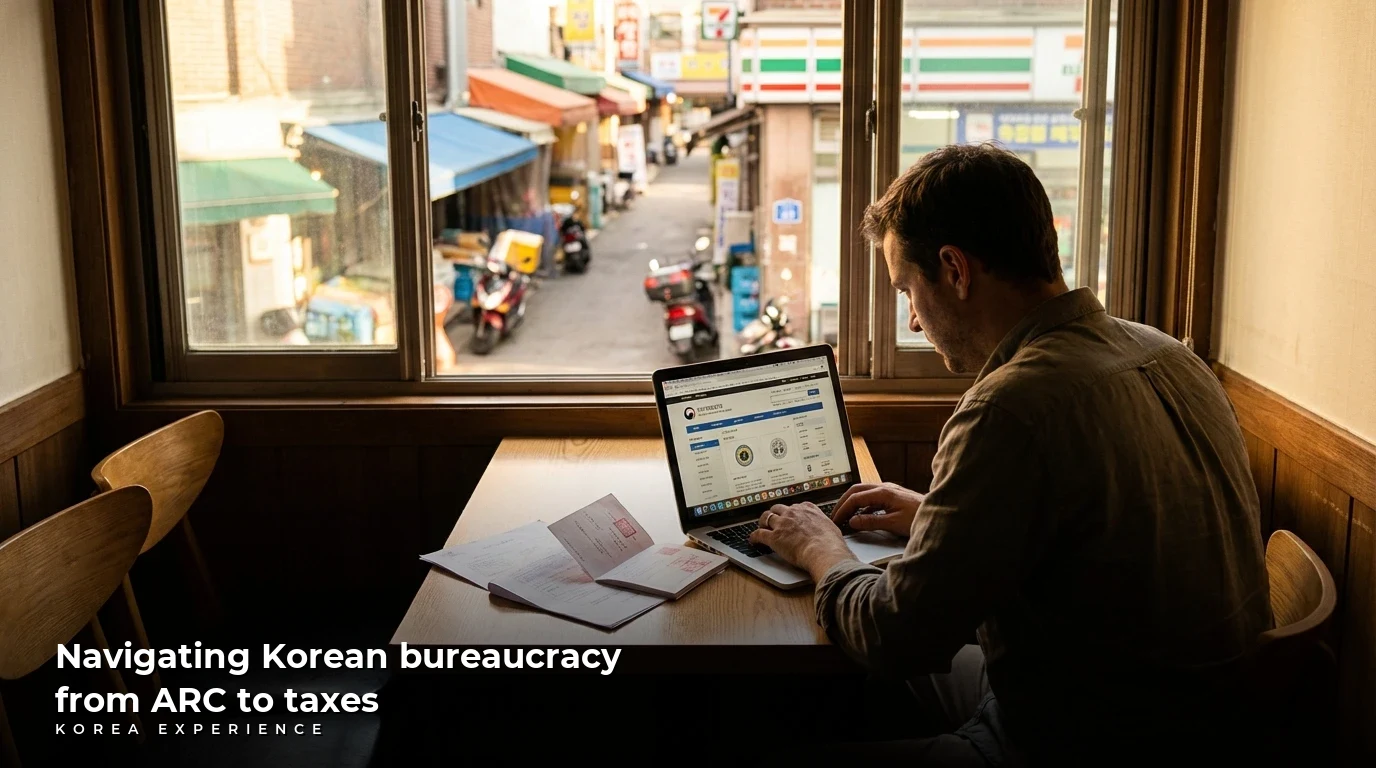
Navigating Korean Bureaucracy: Your Guide from ARC to Taxes

Unlock Korea's administrative maze. This guide demystifies Alien Registration Cards, visas, housing, healthcare, banking, and taxes for expats.

Navigating Korean Bureaucracy: Your Guide from ARC to Taxes

Moving to a new country is an exciting adventure, filled with new sights, sounds, and experiences. However, beneath the surface of vibrant culture and delicious food often lies a complex administrative landscape. For international residents and expats in South Korea, dealing with Korean bureaucracy can initially feel like navigating a labyrinth, from securing your essential Alien Registration Card (ARC) to understanding the intricacies of the Korean tax system. The good news is, with the right information and a proactive approach, this process can be surprisingly manageable.

This comprehensive guide is designed to be your trusted companion through South Korea's administrative procedures. We'll demystify everything from your initial visa and ARC application to managing your housing, healthcare, banking, and annual tax settlement. Our goal is to equip you with practical tips, insider knowledge, and clear instructions to empower you to confidently handle Korean bureaucracy and fully enjoy your time in this dynamic nation. Get ready to transform potential bureaucratic headaches into simple, step-by-step tasks.

The Alien Registration Card (ARC): Your Bureaucratic Cornerstone

The Alien Registration Card, often simply referred to as the ARC, is arguably the most crucial document for any long-term foreign resident in South Korea. It serves as your primary form of identification, akin to a national ID card, and is essential for virtually all administrative tasks, from opening a bank account to signing up for a phone plan. Obtaining your ARC is one of the first and most important steps after arriving in Korea.

Initial Application & Required Documents

Your ARC application must typically be submitted to the local Immigration Office (Churipguk Oegugincheong) within 90 days of your arrival. It is highly recommended to make an online appointment via the HiKorea website (www.hikorea.go.kr) well in advance, as slots fill up quickly.

Key Documents You'll Need:

  • Passport: Your original passport and a photocopy of the biographical page.
  • Visa: A valid visa in your passport, unless you are from a visa-exempt country and changing your status.
  • Application Form (Form No. 34): This can be downloaded from HiKorea or obtained at the Immigration Office. Fill it out completely.
  • Color Passport Photo: One recent (within six months) color photo (3.5cm x 4.5cm) with a white background. Ensure it meets standard passport photo requirements (no glasses, direct gaze).
  • Proof of Residency: This is critical. Examples include a housing contract (lease agreement), a confirmation of residence from your employer or university, or a notarized letter from a host. The address on this document will be printed on your ARC.
  • Proof of Purpose of Stay: This varies depending on your visa type:
    • E-2 Visa (English Teachers): Employment contract, business registration certificate of your school/academy, education certificate (e.g., diploma), criminal background check.
    • D-2 Visa (Student Visa): Certificate of admission, tuition payment receipt, financial solvency proof.
    • F-series Visa (Spouse/Family): Marriage certificate, family relations certificate, proof of Korean spouse's income.
  • Application Fee: Currently 30,000 Korean Won (KRW). This must be paid in cash at the Immigration Office or via an ATM inside the office.

Practical Tip: Always bring extra copies of all documents and a few extra passport photos. It's better to be over-prepared. Also, consider writing down your Korean address and phone number for the application form.

Picking Up Your ARC & What to Do Next

The processing time for an ARC typically ranges from 3-6 weeks, though it can vary. You will receive a notification via SMS (if you provided a Korean phone number) or you can check the status on the HiKorea website. Once ready, you'll return to the Immigration Office with your passport and the receipt to pick it up.

Upon receiving your ARC:

  • Verify all details: Immediately check that your name, date of birth, nationality, visa type, and address are all correct. Any errors should be reported immediately.
  • Keep it safe: Your ARC is vital. Do not lose it. Consider carrying a photocopy and leaving the original in a safe place, only carrying it when necessary for official business.
  • Register for online services: Many government and public services require ARC registration. This will be a gateway to easier online transactions.

ARC Renewal & Updates

Your ARC has an expiration date tied to your visa validity. Renewing your ARC essentially means renewing your visa. This process should be initiated at your local Immigration Office within four months of your ARC's expiration date. The required documents will be similar to your initial application, focusing on continued proof of purpose of stay and residency.

Crucial Updates:

  • Address Change: If you move, you must report your new address to the Immigration Office or your local Gu Office (Goo Cheong - district office) within 14 days of moving. Failure to do so can result in fines. Bring your ARC, passport, and the new housing contract.
  • Passport Renewal: If you renew your passport, you should also update your passport information with the Immigration Office, as your ARC is linked to your passport details.
  • Change of Workplace/School: If your employment or student status changes, you must report this to the Immigration Office within 14 days.

Visa Types & Stays: Understanding Your Status

Understanding your visa type and its implications is fundamental to a smooth stay in South Korea. Your visa dictates your rights, responsibilities, and the duration of your legal residency.

Common Visa Categories

South Korea offers a wide array of visas for foreigners. Here are some of the most common ones encountered by expats:

  • E-2 Visa (Foreign Language Instructor): For those teaching English or other foreign languages.
  • D-2 Visa (Student Visa): For students enrolled in degree programs at Korean universities.
  • D-4 Visa (General Trainee): For language study, vocational training, or non-degree programs.
  • F-2 Visa (Resident Visa): A long-term residency visa, often a stepping stone to permanent residency. Can be obtained after a certain period of legal stay under other visas, or through marriage to a Korean citizen.
  • F-4 Visa (Overseas Korean Visa): For ethnic Koreans who hold foreign citizenship. Offers significant flexibility in employment and residency.
  • F-5 Visa (Permanent Resident Visa): The highest level of residency, offering nearly all the rights of a Korean citizen except voting in national elections.
  • C-3 Visa (Short-Term General): For tourists, short business trips, or temporary visits, typically valid for up to 90 days. Not suitable for long-term residency or employment.

Visa Extensions & Changes

If you wish to extend your stay or change your visa status (e.g., from a D-4 language student to a D-2 university student, or from an E-2 teacher to an F-2 resident), you must apply at the Immigration Office before your current visa expires.

General requirements for extensions/changes:

  • Your existing ARC and passport.
  • An application form (Form No. 34).
  • Proof of valid reason for extension/change (e.g., renewed employment contract, new university admission, marriage certificate).
  • Proof of financial solvency (bank statements, income proof).
  • Proof of residency.
  • Application fee (often 60,000 KRW for extensions, more for status changes).

Important Note: Never overstay your visa. Overstaying, even for a single day, can lead to severe penalties, including fines, deportation, and a ban from re-entering Korea for an extended period. Always be mindful of your visa's expiry date and initiate extensions well in advance.

The Importance of Compliance

Adhering to your visa conditions is not just a formality; it's essential for a smooth and lawful stay in South Korea. This includes:

  • Not working on a non-work visa: Unless your visa explicitly permits work (e.g., E-series, F-series), engaging in paid employment is illegal.
  • Reporting changes promptly: As mentioned, address changes, workplace changes, or passport renewals must be reported.
  • Maintaining valid documents: Always keep your passport and ARC up-to-date.

Once you've secured your visa and ARC, establishing your home base is the next major step. This involves not only finding a place but also officially registering your residence and setting up essential utilities.

Reporting Your Address Change

As covered in the ARC section, if you move, you must report your new address. This is done at either your local Immigration Office or a Gu Office (district office). It's a quick process: bring your ARC, passport, and your new housing contract (Jeonse or Wolse agreement). The officer will update your address in the system and often stamp your ARC with the new address.

Insider Tip: While both Immigration and Gu Offices handle address changes, the Gu Office is generally less crowded and quicker for this specific task. Look for the "Foreigner Registration" or "Civil Affairs" counter.

Setting Up Utilities

Setting up utilities in Korea is generally straightforward once you have your ARC and a valid housing contract. Most landlords will assist with this, or the real estate agent who helped you find your place.

  • Electricity (Jeon-gi): Provided by Korea Electric Power Corporation (KEPCO). Bills are typically paid monthly. You can register online or call KEPCO's English-speaking service line (dial 123 from a Korean phone and press 9 for English). You'll need your ARC and your billing address.
  • Gas (Gaseu): Provided by various regional gas companies (e.g., Seoul City Gas). Your landlord or real estate agent will typically initiate this. Bills are usually monthly.
  • Water (Sudo): Managed by the local waterworks authority. Often included in the maintenance fee (gwanlibi) for apartments, or billed separately for houses.
  • Internet & Mobile Phone: Numerous providers exist (KT, SK Telecom, LG U+). You'll need your ARC and often a local bank account. Shop around for plans, as competition is fierce. It's often easier to get a mobile phone first, then use that number for internet registration.

Practical Tip: When moving into a new place, take photos of the utility meters (electricity, gas, water) on your move-in day. This helps prevent disputes over initial readings.

Rental Contracts & Rights

Korean rental agreements are primarily of two types:

  • Wolse (Monthly Rent): Similar to Western rentals, you pay a deposit (often several months' rent) and then monthly rent.
  • Jeonse (Lump-Sum Deposit): A unique Korean system where you pay a large, interest-free deposit (often 50-80% of the property's value) upfront. The landlord invests this money, and at the end of the contract, the full deposit is returned. No monthly rent is paid. This requires significant capital but can be cost-effective long-term.

Ensure your rental contract is properly notarized or registered with the local Gu Office (Hwaljeok Jeonse) or Community Center (Dong Samuso). This is crucial for protecting your deposit, especially in Jeonse contracts, by granting you preferential claim status.

Healthcare & National Insurance System (NHIS)

South Korea boasts one of the world's most efficient and accessible healthcare systems, largely thanks to the National Health Insurance Service (NHIS). As a long-term resident, participation in NHIS is mandatory.

Automatic Enrollment & Contributions

Foreigners residing in Korea for more than six months are automatically enrolled in NHIS (Gungmin Geongang Boheom Gongdan). Your contributions are based on your income (for employed individuals) or a standard rate for self-employed/non-earning residents. Your employer will typically handle your enrollment and deductions if you are employed. For others, you'll receive a bill directly from NHIS.

  • NHIS Contact: You can reach the NHIS Foreign Language Call Center by dialing 1577-1000 and pressing 7 for English.

Using Your NHIS Card

Once enrolled, you'll receive an NHIS card (or can use your ARC for identification at clinics). This card grants you access to most public and private hospitals, clinics, and pharmacies across the country at subsidized rates.

  • Finding a Clinic: Look for clinics (Ui Won for general, Naegwa for internal medicine, Jeonghyeong-oegwa for orthopedics) with the NHIS logo. Most clinics will have English-speaking staff or at least basic English capabilities.
  • Co-Pays: While NHIS covers a significant portion, you will still pay a co-payment (typically 20-30% of the cost) for most services, including consultations, tests, and medication.
  • Medication: After a doctor's visit, you'll receive a prescription. You can take this to any pharmacy (Yak Guk) to get your medication. Pharmacists are highly knowledgeable and can often provide basic over-the-counter advice.

Understanding Coverage

NHIS provides comprehensive coverage for a wide range of medical services, including:

  • Doctor's visits and consultations
  • Hospitalization and surgery
  • Prescription medications
  • Dental care (limited coverage for certain procedures like scaling)
  • Some traditional Korean medicine (Hanbang) treatments

Exclusions: Generally, cosmetic procedures, specific dental work (e.g., implants), and some specialized treatments are not covered. It's always wise to clarify coverage with your doctor or NHIS if you have specific concerns.

Table 1: NHIS vs. Private Health Insurance in Korea

FeatureNational Health Insurance Service (NHIS)Private Health Insurance (Supplemental)
Mandatory?Yes, for residents staying over 6 monthsNo, optional
Cost BasisIncome-based (employed) or standard rate (self-employed/non-earning)Fixed monthly premium based on plan, age, and health
Coverage ScopeComprehensive for essential medical services, often 70-80%Supplements NHIS, covers non-covered items, higher co-pays, specific diseases
Doctors/HospitalsAccepted at virtually all public and private facilitiesAccepted at facilities that accept private insurance, often less common
Pre-existing ConditionsGenerally covered upon enrollmentMay have waiting periods or exclusions for pre-existing conditions
Claims ProcessAutomatic billing to NHIS, you pay co-pay onlyYou may pay upfront, then submit receipts for reimbursement
BenefitUniversal access, affordable basic care, broad coverageEnhanced coverage, peace of mind for specific risks, higher limits

Banking & Financial Transactions

Managing your finances is a cornerstone of living abroad. Opening a bank account in Korea is a relatively simple process once you have your ARC.

Opening a Bank Account

You'll need your ARC, passport, and typically your local Korean phone number. Some banks might also ask for proof of employment (e.g., employment contract or certificate of employment).

Popular Banks with English Services:

  • Kookmin Bank (KB Kookmin Bank): Widely used, good English services, many ATMs.
  • Shinhan Bank: Excellent online and mobile banking, good English support.
  • Woori Bank: Another large bank with strong international services.
  • KEB Hana Bank: Known for its foreign exchange services and expat-friendly options.

Process:

  1. Visit a Branch: Go to a branch of your chosen bank. Some larger branches in expat-dense areas will have English-speaking staff.
  2. Required Documents: Present your ARC, passport, and phone number.
  3. Fill out Forms: You'll fill out an application form.
  4. Debit Card & Online Banking: You'll usually receive a debit card immediately. Ask to set up online banking and mobile banking, as these are incredibly convenient for daily life. You'll likely need to set up an electronic certificate for secure online transactions.
  5. ATM Card: Make sure your card is also an ATM card.
  6. Basic vs. Full Account: Initially, you might receive a "basic" account with withdrawal limits or international transfer restrictions. After a few weeks or months, once your income history is established, you can upgrade to a "full" account by providing proof of income.

International Transfers & Currency Exchange

  • Sending Money Home: Banks offer international transfer services, but they can be costly. Dedicated remittance services like Wise (formerly TransferWise) or Wirebarley often offer better exchange rates and lower fees. You'll usually need your ARC to register for these services.
  • Receiving Money: For international transfers to your Korean account, your bank will provide you with a SWIFT/BIC code and your account number. Be aware of potential receiving fees.
  • Currency Exchange: Banks offer currency exchange services. For competitive rates, check dedicated money exchange offices, especially in areas like Myeongdong or near major train stations, although their legality for large sums can be tricky for foreign residents.

Online Banking & Mobile Payment Apps

South Korea is highly technologically advanced, and its banking system is no exception.

  • Online Banking: Once set up, Korean online banking is powerful but can be initially challenging due to security protocols (e.g., required security programs, electronic certificates). Persevere, as it makes bill payments and transfers incredibly easy.
  • Mobile Payment Apps: Kakao Pay, Naver Pay, and Samsung Pay are ubiquitous. Link your bank account or credit card to these apps for seamless payments at most stores, restaurants, and online platforms. They are essential for daily convenience.

Understanding the Korean Tax System

Taxes are an inevitable part of living and working in any country. Understanding the Korean tax system is crucial for expats to ensure compliance and avoid issues. The primary tax concern for most expats is income tax.

Income Tax & Annual Tax Settlement (Yeonmaljeongsan)

If you are employed in South Korea, income tax will be automatically deducted from your monthly salary. However, every February, Korea conducts its annual tax settlement, known as Yeonmaljeongsan (연말정산), which functions much like a tax refund process or final adjustment. This is where you declare your deductions and expenses from the previous year.

  • Who Needs to File: Anyone who earned income in Korea during the previous calendar year.
  • When: Annually, typically in February for income earned from January 1 to December 31 of the previous year.
  • How: Your employer will usually assist in collecting the necessary documents and submitting them to the National Tax Service (NTS - Guksecheong).
  • Result: Depending on your deductions, you might receive a tax refund or owe additional taxes.

Required Documents for Tax Filing

To maximize your tax deductions during Yeonmaljeongsan, you'll need to gather specific documents. Many of these can be retrieved through the NTS Hometax website (hometax.go.kr) using your accredited digital certificate (which you set up with your bank for online banking).

Common Deductions & Required Documents:

  • Employment Income: Your employer provides a Statement of Earnings.
  • Medical Expenses: Receipts from hospitals/clinics, pharmacy receipts.
  • Education Expenses: Tuition fees (for yourself or dependents), cram school fees.
  • Housing Expenses: Rent receipts (cash receipts), housing loan interest.
  • Credit Card/Debit Card Usage: Your card statements.
  • Cash Receipts (Hyeongeum Yeongsujeung): Register your mobile number with the NTS for automatic cash receipt accumulation when you make cash payments.
  • Pension Contributions: National Pension Service statements.
  • Insurance Premiums: Health insurance, life insurance statements.

Practical Tip: It's essential to apply for a cash receipt card (Hyeongeum Yeongsujeung Card) or register your phone number with the NTS. This ensures that cash purchases are recorded and contribute to your tax deductions.

Tax Residency Rules for Expats

Your tax obligations in Korea depend on your tax residency status:

  • Resident (거주자 - Geo-ju-ja): Generally, if you have a domicile in Korea or reside in Korea for 183 days or more during a tax year. Residents are taxed on their worldwide income.
  • Non-Resident (비거주자 - Bi-geo-ju-ja): If you do not meet the resident criteria. Non-residents are generally only taxed on their income sourced in Korea.

Most expats on long-term visas will be considered tax residents. If you have questions about your specific tax situation, especially concerning income from outside Korea, it is advisable to consult with a local tax accountant specializing in expat taxes. The NTS also operates an English-language helpline (dial 126 from a Korean phone and press 2 for English).

Table 2: Common Tax Deductions for Expats in Korea (Yeonmaljeongsan)

Deduction CategoryDescriptionKey Documents Required (Examples)
National PensionContributions to the National Pension ServiceNational Pension Service statement
Health InsurancePremiums paid for NHISNHIS payment statements
Life InsurancePremiums for private life insurance policiesInsurance policy statements
Medical ExpensesOut-of-pocket medical costs for you and dependentsReceipts from hospitals, clinics, pharmacies
Education ExpensesTuition fees for yourself (university/grad school), dependentsTuition receipts, school certificates
Housing ExpensesMonthly rent (Wolse) or Jeonse loan interestHousing contract, rent receipts, bank statements for loan interest
Credit/Debit Card UseAmount spent on registered Korean credit/debit cardsCard statements (often auto-collected via Hometax)
Cash ReceiptsAmount spent using registered cash receipts (Hyeongeum Yeongsujeung)Cash receipt records (auto-collected via Hometax)
DonationsCharitable contributions to registered organizationsDonation receipts

Driving, Transport, and Other Registrations

While not everyone drives in Korea, for those who do, understanding the relevant regulations is important. Even for non-drivers, knowing about transport cards is key to convenience.

Converting Your Foreign Driver's License

If you hold a valid foreign driver's license from a country with an agreement with Korea, you can often convert it without taking a driving test.

Steps for Conversion:

  1. Required Documents:
    • Original foreign driver's license.
    • ARC.
    • Passport.
    • Three color passport photos (3.5cm x 4.5cm).
    • Consulate-issued verification of your foreign license (or apostille).
    • Entry and Exit Certificate (from HiKorea or local Community Center).
    • Fee (approx. 10,000 KRW for the Korean license, 6,000 KRW for physical exam).
  2. Physical Examination: Pass a basic medical check at the Driver's License Examination Office (Unjeon Myeonheo Sijeom).
  3. Application: Submit all documents and pass the physical exam at a Driver's License Examination Office.
  4. Wait: You'll typically receive your Korean driver's license on the same day. Your foreign license may be held by the office and returned upon your departure, or noted on your record.

Buying a Car & Vehicle Registration

Buying a car in Korea involves several bureaucratic steps:

  1. Purchase: Buy from a dealership (new) or a used car market.
  2. Registration: Register the vehicle at your local Vehicle Registration Office (Charyang Deungnok-gwan). You'll need your ARC, passport, the vehicle's bill of sale, and proof of insurance.
  3. Insurance: Mandatory vehicle liability insurance (Ja-dong-cha Bo-heom) is required.
  4. Taxes: Acquisition tax and registration tax are paid during registration. Annual vehicle taxes are also levied.

Public Transport Cards (T-Money)

For those relying on public transport, a T-Money card is indispensable.

  • Purchase: Buy a T-Money card at convenience stores (e.g., GS25, CU, 7-Eleven) or subway stations.
  • Load Money: Load money onto the card at subway stations, convenience stores, or charging machines.
  • Usage: Tap the card when entering and exiting buses, subways, and even for taxis or some convenience store purchases. It offers discounted transfer fares.

FAQ Section

1. Can I apply for my ARC immediately upon arrival? No, you typically need a valid long-term visa (not a C-series short-term visa) and proof of residency in Korea to apply for your ARC. You must apply within 90 days of your entry.

2. What if I lose my ARC? You must report the loss to the Immigration Office immediately and apply for a reissuance within 14 days of realizing it's lost. Failure to do so can result in fines. Bring your passport, a new photo, and the application fee.

3. Is it necessary to learn Korean to deal with bureaucracy? While not strictly "necessary" as many offices offer English services or translation apps are available, learning basic Korean phrases will significantly ease your interactions and show respect. Many official forms are primarily in Korean.

4. How long does the ARC renewal process take? ARC renewal is essentially a visa extension. The processing time can vary from a few days to several weeks, depending on your visa type and the Immigration Office's workload. It's best to apply well in advance of your current ARC's expiry, typically within four months.

5. Do I need an ARC to open a bank account? Yes, an ARC is generally a mandatory requirement for opening a full-service bank account in South Korea. Without it, you might only be able to open a very basic, restricted account.

Conclusion

Navigating the administrative landscape in South Korea, from obtaining your Alien Registration Card to understanding your tax obligations, might seem daunting at first glance. However, by approaching each step methodically, armed with the right documents, and a healthy dose of patience, the process becomes surprisingly manageable.

Remember these key takeaways:

  • Preparation is paramount: Always have multiple copies of essential documents, passport photos, and a clear understanding of what's required before visiting any government office.
  • HiKorea and 1345 are your friends: Utilize the HiKorea website for online appointments and information, and the 1345 Immigration Contact Center (with English support) for questions.
  • Stay compliant: Adhere to visa regulations, report changes promptly, and track deadlines for renewals and tax filings to avoid penalties.
  • Embrace technology: Korean online banking and mobile payment apps, once mastered, are incredibly efficient tools for daily life.

By taking a proactive and informed approach, you can effectively deal with Korean bureaucracy and dedicate more time to experiencing the vibrant culture and wonderful opportunities that living in South Korea offers. Your journey here is an exciting one, and mastering the administrative side will only enrich your overall experience. Good luck, and welcome to Korea!

About the Author

Korea Experience Team

Written by the Korea Experience editorial team - experts in Korean medical tourism, travel, and culture with years of research and firsthand experience.

⚠️ Medical Disclaimer

The information provided on this website is for general informational purposes only and does not constitute medical advice. Always consult with qualified healthcare professionals before making any medical decisions.

Continue Reading

Explore more articles you might find interesting