Medical Complications in Korea: Emergency Contacts & What to Do
A complete guide to handling medical emergencies and surgical complications in Korea, including 119 services, translation help, and hospital costs.
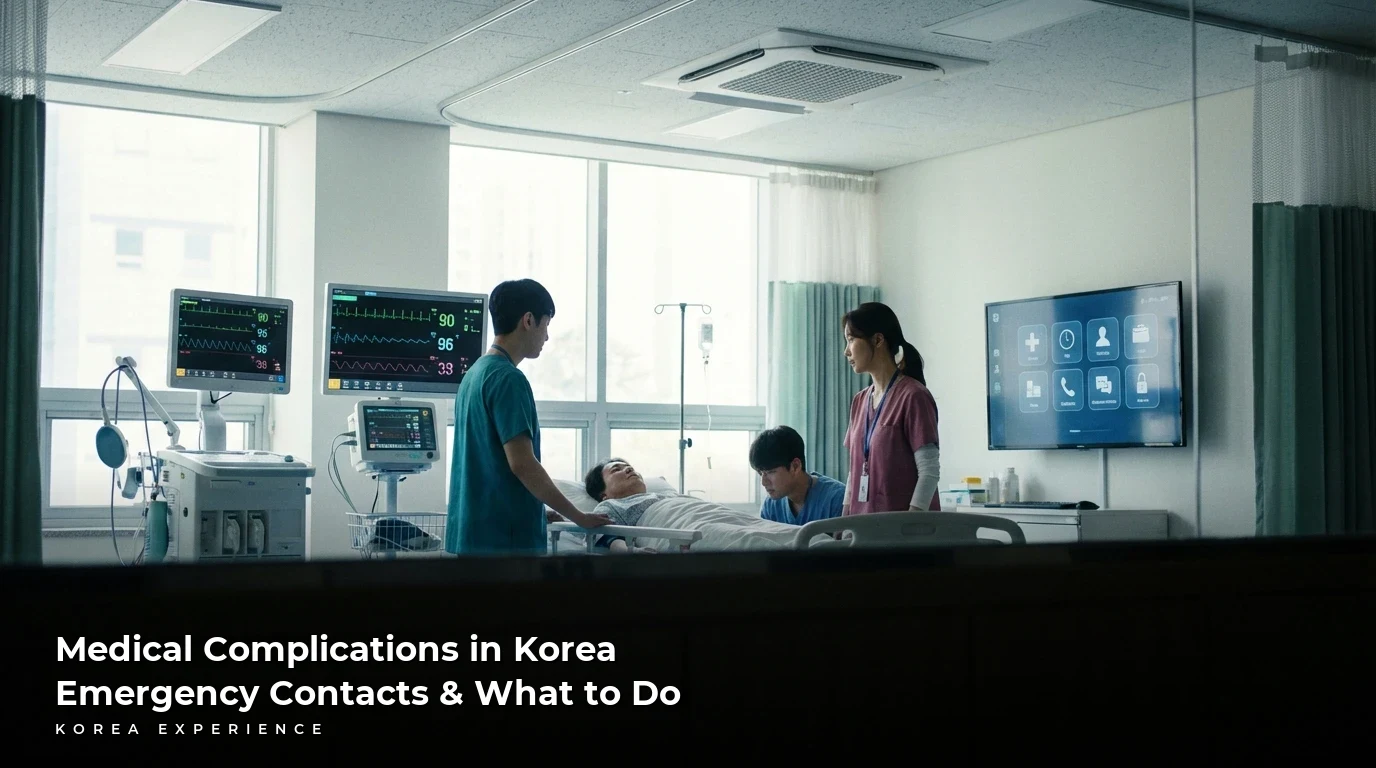
If you are experiencing a medical emergency in South Korea, dial 119 immediately for ambulance and fire services. This service is free, available 24/7, and has interpretation services available in 19 languages. For non-emergency medical consultations, hospital referrals, or advice on handling complications from a procedure, dial 1339 (Korea Disease Control and Prevention Agency Call Center).
The short answer: In a life-threatening emergency, call 119 (Ambulance). For medical advice, hospital finding, or translation help regarding symptoms, call 1339. If you are a medical tourist facing disputes or specific surgical complications, contact the Medical Korea Support Center at 1577-7129.
Key Takeaways
- 1Dial 119 for free ambulance services; interpretation is available
- 2Dial 1339 for hospital referrals and medical advice in English
- 3Foreigners must usually pay a deposit for ER admission without Korean insurance
- 4Medical Korea Support Center (1577-7129) helps with medical tourism disputes
Medical Disclaimer
The information provided in this guide is for educational purposes only and does not constitute medical advice. In the event of a severe medical emergency, seek professional help immediately by dialing 119 or visiting the nearest emergency room.
Understanding the Korean Emergency Infrastructure
South Korea possesses one of the most efficient and high-tech emergency response systems in the world. As a medical tourist or traveler, understanding how to navigate this infrastructure is crucial, especially if you are dealing with complications following a procedure. The system is highly centralized, meaning response times are exceptionally fast—often averaging under 8 minutes in Seoul.
However, the language barrier remains the single biggest complication for foreigners. While major hospitals in Gangnam (the hub of medical tourism) have international centers, a sudden complication at 3:00 AM in a hotel room requires immediate knowledge of who to call.
📊 Emergency Response Stats 2026
The "Big Three" Emergency Numbers
You should memorize three numbers before landing at Incheon International Airport. Unlike the universal "911" in the US, Korea separates its services.
- 119 (Fire & Ambulance): This is the most critical number. It connects you to the National Fire Agency. They handle medical emergencies and rescue operations.
- 112 (Police): Call this for criminal acts, theft, or assault.
- 1339 (KCDC Medical Helpline): This is non-emergency but urgent. They tell you which hospitals are open, guide you on symptoms, and provide interpretation.
📋 Emergency Numbers Breakdown
Immediate Actions for Medical Complications
When a complication arises—whether it is excessive bleeding after rhinoplasty, a sudden high fever, or an allergic reaction—time is the most valuable currency.
Step 1: Assess the Severity
If the patient is unconscious, having trouble breathing, or bleeding uncontrollably, do not hesitate. Call 119. When you call, the location tracking system (LBS) automatically pinpoints your location within a 5 to 10-meter radius if you are calling from a mobile phone, even if you cannot speak.
If you can speak, say "Foreigner" or "English." They will patch in a BBB Korea volunteer or an in-house interpreter. This usually takes 15 to 30 seconds.
Step 2: Contacting Your Clinic
If the issue is related to a recent surgery (e.g., plastic surgery or dermatology), your first point of contact should ideally be the clinic where the procedure was performed. Most top-tier clinics in Gangnam provide a 24-hour emergency contact number for post-op patients.
Pro Tip
Before undergoing any surgery, explicitly ask for the "After-Hours Emergency Contact" (Yagan-eunggeup-yeollak-cheo). Do not settle for the general office number, which will likely be unmanned after 7:00 PM.
However, if you cannot reach them, do not wait. Go to a university hospital emergency room.
Step 3: Visiting the Emergency Room (ER)
Korean Emergency Rooms (Eung-geup-sil) are categorized by level. For serious complications, you want a Regional Emergency Medical Center (University Hospital).
Top ERs for Foreigners in Seoul:
- Severance Hospital (Sinchon/Gangnam): Highly foreigner-friendly.
- Samsung Medical Center (Gangnam): Excellent infrastructure.
- Asan Medical Center (Songpa): Largest in Korea.
Expect a wait time. The triage system in Korea is strict. If your condition is deemed "Level 4 or 5" (non-urgent), you might wait 2 to 4 hours while critical patients are treated.
📖 How to Call an Ambulance (119)
Step 1: Dial 119
No area code needed. Works on locked phones.
Step 2: Request Language
Say 'English' clearly and wait for the interpreter patch-in.
Step 3: State Location
Give a landmark (e.g., 'Gangnam Station Exit 4') if you don't know the address.
Step 4: Describe Symptoms
Be concise: 'Bleeding', 'Unconscious', 'Chest Pain'.
Dealing with Surgical Complications (Medical Tourism Focus)
Medical tourism is a massive industry in Korea, but procedures carry risks. Dealing with complications in a foreign country requires a different protocol than dealing with a stomach flu.
Post-Operative Infections and Bleeding
If you have undergone plastic surgery, knowing the difference between normal recovery and a complication is vital.
- Normal: Swelling, bruising, mild pain (manageable with Tylenol).
- Emergency: Bright red blood soaking bandages rapidly, temperature over 38.5°C (101.3°F), pus, or blackening skin (necrosis).
If you experience these, and your clinic is closed, proceed to a University Hospital ER. Be sure to bring your "Surgery Certificate" or discharge papers so the ER doctors know exactly what procedure was done and what medications you are on.
For more on finding reputable clinics to minimize these risks, read our guide on best plastic surgery clinics for foreigners in Seoul.
The Medical Korea Support Center
The Korean government operates the Medical Korea Support Center (1577-7129) specifically for medical tourists. This is a crucial resource often overlooked.
- Hours: 9:00 AM – 6:00 PM (Weekdays).
- Services: They help with consulting on medical services, but more importantly, they assist with dispute mediation. If you believe a clinic has botched a procedure or is refusing to treat a complication, this is your first government-backed port of call.
Who to Call: Complication vs. Emergency
| Scenario | Contact | Availability | Language Support |
|---|---|---|---|
| Life Threatening | 119 | 24/7 | High (Interpreters) |
| Surgical Dispute | 1577-7129 | Weekdays 9-6 | High (Specialized) |
| General Sickness | 1339 | 24/7 | High (Medical Advice) |
Medical Mediation and Legal Disputes
Dealing with complications can sometimes lead to disputes with clinics regarding liability and refunds. Korea has a specific body for this: the Korea Medical Dispute Mediation and Arbitration Agency (K-Mediation).
If a complication has caused significant harm, financial loss, or extended hospital stays, and the original clinic is uncooperative, you should file a request here.
- Website: www.k-medi.or.kr
- Phone: 1670-2545
- Process: It is a free/low-cost alternative to a lawsuit. The process usually takes 90 to 120 days.
- Success Rate: Mediation is successful in about 60-70% of cases where clinics agree to participate.
"Many foreigners immediately threaten to sue or go to the police when a complication happens. This is often ineffective in Korea due to defamation laws. The most effective route is K-Mediation. Clinics fear this agency more than bad Yelp reviews because it triggers government audits."
Costs: What to Expect in an Emergency
One of the biggest anxieties for travelers dealing with medical complications is the cost. Korea's healthcare is affordable compared to the US, but it is not free for tourists.
Emergency Room Pricing
If you do not have Korean National Health Insurance (NHIS), you are considered a "General Patient" (Ilban).
- Base ER Fee: ₩60,000 – ₩100,000 ($45 - $75 USD).
- Consultation & Treatment: Varies wildly. A simple stitch-up might cost ₩200,000 ($150), while an MRI can cost ₩800,000 ($600).
- Deposit: Most large hospitals require a deposit for international patients upon admission, often ranging from ₩500,000 to ₩1,000,000 ($375 - $750).
Payment Methods
Hospitals accept major credit cards (Visa, Mastercard, Amex). However, some smaller clinics handling minor complications might prefer cash or domestic transfers.
If you are concerned about general living costs during your recovery or extended stay, check our cost of living comparison.
💵 Estimated ER Costs for Tourists (No Insurance)
MRI, CT Scan, Overnight Stay
Fluids, X-ray, Medication
Pharmacies and Minor Medical Issues
Not every complication requires an ER visit. Perhaps your incision site is itchy (mild infection risk) or you are experiencing nausea from painkillers.
Pharmacies (Yakkuk / 약국)
Korean pharmacists are highly trained and can prescribe stronger medication than what is available over the counter in many Western countries. Look for the "약" sign.
- Cost: A consultation is free. Medication is cheap (3,000 - ₩6,000 for antibiotics or painkillers).
- Hours: Most close by 8:00 PM or 9:00 PM. Sundays are often closed.
- Language: Use Papago or Google Translate. Pharmacists often read English medical terms well even if they don't speak fluently.
24-Hour Safe Medicine Centers
If it is late at night, you can find basic medical supplies (Tylenol, digestive medicine, patches) at convenience stores like CU, GS25, and 7-Eleven. For more on what you can find there, read our guide to must-try convenience store items.
Safe Pharmacy (Example Type)(공공심야약국)
Overcoming the Language Barrier
The fear of not being understood during a medical complication is real. Technology and volunteer services bridge this gap effectively in 2026.
BBB Korea (1588-5644)
This is a volunteer interpretation service.
- How it works: You call the number, select the language (English is #1), and a volunteer answers. You put them on speakerphone with the doctor or taxi driver.
- Availability: 24/7.
- Cost: Free (call charges apply).
Translation Apps
- Naver Papago: Superior to Google Translate for Korean-English medical terms. Use the "Conversation" mode.
- Google Translate: Good for camera translation of prescription bags or hospital forms.
Process for Using BBB Korea
Dial 1588-5644
Standard call rates apply.
Select Language
Press 1 for English.
Speakerphone
Hand phone to doctor/nurse.
Specialized Support for Skin and Beauty Issues
Many travelers visit Korea specifically for dermatology. If you have a severe reaction to a laser treatment or facial (burns, extreme swelling), a general ER might not be the best first stop unless it is systemic (affecting your whole body).
Instead, look for specialized Dermatology Hospitals. If it is after hours, stick to the University Hospitals mentioned earlier, as they have dermatology residents on call. For preventative advice, consult our list of best dermatology clinics in Seoul.
Essential Apps for Emergencies
Before you leave your hotel, ensure you have these apps installed. They are lifelines when dealing with complications.
- KakaoMap or Naver Map: Google Maps does not work well for walking directions or finding specific clinic entrances in Korea.
- Emergency Ready App: Launched by the government, this app (available in English) locates the nearest ER, pharmacy, and shelter based on your GPS.
- KakaoTaxi (Kakao T): If you are not injured enough for an ambulance but cannot walk to the subway, you need a taxi. Uber exists (as UT) but is less reliable than Kakao T.
Transport to Hospital: Ambulance vs. Taxi
- ✓Ambulance (119): Medical equipment on board
- ✓Ambulance: Cuts through traffic
- ✓Taxi: Faster for non-critical injuries
- ✓Taxi: Privacy
- ✗Ambulance: Will take you to nearest hospital, not choice
- ✗Ambulance: Fees if determined non-emergency (rare)
- ✗Taxi: Driver may refuse bleeding passenger
- ✗Taxi: Stuck in traffic
Embassy Contacts
In extreme cases—death, severe incapacitation, or legal arrest related to an incident—you must contact your embassy. They cannot pay your medical bills, but they can contact your family and provide a list of lawyers.
- USA Embassy: 02-397-4114 (After hours: 02-397-4114, press 1)
- UK Embassy: 02-3210-5500
- Canadian Embassy: 02-3783-6000
- Australian Embassy: 02-2003-0100
Warning: Insurance
Most embassies will strictly state they cannot provide financial assistance. This is why having comprehensive travel insurance or specific medical complications insurance (often sold by medical tourism agencies) is non-negotiable.
Mental Health Emergencies
Travel can be stressful, and complications can lead to panic attacks or mental health crises.
- Seoul Global Center: Offers counseling services in multiple languages. (02-2075-4180).
- 24-hour Crisis Hotline: 1577-0199 (Korean, but sometimes English speakers are available, or use BBB Korea to mediate).
Final Checklist for Preparedness
To minimize the stress of dealing with complications, prepare this "Digital Safety Kit" on your phone:
- Screenshot of your passport and insurance policy.
- Your clinic's after-hours number saved as a favorite.
- Address of your accommodation in Korean (Hangul) to show taxi drivers.
- Papago App installed.
- 1339 and 119 memorized.
Dealing with medical complications in a foreign country is frightening, but Korea's infrastructure is designed to help you. The key is acting fast, using the right numbers (119 vs 1339), and utilizing translation support like BBB Korea to ensure your symptoms are accurately understood.
❓ Frequently Asked Questions
Have more questions?Contact us →
About the Author
Korea Experience Team
Written by the Korea Experience editorial team - experts in Korean medical tourism, travel, and culture with years of research and firsthand experience.
⚠️ Medical Disclaimer
The information provided on this website is for general informational purposes only and does not constitute medical advice. Always consult with qualified healthcare professionals before making any medical decisions.
Explore more in Medical Tourism
World-class medical procedures at competitive prices. From plastic surgery and dermatology to dental care and health checkups — your complete guide to medical tourism in Korea.
Browse All Medical Tourism ArticlesContinue Reading
Explore more articles you might find interesting
The complete 2026 guide to emergency medical care in Seoul. Find the best international hospitals, ER costs, and English-speaking services for travelers.
Navigating Korea's healthcare system in 2026? We analyze costs (₩50k-150k/hr), hospital tiers, and when you absolutely need a certified medical interpreter.
Everything you need to know about medical tourism insurance for Korea in 2026, covering complications, costs, provider comparisons, and claim procedures.
A complete guide to pediatric healthcare in Seoul for international families, covering top clinics, costs, and emergency protocols in 2026.
Learn the general patient-access rule in Korea, what representatives may need, and why fees and English translation vary by hospital.
Dial 119 for life threats or 1330 for help. Misusing ambulances in 2026 risks a 2 million won fine due to the ongoing doctor shortage and strict triage laws.