Dental Veneers in Korea: Porcelain vs. Composite Resin Compared
Compare porcelain vs composite veneers in Korea for 2026. Discover costs starting at ₩150,000, durability data, and the 1-day procedure in Gangnam.
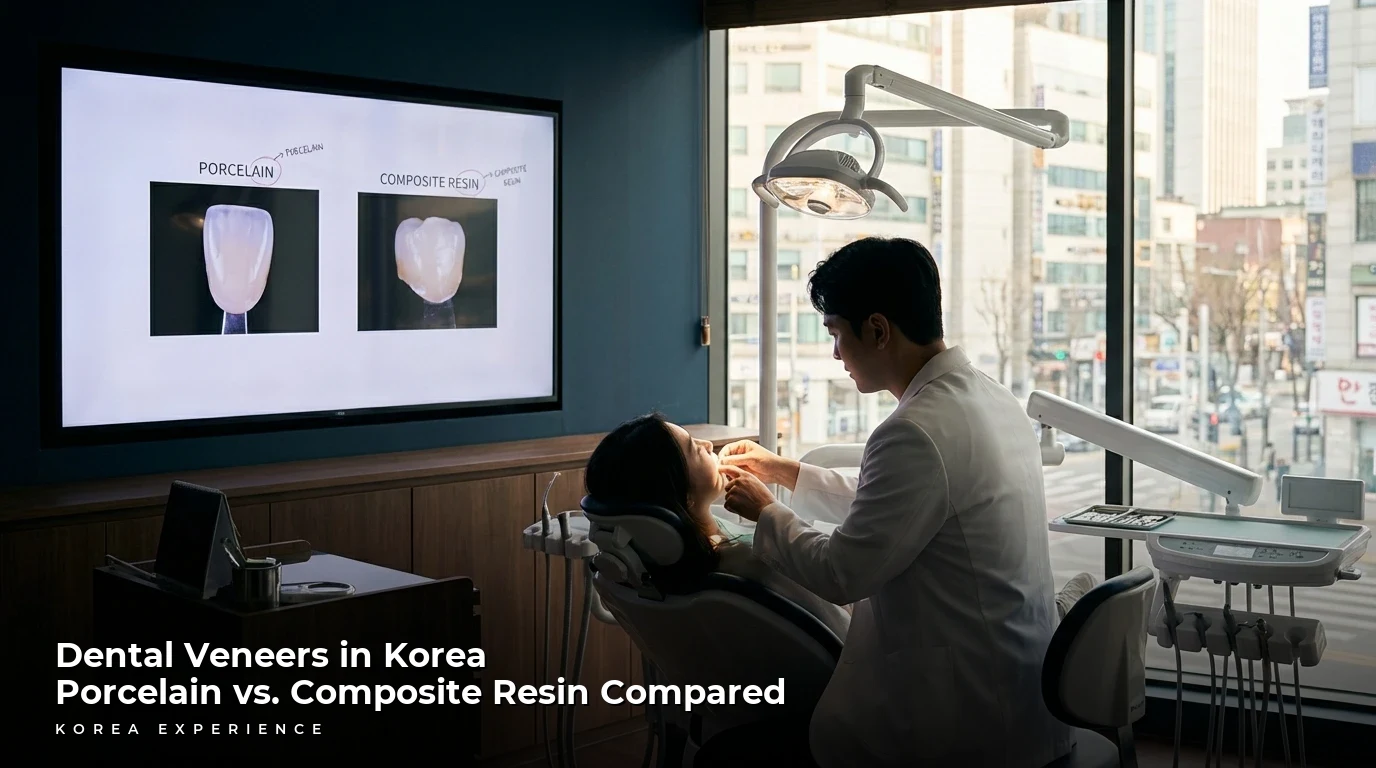
Choosing between porcelain and composite resin veneers in Korea ultimately comes down to your budget, your timeline, and your long-term aesthetic goals. If you are looking for the "Korean Celebrity Smile" that dominates K-Dramas, you are likely seeing high-end porcelain laminates. However, composite resin offers a faster, non-invasive alternative that appeals to many travelers on tighter schedules. In Seoul's competitive dental market, the technology for both has advanced significantly, offering "One-Day" solutions that are rare in Western countries.
The short answer: Porcelain veneers (Laminates) in Korea generally cost between ₩400,000 and ₩800,000 per tooth and last 10-15 years with superior stain resistance. Composite resin veneers are cheaper, ranging from ₩150,000 to ₩350,000 per tooth, can be applied in a single 2-hour visit, but typically require polishing or replacement after 5-7 years.
Key Takeaways
- 1Porcelain veneers in Korea use CAD/CAM tech for 1-day completion
- 2Composite resin is 50-60% cheaper but more prone to staining from coffee/kimchi
- 3Korean clinics specialize in 'Minish' (minimal prep) veneers at 0.1mm thickness
Understanding the core differences
When planning a medical tourism trip to Korea, understanding the material science is crucial before booking a consultation. The fundamental difference lies in how the veneer is fabricated and applied to your natural tooth.
Porcelain Veneers (Ceramic/Laminate): These are thin shells of medical-grade ceramic that are attached to the front surface of the teeth. In Korea, they are often referred to as "Laminates." They are custom-made in a lab (or onsite via 3D printing) to match the color and contour of your surrounding teeth. They are extremely durable, with a compressive strength often exceeding 400 MPa (megapascals), making them resistant to fractures.
Composite Resin Veneers (Bonding): This method involves applying a tooth-colored resin material directly to the tooth surface. The dentist sculpts the material by hand, cures it with a high-intensity light, and polishes it. It is an additive process that usually requires less removal of the natural tooth structure compared to traditional porcelain veneers.
Pro Tip
If you are visiting Korea for less than 4 days, ask specifically for "One-Day Laminates." Standard porcelain veneers usually require 5-7 days for lab work, but clinics with onsite CEREC machines can finish them in roughly 4-6 hours.
Why get veneers in Korea?
Korea has established itself as a global hub for aesthetic dentistry, rivaling its reputation for plastic surgery. The key differentiator is the "Ppalli-ppalli" (hurry-hurry) culture combined with cutting-edge digital dentistry.
In the United States or Europe, getting porcelain veneers is typically a multi-week process involving temporary veneers and waiting for an off-site lab. In Gangnam and Apgujeong (Seoul's medical districts), approximately 80% of major aesthetic dental clinics are equipped with in-house digital labs. This allows for:
- 3D Oral Scanning: Replacing goopy physical impressions with digital scans that take 2-3 minutes.
- Smile Design Software: You can see a simulation of your post-procedure smile on a screen before any work begins.
- Cost Efficiency: Due to high competition among over 500 clinics in the Gangnam district alone, prices remain 30-50% lower than in North America.
📊 Korea Dental Statistics
Deep dive: Porcelain veneers in Korea
Porcelain veneers are the gold standard for aesthetic makeovers in Korea. They are ideal for correcting severe discoloration, chips, cracks, or minor misalignment.
The "Minish" and "Non-Prep" Trend
A specific term you will encounter in Korea is "Minish" or "Non-Prep Laminate." Traditional veneers require grinding down 0.5mm to 0.7mm of the tooth enamel. However, Korean technology now allows for ultra-thin veneers, sometimes as thin as 0.1mm to 0.2mm. This preserves usually 90-95% of your natural tooth structure.
Aesthetics and Durability
Porcelain mimics the light-reflecting properties of natural teeth better than any other material. It is translucent and has a glass-like quality. Crucially for food lovers, porcelain is highly resistant to staining. You can enjoy iconic Korean foods like Kimchi jjim (braised kimchi) or highly pigmented coffees without immediate fear of discoloration, provided you maintain normal hygiene.
Porcelain Veneers Analysis
- ✓Lasts 10-15 years with proper care
- ✓Highly resistant to coffee and food stains
- ✓Extremely natural translucency
- ✓Customizable via 3D CAD/CAM technology
- ✗Higher initial cost (₩400k-800k per tooth)
- ✗Irreversible (enamel is removed)
- ✗Repair is difficult; usually requires replacement
Deep dive: Composite resin veneers
Composite resin is often viewed as the "entry-level" option, but in the hands of a skilled Korean dentist, the results can be stunning. This is often the preferred choice for younger patients or those looking to fix minor imperfections, such as a single chipped tooth or small gaps (diastema).
The "Direct Bonding" Technique
In Korea, this is often called "Resin Art" or "Direct Bonding." The procedure is incredibly fast. A full set of 6-8 front teeth can often be completed in a single morning session, taking approximately 30 to 45 minutes per tooth.
The Staining Issue
The biggest drawback is porosity. Composite resin is essentially a reinforced plastic. Over time, it absorbs pigments. If you are a heavy smoker or drink multiple cups of coffee daily, you may notice yellowing around the edges within 2-3 years. While professional polishing at a Korean clinic (costing roughly ₩50,000) can restore some shine, the material naturally dulls faster than porcelain.
"For international travelers, I usually recommend porcelain if they cannot visit Korea annually. Composite resin looks great initially, but it requires maintenance polishing every 6-12 months to keep that K-Pop idol shine. If you live abroad, porcelain is the 'set it and forget it' option."
Detailed cost comparison: Porcelain vs Resin
Pricing is the most common question for travelers. In 2026, the exchange rate fluctuates, but for estimation, we use a standard of roughly ₩1,350 to $1 USD. Note that most Korean clinics offer tax refunds (roughly 7-8% back) for cosmetic procedures performed on foreign tourists.
Price Factors
Prices in Seoul vary based on location. Clinics in Gangnam (specifically near Gangnam Station and Sinsa Station) charge a premium for their location and English-speaking staff. Clinics in areas like Hongdae or Nowon might be 10-20% cheaper but may have fewer English support services.
For a comprehensive look at how medical costs fit into your travel budget, you might want to read our guide on the cost of living in Seoul vs Busan.
💵 Veneer Price Comparison (Per Tooth)
Includes 3D scan & design
Direct bonding application
Hidden Costs to Consider
- Consultation Fee: ₩30,000 - ₩50,000 (often waived if you proceed with treatment).
- X-Ray/CT Scan: ₩20,000 - ₩50,000.
- Night Guard: If you grind your teeth, you will need a splint to protect veneers, costing ₩300,000 - ₩500,000.
- Sedation: For "Sleep Dentistry" (conscious sedation), add roughly ₩100,000 - ₩200,000 per session.
📋 Cost Summary 2026
The procedure: Step-by-step guide
If you are planning your itinerary, knowing the time commitment is vital. Most medical tourists combine their dental work with shopping or sightseeing. For instance, while your porcelain veneers are being milled, you could explore the best Korean skin clinics in Gangnam for a full beauty day.
Timeline for Composite Resin (1 Visit)
- Consultation (30 mins): Cleaning and color matching.
- Application (1-2 hours): Etching, bonding, sculpting, and curing.
- Polishing (30 mins): Final bite check and shine.
- Done: You walk out with a new smile immediately.
Timeline for Porcelain Veneers (2 Visits or 1 Full Day)
📖 One-Day Porcelain Veneer Process
Step 1: Morning Scan
9:00 AM: Consultation, 3D CT scan, and minimal tooth preparation (shaving).
Step 2: Design & Mill
11:00 AM - 3:00 PM: Break time. The in-house lab designs and mills your ceramic teeth. You can leave the clinic.
Step 3: Bonding
3:00 PM: Return to clinic. The dentist bonds the veneers to your teeth using light-cured cement.
Step 4: Final Check
5:00 PM: Bite adjustment and final polish.
Choosing the right clinic in Seoul
Finding a clinic can be overwhelming. The highest concentration of clinics specializing in veneers for foreigners is along the Gangnam-daero road, stretching from Gangnam Station (Line 2) to Sinsa Station (Line 3). This 2.5km stretch houses over 400 dental facilities.
What to Look For
- Board Certification: Look for specialists in Prosthodontics (restorative dentistry).
- English Coordinators: Essential for communicating nuances about shape and color.
- Before/After Portfolio: Specifically ask for "healed" photos, not just photos taken immediately after the procedure.
- Warranty: Many reputable Korean clinics offer a 1-2 year warranty on porcelain veneers (repairing chips for free), provided you attend check-ups (or prove care).
For tips on how to secure an appointment, check our guide on booking medical consultations in Korea.
Gangnam Dental District(강남 치과 거리)
Comparison Table: The final verdict
To help you decide, here is a direct feature comparison between the two options available in Korea in 2026.
Veneer Type Comparison
| Feature | Composite Resin | Porcelain (Laminate) |
|---|---|---|
| Lifespan | 5-7 Years | 10-15+ Years |
| Stain Resistance | Low (stains over time) | High (glass-like) |
| Reversibility | Yes (usually) | No (enamel removed) |
| Repairability | Easy (patchable) | Hard (must replace) |
| Cost (₩) | ₩150k - 350k | ₩450k - 800k |
Aftercare and maintenance in Korea
Once you have your new smile, maintenance is key. The first 24 hours are critical. If you received anesthesia, be careful not to bite your cheek.
Food and Drink
For porcelain veneers, you can eat normally almost immediately. However, for composite resin, you should avoid highly pigmented foods for at least 48 hours. This includes:
- Curry (the turmeric is a major staining agent).
- Red wine.
- Black coffee.
- Kimchi Jjigae (Kimchi stew).
Cleaning
You must continue to floss. A common misconception is that veneered teeth do not decay. While the veneer itself won't decay, the tooth structure underneath can. Using a non-abrasive toothpaste is recommended to avoid scratching the surface, especially for resin veneers.
Maintenance Timeline
Installation
Avoid hard foods and extreme temperatures.
Sensitivity Check
Minor sensitivity to cold is normal.
Check-up
Professional cleaning and bond check recommended.
Medical disclaimer and safety
While dental procedures are generally low-risk, complications can occur. Sensitivity to hot and cold is common for 1-2 weeks after porcelain veneers because a layer of enamel has been removed. If pain persists beyond two weeks, you may need a root canal, though this is rare (less than 2% of cases).
Medical Disclaimer
This article is for informational purposes only and does not constitute medical advice. Diagnosis and treatment plans must be made by a licensed dentist. In case of a dental emergency in Korea, dial 119. For medical interpretation services, dial 1339.
Frequently Asked Questions
To wrap up, here are the most common questions we receive from travelers considering dental work in Korea.
❓ Frequently Asked Questions
Have more questions?Contact us →
Choosing between porcelain and composite resin in Korea offers a distinct advantage: quality at a competitive price point. Whether you opt for the longevity of porcelain or the affordability of resin, the advanced digital infrastructure of Seoul's clinics ensures a precise fit. Just remember to budget not just for the procedure, but for the maintenance of that new smile.
For more insights on navigating Korea's lifestyle and medical landscape, check out our guide to Anti-aging treatments in Korea.
About the Author
Korea Experience Team
Written by the Korea Experience editorial team - experts in Korean medical tourism, travel, and culture with years of research and firsthand experience.
⚠️ Medical Disclaimer
The information provided on this website is for general informational purposes only and does not constitute medical advice. Always consult with qualified healthcare professionals before making any medical decisions.
Explore more in Medical Tourism
World-class medical procedures at competitive prices. From plastic surgery and dermatology to dental care and health checkups — your complete guide to medical tourism in Korea.
Browse All Medical Tourism ArticlesContinue Reading
Explore more articles you might find interesting
Compare SNU Gangnam and Severance Seoul Station for your 2026 health check-up. Discover why comprehensive packages starting at $640 USD save you thousands.
Discover why 98 percent of Korea hair transplants succeed. Compare 2026 costs from $3500 surgeries to $90 viral 15-step scalp spas for ultimate hair growth.

Save 15 to 30 percent on 2026 skin treatments by taking a $65 KTX train to Daegu instead of Gangnam. Compare exact prices, travel costs and VAT refunds.
Compare Potenza and Morpheus8 costs in Seoul for 2026. Save 70% with prices starting at $215 USD versus $1,500 in the West for skin tightening.
Compare Ultherapy, Thermage, and Shurink costs and results. Discover why Seoul offers treatments at 30-50% less than global rates with our 2026 guide.
The ultimate guide to SMP in Seoul for 2026. Discover costs, top clinics in Gangnam.