Korean movie theaters vs western cinemas differences
Discover how Korean cinema culture differs from the West, from high-tech 4DX screens and gourmet snacks to strict etiquette and mobile booking systems.
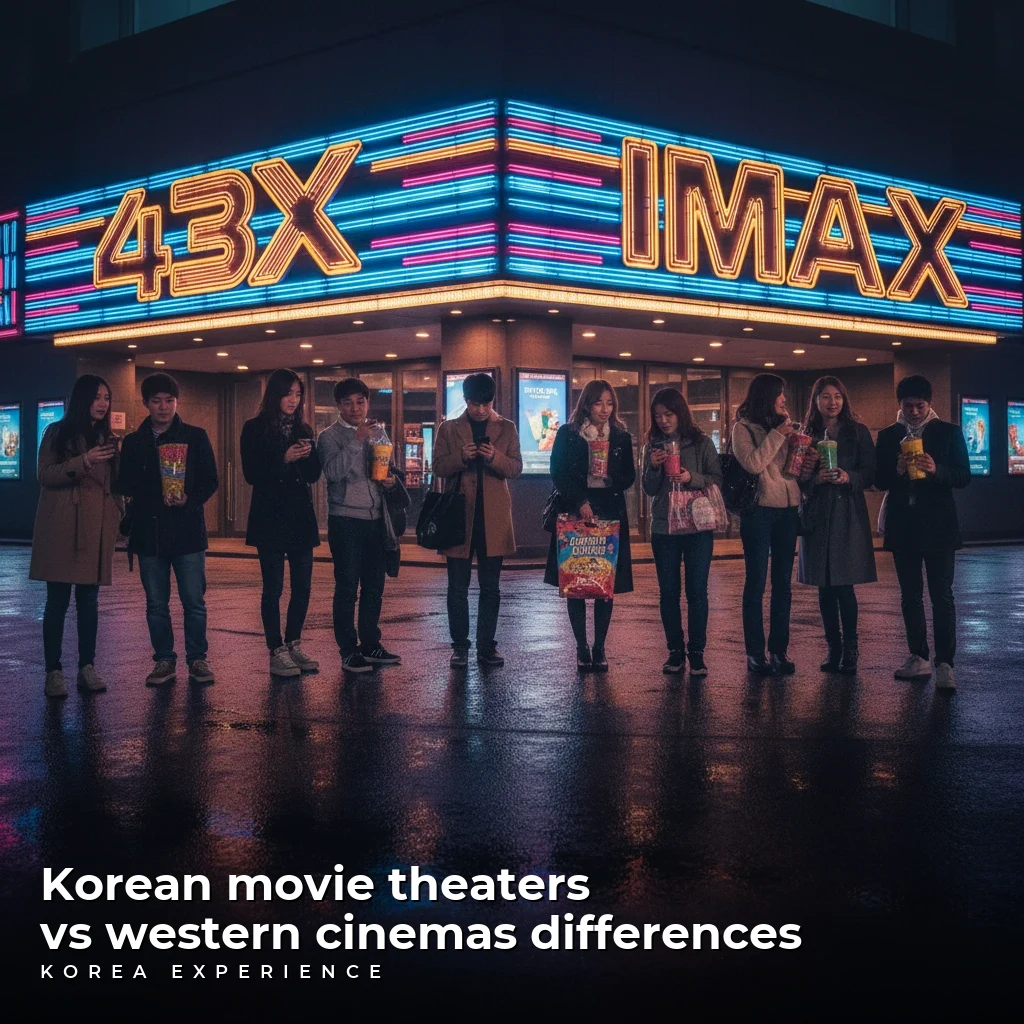
Watching a blockbuster in Seoul is not merely a pastime; it is a meticulously designed lifestyle experience that often surprises international visitors. While the fundamental concept—watching a film on a big screen—remains the same, the ecosystem surrounding Korean movie theaters differs significantly from Western cinemas in terms of technology, service, food, and etiquette.
For travelers and expats settling in Korea, understanding these nuances can transform a simple movie night into a luxury experience. Whether it is the shock of reserved seating for every single ticket or the delight of eating butter-grilled squid instead of nachos, Korean cinema culture is a distinct entity.
Key Takeaways
- 1Strict reserved seating is mandatory for all showings, booked mostly via mobile apps
- 2Korean cinemas lead globally in premium formats like 4DX, ScreenX, and bed-style seating
- 3Snack bars feature unique items like dried squid and beer, distinct from Western candy
The Digital-First Ticketing Ecosystem
The most immediate difference between Korean movie theaters and Western cinemas lies in the booking process. In many Western countries, particularly in suburban areas, walking up to the box office 15 minutes before showtime is standard practice. In Korea, however, the process is overwhelmingly digital and mobile-first.
Related reading: Independent cinema guide art house theaters in Seoul.
Korean moviegoers are "super-planners" regarding entertainment. Tickets for major releases often open weeks in advance, and prime seats are snatched up within minutes. Approximately 85% to 90% of all movie tickets in Korea are purchased via mobile applications like the CGV, Lotte Cinema, or Megabox apps, or through third-party platforms like Naver.
📊 Digital Adoption Rates
If you attempt to buy a ticket at the counter (the "box office"), you may find that the physical counter is unstaffed or directed solely toward snack purchases. Instead, you will be directed to automated kiosks (Photo Ticket machines). This efficiency reduces queue times significantly, usually keeping wait times under 3 minutes even on weekends.
Pro Tip
Download the cinema apps (CGV, Lotte, Megabox) even if you don't speak fluent Korean. Most now accept foreign credit cards, and the visual seat maps make the "Yemae" (reservation) process intuitive.
Reserved Seating Culture
In the US or UK, unless you are in a premium theater, general admission often applies. You buy a ticket and hunt for a seat. In Korea, every seat is reserved. There is no "first come, first served" regarding where you sit once inside the auditorium. You must sit in the exact seat number printed on your ticket.
This strict adherence to order means you will never see the chaotic rush to save seats with coats or bags. It also means that if the theater is empty, you are still technically expected to sit in your assigned spot, although enforcement relaxes slightly in empty halls.
Comfort and Premium Formats: The Gold Standard
Korea is the birthplace of 4DX and ScreenX technologies, and the domestic market serves as a testing ground for the world's most advanced cinematic experiences. The baseline standard for comfort in a Korean cinema is generally higher than the average Western multiplex.
While a standard ticket costs approximately ₩15,000 to ₩16,000 ($11-12 USD), the array of premium options is staggering.
Seating Tier Comparison
| Feature | Standard Seat | Gold Class / Suite | Tempur Cinema |
|---|---|---|---|
| Price (Approx) | ₩15,000 | ₩40,000 | ₩50,000 |
| Recline Ability | Limited | Full Electric | Bed Mattress |
| Food Service | Self-serve | Table Service | Gourmet Course |
| Privacy | Low | High | Private Pod |
The Rise of Immersive Tech
Western cinemas are catching up, but Korea remains the leader in immersive viewing.
- 4DX: Moving seats, water sprays, wind, and scents synced to the movie. Korea has over 40 dedicated 4DX locations in Seoul alone.
- ScreenX: A 270-degree viewing experience where the movie projects onto the side walls.
- IMAX: The CGV Yongsan I-Park Mall features one of the largest IMAX screens in the world, measuring 31 meters wide by 22.4 meters high.
"If you are watching a Marvel or action movie in Korea, book the 4DX Screen at CGV Yongsan. It combines the moving seats of 4DX with the panoramic view of ScreenX. Tickets sell out instantly, so set an alarm for when reservations open, usually 7 days prior at 2:00 PM KST."
The Snack Bar: Squid, Beer, and Gourmet Popcorn
The concession stand is where the cultural divide becomes most flavorful. In the West, the staple is salty, buttered popcorn, soda, and boxed candy (Sno-Caps, Raisinets). In Korea, the menu is a full culinary operation.
The most distinct smell entering a Korean cinema is not just popcorn; it is the savory aroma of "Butter Grilled Squid" (Ojingeo). This chewy, savory snack is as essential to the Korean movie experience as popcorn is to the American one.
The Popcorn Flavors
Korean popcorn is rarely just "buttered." You will encounter a dual-flavor bucket (Half & Half) as the standard order.
- Caramel: The most popular flavor, heavily coated and sweet.
- Onion: Savory onion powder seasoning.
- Cheese: Sharp cheddar dust.
- Garlic: A rich, savory option.
- Basil: A newer trend in premium locations.
💵 Concession Stand Price Comparison
Premium savory snack
Standard Date Set
Alcohol allowed
Meal replacement
Unlike many US theaters where alcohol is restricted to specific VIP areas, beer is widely available at regular concession counters in Korea. You can order a draft beer or buy canned beer to take into the standard auditorium.
Cinema Etiquette: Silence is Golden
The atmosphere inside a Korean theater is markedly different from the reactive crowds often found in US cinemas. Korean audiences are famously quiet.
The "Gwan-keu" Factor
There is a slang term, "Gwan-keu" (a portmanteau of Gwan-ram [viewing] and Keu-n [big trouble/hindrance]), referring to bad etiquette that ruins the movie. The threshold for what constitutes a disturbance is very low.
- Silence: Talking during the movie is strictly taboo. Even whispering is often met with shushing.
- Phone Use: Using a phone, even on dim, is considered a major offense. The darkness is absolute.
- Reactions: While comedy movies will elicit laughter, audiences generally refrain from clapping, cheering, or shouting at the screen during action sequences—behaviors that are common in American screenings of franchise blockbusters.
Etiquette Warning
Do not place your feet on the seat in front of you. This is considered highly disrespectful and unhygienic in Korea. You may be reprimanded by staff or other patrons.
The Exit Speed
Another stark contrast occurs when the movie ends. In Western cinema culture, audiences might linger, especially to discuss the film or wait for post-credit scenes. In Korea, as soon as the credits roll, the house lights often come up to about 50% brightness immediately, and the audience exits rapidly.
Cleaning crews are incredibly efficient, often entering the theater within 30 seconds of the credits rolling to clean for the next showing, which is usually scheduled just 15 to 20 minutes later.
Language and Subtitles: The "Jamak" System
For international travelers, the language barrier is a primary concern. The good news is that Korea is a subtitle-friendly country.
Unlike some European countries (like Germany or Italy) where dubbing is the norm for all foreign films, Korea prefers subtitles ("Jamak") for adult-oriented Western movies.
- Hollywood Blockbusters: 99% are shown in English with Korean subtitles.
- Animation: This is the exception. Animated films (Disney, Pixar) are often split 50/50 between Dubbed ("Deobing") and Subtitled. You must check the showtime carefully. If the time slot says "Deobing," it will be in Korean.
📖 How to Identify English Audio Tickets
Step 1: Check the Tag
Look for '자막' (Jamak) next to the movie title or time. This means Subtitles (English Audio).
Step 2: Verify Animation
If watching a cartoon, double-check. Evening showtimes are more likely to be subtitled than morning ones.
Discount Culture: The Last Wednesday
Movie tickets in Korea have risen in price, currently averaging ₩15,000 ($11 USD). However, there is a government-supported initiative known as "Culture Day."
On the last Wednesday of every month, between 5:00 PM and 9:00 PM, ticket prices are slashed by approximately 50%, usually costing around ₩7,000 to ₩8,000 ($5-6 USD). This applies to standard 2D screenings at major chains like CGV, Lotte, and Megabox.
Consequently, these evenings are the busiest of the month. If you plan to visit a cinema on Culture Day, you must book at least 3-4 days in advance.
Major Cinema Chains and Locations
Korea's cinema market is an oligopoly dominated by three major conglomerates. Each offers a similar standard of luxury, but they have distinct vibes.
- CGV (CJ Group): The market leader. Known for introducing 4DX and ScreenX. They often have the best interior design, resembling vintage streets or brick warehouses.
- Lotte Cinema: Operated by the retail giant Lotte. Often attached to Lotte Department Stores. Their "Super Plex G" screens are enormous.
- Megabox: Known for the best sound systems (often Dolby Atmos) and their premium "The Boutique" suites.
CGV Yongsan I-Park Mall(CGV 용산아이파크몰)
Pros and Cons of the Korean Cinema Experience
To summarize the differences for a Western traveler, here is a balanced view of what to expect.
Korea vs Western Cinema Experience
- ✓Superior technology (4DX, ScreenX) is widely available
- ✓Reserved seating eliminates queue anxiety
- ✓Cleanliness standards are exceptionally high
- ✓Snack variety is vast (Squid, Beer, Gourmet Popcorn)
- ✗Strict silence etiquette can feel restrictive to some
- ✗Mobile booking dominance makes spontaneous walk-ins harder
- ✗Ticket prices for premium formats can exceed $25 USD
- ✗Credits are often interrupted by cleaning lights
How to Plan a Movie Night in Seoul
If you are looking to integrate a movie night into your travel itinerary, follow this timeline for the perfect evening.
The Ultimate Seoul Movie Night Timeline
Book Tickets
Use the CGV or Lotte app to reserve prime seats (Rows G-I are usually best).
Dinner Nearby
Cinemas are usually in malls. Grab a quick meal, but save room for snacks.
Snack Raid
Buy the 'Half & Half' popcorn and a Butter Grilled Squid body.
Print Ticket
Use the kiosk to print your 'Photo Ticket' souvenir (optional but popular).
Showtime
commercials run for exactly 10 minutes past the ticket time. Movie starts at 20:10.
Conclusion
The difference between Korean movie theaters and Western cinemas goes beyond just the language on the screen. It is a reflection of Korea's "Ppalli-Ppalli" (hurry-hurry) efficiency mixed with a deep appreciation for premium service and technology.
While the silence might feel intense to a chatty American audience, and the reserved seating might seem rigid to a casual European viewer, the overall experience is one of polished excellence. From the reclining leather seats to the aroma of garlic popcorn, watching a movie in Korea is a cultural immersion in itself.
Whether you choose a 4DX thrill ride or a relaxing evening in a Gold Class recliner, the Korean cinema experience is undeniably world-class and worth the admission price.
❓ Frequently Asked Questions
Have more questions?Contact us →
About the Author
Korea Experience Team
Written by the Korea Experience editorial team - experts in Korean medical tourism, travel, and culture with years of research and firsthand experience.
Explore more in K-Culture
K-Pop, K-Drama, traditional arts, and modern culture — dive deep into the cultural phenomena that have captivated the world.
Browse All K-Culture ArticlesContinue Reading
Explore more articles you might find interesting
Discover the high-tech world of Korean PC Bang culture, featuring ultra-fast speeds, gourmet food ordering, and 24-hour access for travelers.
Discover the masters of Korean film beyond Parasite. A 2026 guide to top directors, indie cinemas, and film festivals for movie lovers in Korea.
Discover the world of K Pop album unboxing culture. Learn about photocards inclusions buying in Seoul and trading etiquette for international fans.
Discover the best venues for Gugak performances in Seoul. From royal palaces to modern theaters, find ticket info, etiquette, and top cultural experiences.
Discover the best art house theaters in Seoul. From Cinecube to KOFA, find indie films with English subtitles and unique cultural experiences.
Discover the ultimate guide to Korean Anju culture in 2026. Learn how to pair Soju, Beer, and Makgeolli with the perfect snacks for an authentic experience.