Korean parenting styles understanding the tiger mom vs new trends 2026
Explore the evolution of Korean parenting from traditional education fever to modern work-life balance in 2026, with costs and expat tips.
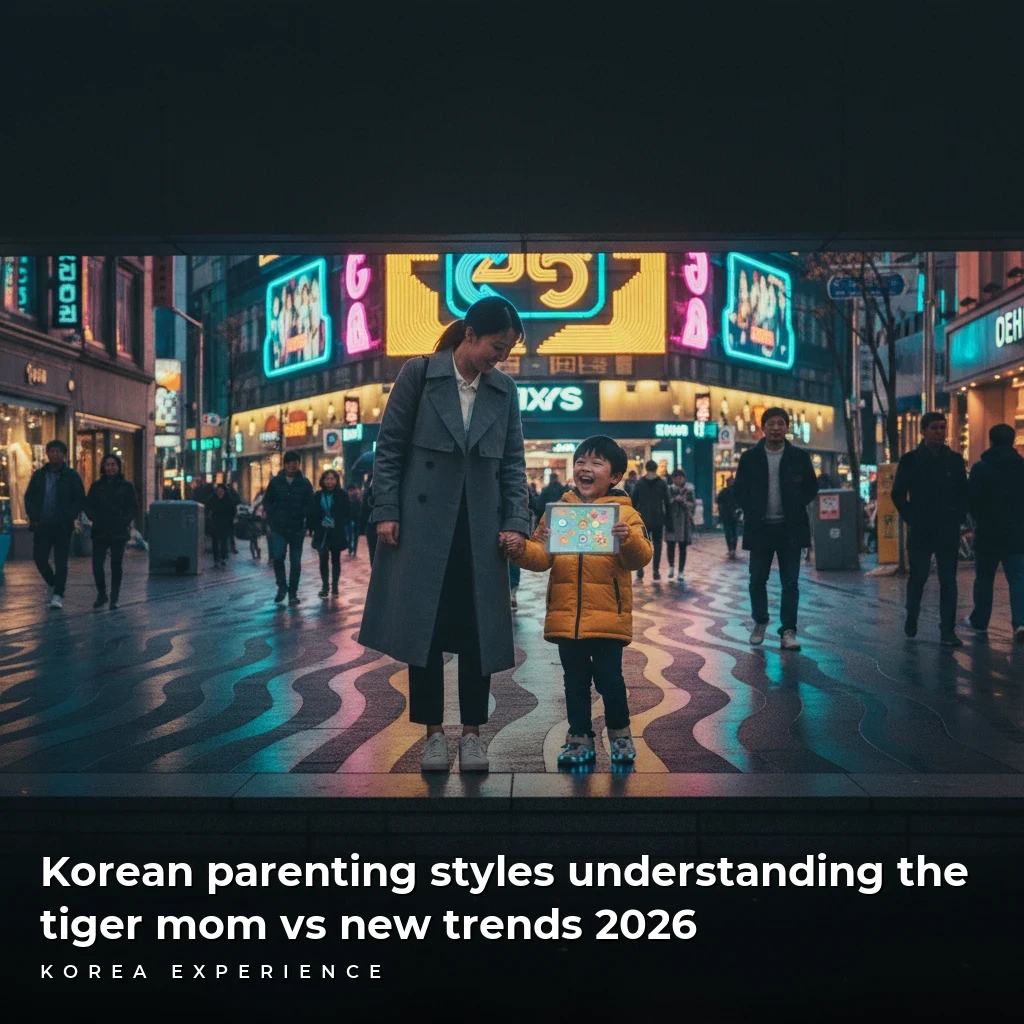
For decades, the global image of South Korean parenting has been dominated by the archetype of the "Tiger Mom"—a figure intensely dedicated to her child's academic success, often at the expense of leisure and sleep. Popular media like the hit drama Sky Castle solidified this image, portraying a cutthroat world of elite private education in Seoul. However, as we move through 2026, the reality on the ground is shifting rapidly. With the world's lowest birth rate and a generation of parents prioritizing happiness over prestige, a complex duality has emerged.
For international travelers, expats, and observers, understanding these dynamics is crucial to navigating Korean society. Whether you are planning to raise a family here or simply want to understand the culture behind the polite children you see in cafes, the landscape of Korean parenting is a fascinating blend of deep-rooted Confucian tradition and hyper-modern adaptation.
You might also enjoy our article about Hanbok rental complete guide styles and pricing.
Key Takeaways
- 1Traditional academic pressure persists, but 'Scandinavian-style' balance is the 2026 trend
- 2Raising a child to age 18 in Korea costs approximately ₩365 million ($275,000 USD)
- 3Government subsidies now offer up to ₩1 million monthly for infants to combat low birth rates
The Legacy of the "Tiger Mom" and Education Fever
To understand the present, we must acknowledge the foundation. The term Chima-baram (literally "skirt wind") refers to the influence of mothers who aggressively support their children's education. This stems from a period of rapid economic growth where education was the sole ladder to social mobility.
Related reading: Korean funeral traditions understanding death and remembr....
In 2026, the Hagwon (private academy) culture remains a pillar of society. Despite government attempts to curb late-night studying, the Gangnam and Daechi-dong districts still bustle with students well into the night.
You might also enjoy our article about Korean youtube culture popular creators and trends.
The Quantifiable Pressure
The dedication to education in Korea is not just a stereotype; it is a measurable economic force. In 2025, South Korean parents spent a record high of 27 trillion won (approximately $20.3 billion USD) on private education.
Learn more in our comprehensive guide to Understanding Uri We in Korean Culture 2026 Guide.
📊 Education Statistics 2026
The goal for many remains the CSAT (Suneung), the college entrance exam that brings the country to a standstill every November. However, the intensity of this pursuit has created a counter-movement among younger parents who witnessed the toll it took on their own mental health.
Cultural Context
Gyo-yuk-yeol (Education Fever): This term describes the national obsession with education. It is why you will see school buses shuttling children as late as 10:00 PM and why cafes are often filled with students studying silently on weekends.
The 2026 Shift: "Gold Kids" and The Latte Papa
By 2026, a significant demographic shift has altered parenting styles. With the fertility rate hovering around 0.65, children born today are often referred to as "Gold Kids"—precious, singular focuses of the family's resources and attention. This scarcity has led to two distinct trends: the hyper-invested parent and the holistic, balance-seeking parent.
The Rise of the "Latte Papa"
Influenced by Scandinavian models, young Korean fathers are taking more active roles. The term "Latte Papa" (men pushing strollers with a coffee in hand) is no longer foreign in Seoul's trendy Seongsu-dong or Mapo-gu districts.
📋 Paternity Trends 2026
While traditional corporate culture still exerts pressure, 2026 bas seen a normalization of men leaving work at 6:00 PM to pick up children from daycare, a rarity just a decade prior.
The "Emo-Mom" (Emotional Coaching)
Modern Korean mothers are increasingly rejecting the authoritarian "Tiger Mom" label in favor of "Emotional Coaching." This involves validating a child's feelings and prioritizing psychological well-being over rote memorization. Bookstores in Kyobo and Aladin now feature bestsellers on child psychology and "conversation methods" more prominently than strict study guides.
The Economics of Parenting: A Price Breakdown
Raising a child in Korea is famously expensive. It is consistently ranked as one of the most costly places in the world to raise a family relative to GDP. For expats moving to Korea, budgeting is essential.
Housing prices in family-friendly districts like Seocho or Pangyo remain high. A standard 84-square-meter apartment (the most popular size for families) in a desirable school district averages ₩2.2 billion ($1.65 million USD).
💵 Monthly Childcare Costs (Age 5)
English Kindergarten + Art/Music Hagwons
State Daycare + 1 Extracurricular
Government Subsidies for Expats
Foreign residents on long-term visas (F-series) are often eligible for the same childcare subsidies as Korean citizens. In 2026, the "Parental Benefit" provides ₩1,000,000 per month for children under 12 months, and ₩500,000 for children aged 12-23 months. Always register your child at the local Dong (community center) immediately upon arrival.
Education Options: Local vs. International
For expat families, the biggest decision is schooling. Korea offers a distinct dichotomy between the rigorous local system and the costly but holistic international system.
Local Schools
Public schools are free and offer high-quality instruction, particularly in math and science. However, the language barrier and the pressure to conform can be challenging for non-Korean children.
International Schools
There are over 40 international schools across Korea, concentrated in Seoul, Incheon (Songdo), and Jeju Island. These schools follow US, UK, or IB curriculums.
School System Comparison 2026
| Feature | Local Public School | International School | Alternative School |
|---|---|---|---|
| Annual Tuition | Free | ₩30M - ₩50M | ₩10M - ₩20M |
| Language | 100% Korean | English | Mixed |
| Class Size | 20-25 Students | 15-20 Students | 10-15 Students |
| Cultural Focus | Conformity/Academic | Individualism | Creativity |
"If you plan to stay in Korea long-term (5+ years), sending your child to a local preschool (Yuchiwon) is the best way for them to master the language. The brain absorbs the distinct Korean sentence structure best before age 7. You can switch to International School later, but you can't easily reverse the language acquisition."
The "Kids Cafe" Culture: A Parent's Lifeline
If you visit Korea with children, you will inevitably discover the "Kids Cafe." These are not just coffee shops with a toy corner; they are elaborate indoor entertainment centers that allow parents to relax while children play in supervised, high-tech environments.
In 2026, premium Kids Cafes have evolved to resemble mini theme parks, featuring VR zones, organic dining menus, and valet parking. They are essential in a country with extreme weather seasons (hot, humid summers and freezing winters) and high urban density.
Lilliput Premium Kids Lounge(릴리펏)
📖 How to Navigate a Korean Kids Cafe
Step 1: Entry & Payment
Pay for the child (usually ~₩20,000 for 2 hours). Parents usually pay an admission fee or must order a meal/drink.
Step 2: Storage
Store shoes and bags in the provided lockers. Keys are usually wristbands that track extra purchases.
Step 3: Ordering Food
Food at premium cafes is restaurant quality. Don't be surprised to see Gorgonzola pizza or Pilaf on the menu.
A Typical Day in the Life of a Korean Student (2026)
To truly understand the "Tiger Mom" persistence, one must look at the schedule of a typical upper-elementary or middle school student. The concept of "free time" is often replaced by a structured rotation of academies.
Daily Schedule: 5th Grade Student (Seoul)
Public School
Regular academic curriculum + lunch
Math Hagwon
Advanced level mathematics
English Academy
Grammar and conversation practice
Dinner / Transit
Quick meal, often convenience store kimbap
Piano or Taekwondo
Arts/Sports rotation
This schedule explains why convenience stores in academy districts stock high-protein snacks and why parents are constantly driving (the "Road Manager" role).
Pros and Cons of Raising Kids in Korea
For expats considering a move, Korea offers a distinct trade-off between safety/convenience and pressure/pollution.
Parenting in Korea: The Trade-offs
- ✓Extreme Safety: Children often walk to school alone from age 7
- ✓High-Quality Healthcare: Pediatric clinics are affordable and accessible
- ✓Convenience: Everything from food to diapers can be delivered within hours
- ✓Respect: Society teaches high levels of respect for elders and community
- ✗Air Quality: Yellow dust in spring necessitates masks and air purifiers
- ✗Competitive Atmosphere: Pressure can affect children's self-esteem
- ✗Limited Outdoor Space: Lack of backyards means relying on public parks
- ✗Cost: Education and organic food prices are significantly higher than global average
Future Outlook: The Demographic Cliff
As we look toward the latter half of the 2020s, the Korean government is in a desperate race against the demographic cliff. The sheer scarcity of children has led to them being treated as VIPs in many sectors.
"No Kids Zones" (cafes or restaurants banning children), which were controversial in the early 2020s, are facing legal challenges and social backlash in 2026. The government is incentivizing "Welcome Kids Zones" with tax breaks.
Furthermore, technology is bridging the gap. AI tutors are becoming standard in households to reduce the cost of private tutoring, and "smart strollers" with air purification systems are a common sight in the wealthy districts of Seoul and Busan.
The Travel Advantage
For travelers, this "Gold Kid" phenomenon means that family-friendly facilities in hotels and malls are world-class. Department stores like The Hyundai Seoul or Shinsegae Centum City offer stroller rentals that are cleaner and more advanced than what you likely own at home, along with nursing rooms that resemble 5-star hotel lounges.
Conclusion
Korean parenting in 2026 is a study in contrasts. The "Tiger Mom" still exists, but she is now likely sharing a table with the "Latte Papa" and the "Eco-Mom." The drive for excellence remains, but the definition of success is slowly broadening beyond just the SKY universities (Seoul National, Korea, Yonsei).
For the observer or the expat parent, Korea offers an environment that is safe, efficient, and deeply communal, provided one can navigate the high costs and competitive undercurrents. As the country grapples with its population crisis, it has never been a more dynamic, challenging, or rewarding place to raise a child.
❓ Frequently Asked Questions
Have more questions?Contact us →
About the Author
Korea Experience Team
Written by the Korea Experience editorial team - experts in Korean medical tourism, travel, and culture with years of research and firsthand experience.
Explore more in K-Culture
K-Pop, K-Drama, traditional arts, and modern culture — dive deep into the cultural phenomena that have captivated the world.
Browse All K-Culture ArticlesContinue Reading
Explore more articles you might find interesting
Discover how traditional Korean Hanbok evolved from Joseon dynasty attire to 2026 global streetwear trends, including rental tips and shopping guides.
Discover the 3000 year history of kimchi, from ancient preservation to modern superfood. Includes 2026 travel tips, museum guides, and cooking class costs.
Explore the epicenter of Seoul's art world. Our 2026 guide covers Hannam-dong's top galleries, from Leeum to Pace, with walking routes and dining tips.
Explore Seouls 5 Grand Palaces with our expert guide to Korean traditional architecture. Discover hidden spots, Secret Garden tips, and Royal Pass details.
Discover the ultimate 2026 BTS tour in Seoul. Explore 15+ must-visit locations, from HYBE HQ to rookie-era eateries, with costs and travel tips.
Discover Korea's best markets beyond Seoul. Explore Busan, Jeju, and Daegu with specific food prices, transport tips, and 2026 travel data.