Korean Trash Bags 2026: The Ultimate Si-rip & Recycling Guide
Master the 2026 Korean trash system to avoid 100,000 KRW fines. Learn bag prices, sorting rules, and how to recycle 60% of waste like a local.
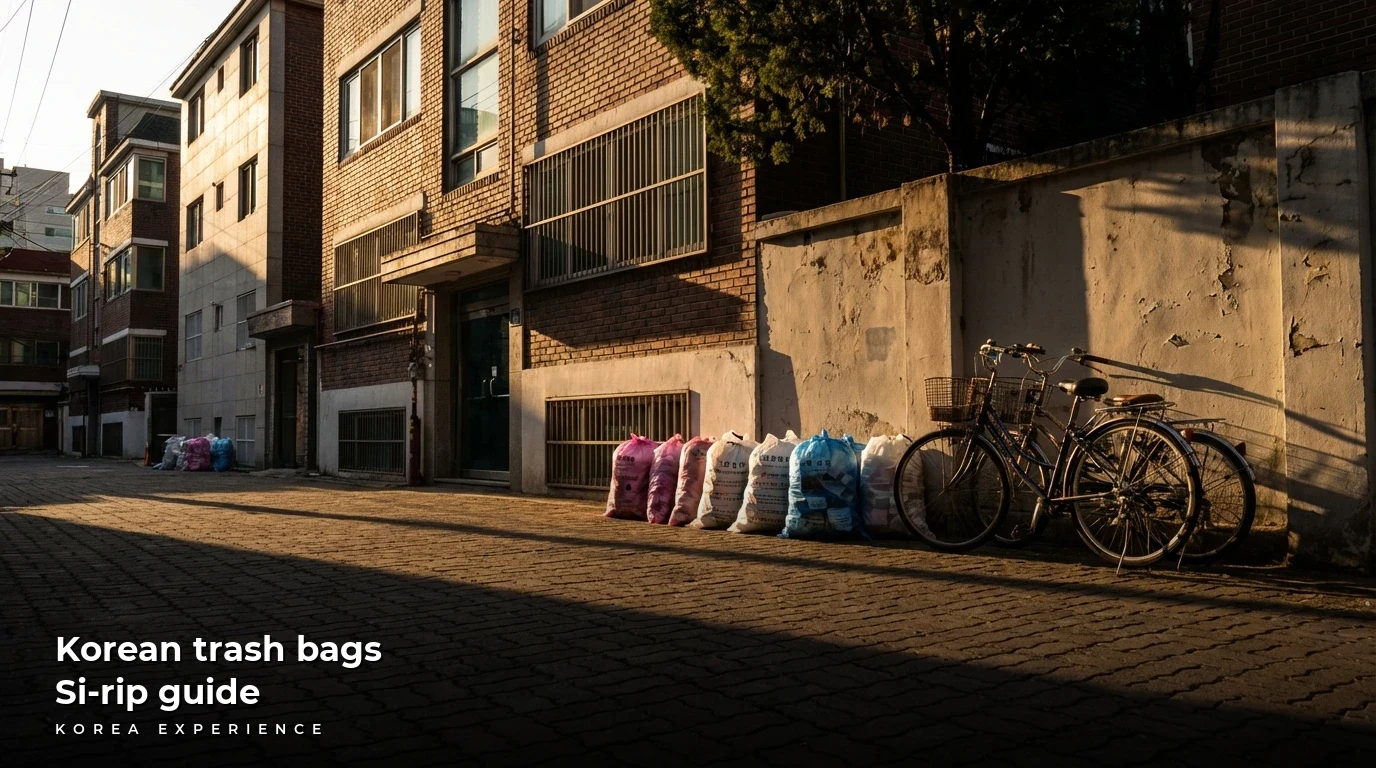
So, you’ve arrived in Korea and realized that throwing away a banana peel is more complicated than filing your taxes? Don't panic—this guide breaks down the colorful, confusing, and strictly enforced world of "Si-rip" (municipal) trash bags so you can live like a local and avoid those dreaded 100,000 won fines.
Key Takeaways
- 1The short answer is: You cannot just use random plastic bags from the store or black bin liners for your household trash. You must buy color-coded, government-issued bags (Jongnyangje) specific to your exact district (Gu), or the garbage man will literally leave your trash on the street to rot.
- 2Here's a number you need to know: 100,000 KRW. That is the starting fine for illegal dumping, which includes innocent mistakes like putting chicken bones in the food waste bag or using a bag from Gangnam-gu when you live in Mapo-gu.
- 3Go do this right now: Walk to your nearest convenience store (CU, GS25, 7-Eleven), walk straight to the counter, and ask for Il-ban Sseu-re-gi Bong-tu (General Trash Bag) and Eum-sik-mul Bong-tu (Food Trash Bag). Buy a pack of 10 in the 10-liter size to start.
📋 Quick Facts
Answer the Main Question First!
Look, I get it. You just wanted to throw away a used tissue and a banana peel, and now you're staring at a wall of different colored plastic bags in a Korean convenience store, sweating because you heard a rumor that the "trash police" will hunt you down if you buy the wrong one. The short answer to your anxiety is this: You are dealing with the "Si-rip" (municipal) Volume-Based Waste Fee system, and yes, it is mandatory.
You cannot use a random black plastic bag. You cannot use a bag from the district where you work for the trash at your house. You must go to a convenience store in your specific neighborhood (Dong/Gu), ask for a "Jongnyangje Bongtu" (Standard Trash Bag), and pay for it. The price of the bag is the trash tax. For 2026, a standard 20-liter bag costs around 490 KRW (about 35 cents). It’s cheap, strict, and if you mess it up, the fine starts at 100,000 KRW. So, put down the black bag, grab some cash, and let’s get you the right "Si-rip" gear.
The Background Story
How did throwing away trash become so complicated? Well, rewind to the early 1990s. South Korea was industrializing fast, and Seoul was drowning in garbage. The famous Nanjido—now a beautiful eco-park where you might go for a picnic—was actually a massive, stinking landfill mountain. The government realized they were running out of space to bury trash. They needed a radical solution to force people to recycle and reduce waste.
Enter the Volume-Based Waste Fee (VBWF) system in 1995. Before this, you paid a flat fee for trash collection, so nobody cared how much they tossed. The new law was simple but brilliant: "If you want to throw it away, you have to buy a specific bag for it." Suddenly, recycling (which is free) became very popular because it saved people money.
Fast forward to 2026, and the rules are tighter than ever. A ban on direct landfilling for the Seoul Metropolitan area has just kicked into high gear. This means trash can't just be buried anymore; it has to be incinerated or recycled. This has led to stricter sorting rules, higher bag prices to cover incineration costs, and high-tech solutions like those sci-fi RFID food waste bins you see in apartment complexes. The "Si-rip" aspect basically means "City-Run," emphasizing that this is a municipal government program, not a private service. Each district (Gu) manages its own budget, which is why a Mapo-gu bag is useless in Gangnam-gu—they are different "tax jurisdictions" for trash.
Breaking Down Your Options
Okay, let's look at the arsenal of bags you'll need. For a deeper dive into the recycling specifics, check out our guide on How to Recycle in Korea 2026.
1. General Waste (Il-ban Sseu-re-gi)
This is your main bag. In Seoul, it's usually white with lettering specific to your district. In other cities like Busan or Daegu, it might be green, blue, or yellow.
- What goes in: Tissues, dirty plastic that can't be washed, rubber, broken ceramics, old shoes, and the confusing "not-food" food items like chicken bones and eggshells.
- Scenario: You ordered fried chicken. The cardboard box goes to recycling (if clean). The bones go in this general bag. The greasy paper liners go in this bag.
2. Food Waste (Eum-sik-mul Sseu-re-gi)
This is usually a smaller, yellow or orange bag.
- What goes in: Anything soft and organic that an animal could technically eat. Leftover rice, kimchi scraps, fruit peels, vegetable cuttings.
- The RFID Curveball: If you live in a modern apartment complex, you might not need these bags. Instead, you'll see a metal machine with a scanner. You tap a card, the lid opens, you dump your food slop directly in, and it weighs it. You are billed monthly on your maintenance fee. It’s cleaner, but you pay for the weight, so drain that soup liquid first!
3. Recyclables (Jae-hwal-yong)
The good news: These are free! You don't need a government bag. You can use any clear plastic bag.
- The Catch: You must separate them. Typically: Paper, Glass, Cans, Plastics, and Vinyl (wrappers).
- 2026 Update: "Transparent PET" (water bottles) is now its own strict category. You must rip off the label and crush it. If you mix clear bottles with colored shampoo bottles, the recycling guys might leave your trash behind with a "shame sticker" on it.
Jongnyangje Implementation
South Korea officially launches the Volume-Based Waste Fee (VBWF) system nationwide to reduce landfill usage.
Food Waste Landfill Ban
The government bans the direct burial of food waste in landfills, forcing strict separation.
RFID System Rollout
High-tech RFID food waste bins are introduced in apartments to weigh trash and charge residents by the gram.
Plastic Chaos Crisis
China stops importing plastic waste, forcing Korea to strictly enforce transparent/clean recycling rules.
Transparent PET Law
Regulations mandating that clear PET bottles (water/soda) must be separated without labels become strictly enforced.
Metropolitan Landfill Ban
CRITICAL UPDATE: Direct landfilling of household waste is banned in the Seoul Capital Area; everything must be incinerated or recycled first.
Comparison Table: Know Your Bags
| Feature | General Waste | Food Waste | Recycling |
|---|---|---|---|
| Bag Color | White (usually) | Yellow/Orange | Transparent |
| Cost | ~₩490 (20L) | ~₩190 (2L) | Free |
| Requirements | District Specific | No bones/shells | Clean & Dry |
| 2026 Update | Price Hikes | Drying Rules | Strict PET Separation |
Pros and Cons of the System
Pros
- ✓It's Actually Fair: The Pay-As-You-Throw system means if you produce less trash, you pay less money. It stops you from subsidizing your neighbor who throws away three sofas a week.
- ✓The Streets are (Mostly) Clean: Because everyone has to pay to toss stuff, people are hyper-conscious about waste. You won't find massive dumpsters overflowing on every corner.
- ✓Recycling is Free: This is the best hack. If you get really good at sorting your recycling, you barely ever have to buy the expensive general trash bags.
Cons
- ✗The District Trap: If you move across the street but cross a district line, your expensive stack of leftover trash bags becomes useless plastic.
- ✗The Is This Food? Game: Determining what counts as food waste is harder than learning Hangul. An eggshell? Not food. A chicken bone? Not food. A banana peel? Food.
- ✗Summer Smells: Because the bags cost money, people try to stuff them until they are bursting. In the humid Korean summer, a half-full food waste bag is a biological weapon.
Essential Survival Hacks & Warnings
Before we get to the step-by-step guide, there are two critical things you need to know to survive the Korean summer and the law.
💡 Pro Tip: Freeze Your Food Waste
I am dead serious. In the summer, your food waste bag will attract fruit flies within hours. Many Koreans keep a designated Tupperware container in their freezer for the food waste bag. You fill it up frozen, no smell, no bugs, and then toss the bag when it's full.
⚠️ Warning: CCTV is Watching
Illegal dumping (throwing trash in black bags or regular grocery bags) is taken very seriously. Districts have installed "talking CCTV" cameras in trash zones that detect motion and warn you in a robot voice. They will go through your trash to find a delivery receipt with your address on it to mail you the fine. Tear off your address labels from boxes! For more on safety alerts, check out our guide to the Emergency Ready App Korea 2026.
Step-by-Step Guide: Your First Trash Run
Total Time: 15 Minutes (Buying + Sorting) Difficulty: Medium (until you get the hang of it!)
📖 How to Survive Your First Trash Run in Korea
Step 1: Locate Your Si-rip Bags
Go to a convenience store (CU, GS25, 7-Eleven) or a local mart in your specific neighborhood. Do not buy bags near your work. Go to the counter and say: 'Il-ban sseu-re-gi bong-tu, sip-liter, juseyo' (General trash bag, 10L, please). Also ask for 'Eum-sik-mul sseu-re-gi bong-tu' (Food waste bag).
Step 2: The Great Sort (General vs. Food)
Set up two bins. Line one with the white General bag and one with the yellow/orange Food bag. The rule of thumb: 'If a pig can eat it, it's food waste.' Chicken bones, fish bones, eggshells, onion skins, and tea bags are NOT food waste—put them in the General bag.
Step 3: Handle the Recyclables
You don't need a special paid bag for recycling. Any clear plastic bag works. You must RINSE everything. If a pizza box has cheese grease, it's general trash. For water bottles (PET), remove the label and cap, and crush the bottle flat.
Step 4: The Drop Off
If you live in an officetel, use the designated trash room. If you live in a Villa, place bags on the street between sunset and midnight. Check the bag for printed collection times. Do not put it out in the morning or cats will rip it open.
If you need to buy bins or cleaning supplies for your new sorting station, our Daiso Korea 2026 Survival Guide has the best budget-friendly recommendations. Also, ensure you have a working card for these small purchases; see our NH vs Hana Bank 2026 comparison if you haven't set up banking yet.
Foreigners always panic about leftover trash bags when they move. Don't throw them away! Go to the 'Jumin Center' (Community Center) in your new neighborhood. Show them your old bags. They will give you a 'certified sticker' (jeung-ji) to stick on the old bags that makes them legal to use in the new district. It saves you money and waste.
No Korean Phone/ARC? Large Waste Hack
If you need to throw away Large Waste (Suitcase, broken chair, mattress) but you don't have an Alien Registration Card (ARC) or a Korean number to verify your identity on disposal apps like Yeogiro or Ppaegi:
- Take a photo of the item.
- Go to the nearest Community Center (Jumin Center) or sometimes a larger convenience store in the district.
- Show them the photo and say "Dae-hyeong Pye-gi-mul" (Large waste).
- You can pay cash/card right there. They will give you a physical sticker.
- Slap the sticker on the item and put it on the street. Do not try to use the apps if you lack ID verification; you'll just get stuck in a loop.
For more on connectivity issues without an ARC, read our eSIM vs USIM vs Pocket Wi-Fi Korea 2026 guide.
Cost of Living: Standard Seoul Prices 2026
| Option | Price (approx) | Category | Description |
|---|---|---|---|
| 5 Liter Bag | ₩130 | Budget | Perfect for bathroom trash bins. |
| 10 Liter Bag | ₩250 | Budget | Best for singles/students. Fills up before it smells. |
| 20 Liter Bag | ₩490 | Mid | The standard household size. Fits most kitchen bins. |
| 50 Liter Bag | ₩1,250 | Large | For families or spring cleaning. Heavy when full! |
| 75 Liter Bag | ₩1,880 | Large | Huge. Often used for moving out (clothes/soft items). |
| 2L Food Bag | ₩190 | Food | Tiny. Good for singles who don't cook much. |
| 5L Food Bag | ₩300 | Food | Standard family food waste size. |
FAQ
❓ Frequently Asked Questions
Have more questions?Contact us →
Conclusion: Your Action Plan
Okay, friend, you're ready. Here is your action plan for the next 24 hours:
- Go to the convenience store nearest your house.
- Buy a pack of 10L General bags and 2L Food bags.
- Set up your sorting station.
- Stick a note on your fridge: "Chicken bones go in General Trash!"
It feels overwhelming at first, confusing "Si-rip" rules and all, but after a week, you'll be separating plastics from vinyls like a pro. You're not just avoiding fines; you're joining a society that recycles 60% of its waste. That’s pretty cool. Now, go buy those bags! And if you end up spilling kimchi juice on your clothes while taking out the trash, check out our guide to 24/7 Coin Laundromats in Korea 2026 to get cleaned up.
Sources
- Seoul Metropolitan Government - Details on bag types, sorting rules, and bulky waste fees.
- Hanam City Hall - Comprehensive price lists for trash bags and sorting guides.
- Ministry of Environment (via K-Eco) - Information on the RFID food waste systems and environmental policies.
- Korea JoongAng Daily - Historical context on price hikes and the VBWF system.
- The Guardian - 2025/2026 updates on smart bin technology and food waste reduction.
About the Author
Korea Experience Team
Written by the Korea Experience editorial team - experts in Korean medical tourism, travel, and culture with years of research and firsthand experience.
Explore more in Living in Korea
Everything expats and long-term visitors need to know — from visa requirements and housing to banking, healthcare, and daily life tips.
Browse All Living in Korea ArticlesContinue Reading
Explore more articles you might find interesting
Discover how to book 2,000+ top Korean restaurants using CatchTable Global in 2026. Bypass local phone rules, pay deposits, and avoid the new 40% no-show fee.
Discover how KakaoMetro calculates travel time using 2026 telemetry and why the 65,000 KRW Climate Card is essential for your Seoul subway commute.
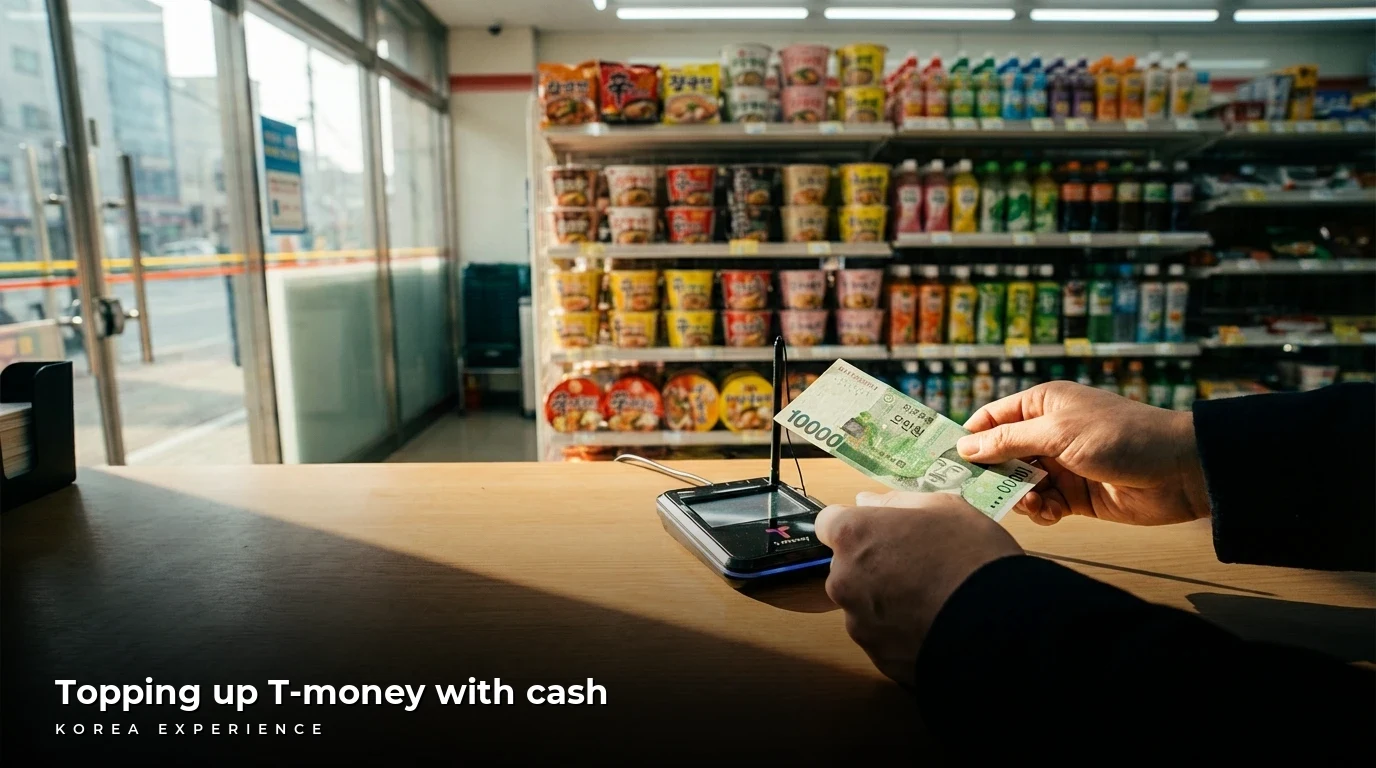
Learn how to top up your T-money card with cash in 2026. A 30,000 KRW reload at any convenience store is the best way to ride Seoul transit without an ARC.

Compare Wowpass vs. Namane for 2026. Learn why the 1,550 KRW subway fare means you need a Climate Card Tourist Pass to save money in Seoul.
Discover Seoul's best hidden cafes with 85 Mbps Wi-Fi speeds. Learn how to secure laptop-friendly seating and avoid the 2026 2-hour study limits.

Get a local 010 number for 35,000 KRW to access reservations and delivery apps while navigating the mandatory 2026 facial recognition laws.