KTX vs SRT comparison 2026: Best high-speed train for Seoul travel
Compare KTX and SRT high-speed trains in Korea. Discover price differences (10% cheaper), station locations, and how to book tickets for your 2026 trip.
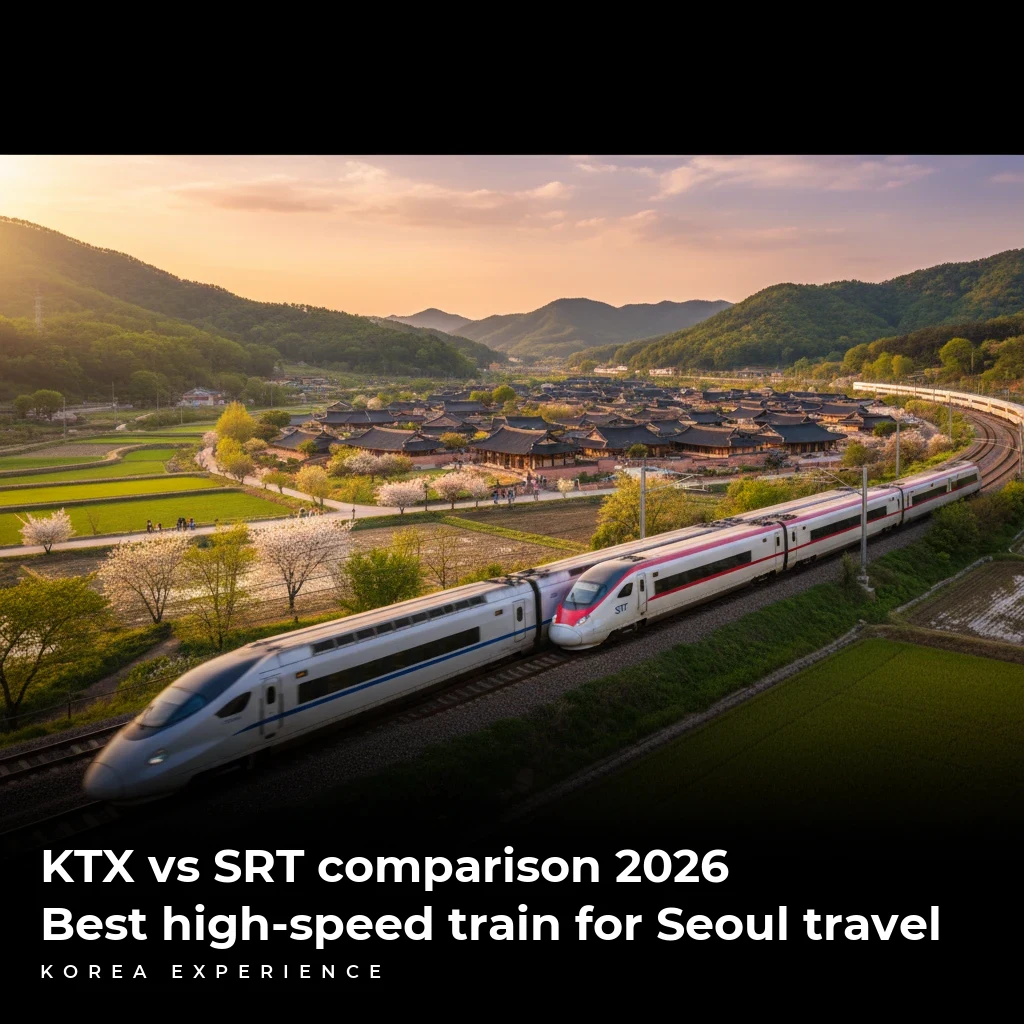
If you are planning to travel between Seoul and other major Korean cities like Busan, Mokpo, or Gwangju, you have two primary high-speed rail options: the famous KTX (Korea Train eXpress) and the newer SRT (Super Rapid Train). While both offer speeds exceeding 300 km/h, the choice largely depends on where you are staying in Seoul.
The short answer: Choose the SRT if you are staying in Gangnam or Southern Seoul, as it departs from Suseo Station and is generally 10% cheaper. Choose the KTX if you are staying in Downtown Seoul (Myeongdong, Hongdae, Jongno), as it departs from Seoul Station or Yongsan Station, and is the only train that accepts the Korail Pass.
Key Takeaways
- 1Location is the #1 deciding factor: KTX serves downtown Seoul (North), SRT serves Gangnam (South).
- 2SRT tickets are consistently 10-15% cheaper than KTX tickets for the same distance.
- 3Only KTX accepts the 'Korail Pass' (KR Pass) for unlimited travel; SRT requires point-to-point tickets.
- 4KTX services the Gangneung line (East Coast); SRT currently focuses on Gyeongbu (Busan) and Honam (Mokpo) lines.
Understanding the Basics: KTX and SRT
Korea’s high-speed rail network is one of the most efficient in the world, with a punctuality rate exceeding 99%. For international travelers arriving in 2026, understanding the distinction between the two operators is the first step to a smooth journey.
What is the KTX?
The KTX (Korea Train eXpress) is operated by Korail, the national railway operator. Launched in 2004, it was Korea's first high-speed train.
- Primary Hubs: Seoul Station, Yongsan Station.
- Network Coverage: Extensive. It covers almost every major city in Korea, including the east coast (Gangneung, Donghae).
- Train Types: KTX-1 (older, narrower), KTX-Sancheon (newer, more legroom), and KTX-Eum (eco-friendly, distributed power).
What is the SRT?
The SRT (Super Rapid Train) is operated by SR Corporation. Launched in 2016, it was designed to introduce competition to the rail sector.
- Primary Hub: Suseo Station (Southeast Seoul/Gangnam).
- Network Coverage: Focuses on the two most popular lines: Gyeongbu Line (to Busan) and Honam Line (to Mokpo/Gwangju).
- Train Types: Exclusively uses trains similar to the KTX-Sancheon model, meaning consistently modern interiors.
📊 Speed Comparison 2026
Location: The Most Critical Difference
For 90% of travelers, the decision between KTX and SRT should be based on departure location. Seoul is a massive metropolis; crossing the city from Gangnam to Seoul Station can take 45-60 minutes during rush hour, negating any speed advantage of the train itself.
Seoul Station (KTX Hub)
Located north of the Han River, this is the heart of historic Seoul.
- Best for travelers staying in: Myeongdong, Hongdae, Insadong, Itaewon, Dongdaemun.
- Connectivity: Connected to Subway Line 1, Line 4, and the AREX Airport Railroad.
- Vibe: A massive transportation complex with a department store (Lotte Outlets) and huge hypermarket (Lotte Mart).
If you are just arriving in Korea and heading straight to the provinces, take the Airport Railroad Express (AREX) from Incheon Airport to Seoul Station and transfer to the KTX.
Suseo Station (SRT Hub)
Located in the southeastern district of Gangnam-gu.
- Best for travelers staying in: Gangnam, COEX area, Jamsil (Lotte World Tower), Seongnam, Bundang.
- Connectivity: Connected to Subway Line 3, the Suin-Bundang Line, and the newly expanded GTX-A (Great Train Express) line as of 2026.
- Vibe: Modern, subterranean, and efficient, but fewer shopping options compared to Seoul Station.
Pro Tip: The GTX Factor
As of 2026, the GTX-A line connects Seoul Station to Suseo Station in under 20 minutes. This means if tickets are sold out for the KTX at Seoul Station, you can quickly zip down to Suseo to catch an SRT, or vice versa. This new connectivity is a game-changer for last-minute bookings.
Route Comparison: Where Can You Go?
While both trains run on the same high-speed tracks once they leave the Seoul metropolitan area, their destination lists differ slightly.
The Gyeongbu Line (To Busan)
- Served by: Both KTX and SRT.
- Stops: Daejeon, Daegu (Dongdaegu), Ulsan, Busan.
- Frequency: KTX departs roughly every 15-20 minutes; SRT departs every 20-30 minutes.
- Travel Time:
- KTX: 2 hours 15 minutes to 2 hours 45 minutes.
- SRT: 2 hours 10 minutes to 2 hours 30 minutes (Suseo is physically closer to Busan than Seoul Station is, shaving off about 7-10 minutes).
The Honam Line (To Mokpo/Gwangju)
- Served by: Both KTX and SRT.
- Departure: KTX trains for this line usually depart from Yongsan Station (near Itaewon/Dragon Hill Spa), not Seoul Station, though some do originate from Seoul Station. SRT always departs from Suseo.
- Stops: Iksan, Gwangju-Songjeong, Mokpo.
The Gangneung Line (To East Coast)
- Served by: KTX Only.
- Stops: Yangpyeong, Manjong, Pyeongchang, Gangneung, Donghae.
- Note: If you are planning a trip to the mountains or the beaches of the east coast, you must use the KTX. The SRT does not service this route.
If you are looking for a weekend getaway to the coast, check out our guide to seasonal travel in Korea to decide whether the East Coast (KTX) or South Coast (SRT/KTX) is better for your dates.
Price Comparison: Budgeting Your Trip
One of the SRT's main selling points is that its base fares are legislated to be roughly 10% lower than KTX fares. While the difference isn't massive for a single ticket, it adds up for families or round trips.
💵 One-Way Fare Comparison (Seoul/Suseo to Busan)
From Suseo Station
First Class vs. Economy
Both trains offer First Class (Special Room) seating.
- KTX First Class: 2x1 seating arrangement, significantly more legroom, free water/snacks (self-service vending or handed out), and quiet atmosphere. Roughly 40% more expensive than standard (approx. ₩83,700 to Busan).
- SRT First Class: Similar 2x1 seating, spacious overhead bins, and "aviation-style" overhead luggage compartments. Slightly cheaper than KTX First Class (approx. ₩76,000 to Busan).
Standing Tickets (Ip-seok)
If all seats are sold out—common on Friday evenings and Sunday afternoons—you can purchase "Standing/Non-reserved" tickets.
- Cost: 15% discount off standard fare.
- How it works: You stand in the vestibules between cars or sit on the fold-down jump seats located there. Jump seats are first-come, first-served.
- Availability: Usually only purchasable at the station counter or vending machine, not always available online for foreigners.
Amenities and Comfort: The Experience
Having ridden both trains dozens of times, the difference in comfort is noticeable depending on the specific train model you get.
KTX Train Models
- KTX-1 (The Original): These are the long, 20-car trains.
- Pros: Stable ride.
- Cons: Some seats face backward (fixed direction), and legroom is tight. Power outlets are limited to the spaces between windows (not every seat).
- KTX-Sancheon (The Newer Model):
- Pros: All seats rotate to face forward. More legroom (960mm seat pitch). Power outlets at every seat (under the seat in front or between seats).
- KTX-Eum (The Newest):
- Pros: Used on lines like Gangneung and Andong. Features wireless charging pads in some seats and individual windows.
SRT Train Models
SRT exclusively uses trains that are virtually identical to the KTX-Sancheon.
- Legroom: consistently good (960mm).
- Wifi: Free 4G/LTE-based Wifi is available on both KTX and SRT. It is generally reliable for messaging and browsing but can struggle with streaming HD video when passing through deep mountain tunnels (which is 60% of the journey).
- Toilets: Available in roughly every other car. Clean, Western-style, with baby changing stations.
- Vending: Neither train has a dining car anymore. They rely on vending machines for water and snacks. Bring your own food!
Onboard Features Comparison
| Feature | KTX-1 (Old) | KTX-Sancheon | SRT |
|---|---|---|---|
| Power Outlets | Limited (Wall) | Every Seat | Every Seat |
| Legroom | Tight (930mm) | Good (960mm) | Good (960mm) |
| Seat Rotation | Fixed (some backward) | All Forward | All Forward |
| Free Wifi | ✅ | ✅ | ✅ |
Booking Guide: How to Buy Tickets
This is where the user experience diverges significantly for international travelers.
Booking KTX
Korail has a relatively foreigner-friendly ecosystem.
- Website: "Let's Korail" website (available in English, Chinese, Japanese).
- App: "Korail Talk" app. It has an English language setting.
- Payment: Accepts foreign Visa, Mastercard, JCB, and Amex without issues.
- Reservations: Opens 1 month in advance.
📖 How to Book KTX Tickets on Mobile
Step 1: Download App
Download 'Korail Talk' from App Store or Google Play.
Step 2: Select Route
Choose 'One Way', departure (Seoul), arrival (Busan), date, and time.
Step 3: Choose Train
Select your train. Note: 'General' is Economy. 'Special' is First Class.
Step 4: Payment
Select 'Foreign Card'. Enter card details. No authentication (3D secure) usually required.
Booking SRT
SRT is notoriously more difficult for foreigners without a Korean phone number because their official app often requires identity verification via a local telecom provider.
- Official Website: Has an English version but can be buggy with foreign cards.
- Official App: "SRT" app. Often requires Korean ID verification.
- Alternative (Recommended): Use third-party platforms like Trip.com or the "SRT Play" mobile web service (which allows booking without Korean phone verification).
SRT Booking Warning
If you do not have a Korean Alien Registration Card (ARC) or a local phone number verified under your name, the official SRT app may block you. We highly recommend using the ticket counters at the station or booking via a travel aggregator like Trip.com for SRT tickets.
Rail Passes: The KTX Ace Card
This is the single biggest factor for budget backpackers. The Korail Pass (KR Pass) is an unlimited rail pass strictly for foreigners.
- Validity: It works on KTX, ITX, and Mugunghwa trains.
- Exclusion: It does NOT work on the SRT.
If you buy a Korail Pass, you are locked into the Korail ecosystem (Seoul Station/Yongsan). You cannot just hop on an SRT train with a KR Pass; you will be fined for traveling without a valid ticket.
Is the Rail Pass Worth It?
- 2-Day Select Pass (approx. ₩131,000):
- Round trip Seoul ↔ Busan on KTX is approx ₩119,600.
- The pass costs slightly more than a simple round trip. It is only worth it if you add a stop (e.g., Seoul -> Daegu -> Busan -> Seoul) or take a side trip.
- 4-Day Flexible Pass: Great if you are doing a grand tour of the country.
Food and Station Amenities
A major part of the Korean train travel experience is the food. Unlike European trains with dining cars, Koreans buy food at the station to eat on the train. It is culturally acceptable to eat bento boxes (dosirak), burgers, and snacks on board, provided they aren't overwhelmingly smelly.
Seoul Station Eats
- Lotte Outlets/Mart: You can buy cheap sushi, fried chicken, and beer at Lotte Mart before boarding.
- Station Bento: There are dozens of "Dosirak" vendors selling Korean lunchboxes for ₩10,000–15,000.
- Fast Food: McDonald's, Lotteria, and Beans Bins Coffee are prominent.
Suseo Station Eats
- Underground Plaza: The connection between the subway and the SRT platform is lined with bakeries, cafes, and restaurants.
- Gimbap: Several high-quality Gimbap shops offer perfect portable meals.
- Krispy Kreme & Cafes: Plenty of coffee options for the morning commute.
For a great food experience in Busan after you arrive, check out our guide to Busan night markets.
Advanced Tips for 2026 Travelers
The "Sold Out" Scenario
Korean trains sell out fast, especially on weekends and holidays (Chuseok/Seollal).
- Refresh: People cancel tickets constantly. Refresh the app every few minutes; seats often reappear 1-2 days before departure.
- Split Tickets: Sometimes Seoul to Daejeon is available, and Daejeon to Busan is available, but the direct ticket isn't. You can book two separate segments (you may have to change seats).
- Standing Tickets: Go to the station 1 hour early and buy a standing ticket at the vending machine.
Luggage Storage
Both KTX and SRT have luggage racks at the end of every car.
- Small/Medium bags: Fit in the overhead shelf.
- Huge suitcases (28"+): Must go in the luggage racks between cars.
- Safety: Theft is extremely rare in Korea. It is standard practice to leave your expensive Rimowa suitcase in the vestibule rack and go sit in your seat. If you are anxious, bring a bicycle lock to secure it to the rack.
"Don't panic if the luggage rack is full. On the KTX-1, there is often space behind the last row of seats in the car (Row 15 or 16). If you book your seat specifically for the last row, you get 'private' storage space right behind you!"
Detailed Route Example: Seoul to Busan
To give you a realistic idea of the journey, here is a comparison of the typical user journey for a traveler heading to Busan for a weekend trip.
Option A: The KTX Journey
- 08:00 AM: Depart hotel in Myeongdong. Take taxi (10 min) to Seoul Station.
- 08:20 AM: Arrive Seoul Station. Buy an iced Americano and a Tuna Gimbap.
- 08:50 AM: Board KTX #023. Locate seat 5A. Place luggage in overhead bin.
- 09:00 AM: Train departs. Smooth acceleration.
- 11:42 AM: Arrive Busan Station. Total cost: ₩59,800.
Option B: The SRT Journey
- 08:00 AM: Depart hotel in Gangnam (near COEX). Take taxi (15 min) to Suseo Station.
- 08:25 AM: Arrive Suseo. The station is less crowded than Seoul Station.
- 08:50 AM: Board SRT #305. Newer train interior feels slightly fresher.
- 09:00 AM: Train departs. Immediately enters a very long tunnel (Yulhyeon Tunnel, 50km long). No view for the first 20 mins.
- 11:30 AM: Arrive Busan Station. Total cost: ₩52,600.
Verdict: If staying in Gangnam, the SRT saved 12 minutes of travel time, ₩7,200 in fare, and about 30 minutes of transit time to the station.
Refunds and Cancellations
Plans change. Here is the refund policy structure for 2026 (applies generally to both, with minor variations).
- Before Departure: Free cancellation up to 1 month before. Small fee (₩400) applies 1 day before.
- 1 Hour Before: Approx 10% fee.
- After Departure: You can still refund a ticket after the train has left (if you missed it), but only up to 20 minutes after departure at the station counter, with a heavy penalty (15-40%). If you miss the train, run to the counter immediately!
Conclusion: Which Should You Choose?
In 2026, the battle between KTX and SRT is less about "which train is better" and more about "where are you sleeping?"
- Choose KTX if: You are a tourist staying in the classic downtown areas (Myeongdong, Jongno), you have a Korail Pass, or you are going to the East Coast (Gangneung).
- Choose SRT if: You are staying in Gangnam, Jamsil, or south of the river, and you want to save a little money.
Both trains offer a world-class travel experience—clean, safe, fast, and punctual. You really can't go wrong with either.
For more tips on navigating life and travel in Korea, check out our guide to best neighborhoods for expats in Seoul to help you decide where to base yourself for your next trip.
❓ Frequently Asked Questions
Have more questions?Contact us →
About the Author
Korea Experience Team
Written by the Korea Experience editorial team - experts in Korean medical tourism, travel, and culture with years of research and firsthand experience.
Explore more in Travel & Tourism
From Seoul's neon-lit streets to Jeju's volcanic landscapes — discover the best of Korea with insider travel tips, itineraries, and seasonal guides.
Browse All Travel & Tourism ArticlesContinue Reading
Explore more articles you might find interesting

Compare medical tourism in Busan vs Seoul for 2026. Discover price differences, clinic quality, recovery spots, and pros/cons for your procedure.
A practical guide for a Seoul to Busan weekend trip covering train operators, neighborhood bases, and managing transit logistics.

Compare Korea's top ski resorts for 2026. Detailed price breakdown, travel times, and slope guides for Vivaldi Park, Yongpyong, and Alpensia.

Discover Korea's best markets beyond Seoul. Explore Busan, Jeju, and Daegu with specific food prices, transport tips, and 2026 travel data.

Discover top night markets in Seoul, Busan, and Jeonju. We compare food prices (₩3,000-15,000), opening hours, and must-try dishes for your 2026 trip.

Escape Seoul's crowds to Incheon's hidden islands. Discover Deokjeokdo, Seonjaedo, and more with ferry schedules, ₩50,000 budgets, and travel tips.