Korea's most photogenic train stations for travel photography 2026
Discover 12 stunning Korean train stations from K-drama sets to seaside stops. Includes travel times, photo spots, and best seasons for the perfect shot.
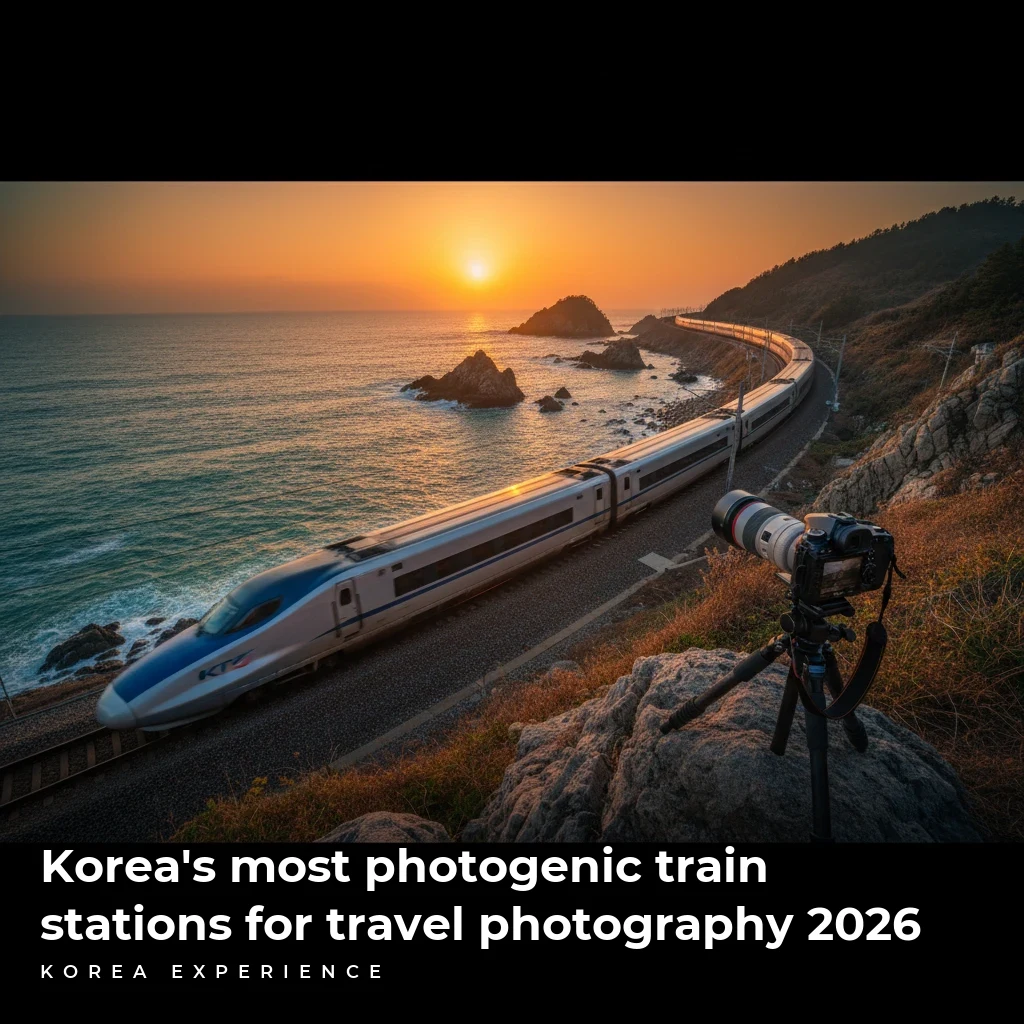
For travelers seeking the most photogenic train stations in Korea, the standout locations are undoubtedly Hwabon Station for its nostalgic 1930s charm, Jeongdongjin Station for being the closest station to the ocean in the world, and Kyeonghwa Station in Jinhae for its legendary cherry blossom tunnel. While Seoul Station offers architectural grandeur, the true photographic gems are often found in the countryside where retro aesthetics meet natural beauty.
The short answer: The top three must-visit stations for photographers are Jeongdongjin (Sunrise/Ocean), Hwabon (Retro/K-Drama), and Kyeonghwa (Spring Blossoms), with best visiting times varying by season.
Key Takeaways
- 1Jeongdongjin Station holds the Guinness World Record for being closest to the sea
- 2Kyeonghwa Station is best visited strictly between March 25 and April 5 for blossoms
- 3Hwabon Station charges a nominal ₩1,000 entry fee for platform access
- 4Book KTX tickets 1 month in advance for peak travel seasons like Chuseok or Spring
Korea’s railway history dates back over a century, leaving a legacy of stations that range from red-brick colonial structures to ultra-modern glass hubs and quaint countryside stops that feel frozen in time. For photographers and Instagram enthusiasts, these stations aren't just transit points—they are destinations in themselves.
Whether you are a K-drama fan looking to recreate a scene or a landscape photographer chasing the perfect sunrise, this guide covers the logistical details, lighting tips, and historical context for Korea’s most visually stunning railway stops.
1. Jeongdongjin Station: Where the Tracks Meet the Sea
Jeongdongjin Station is perhaps the most famous scenic station in Korea, renowned for holding the Guinness World Record as the railway station closest to the ocean. Located in Gangneung, Gangwon-do, the tracks are literally steps away from the sandy beach, offering a surreal composition where the steel rails frame the endless blue horizon of the East Sea.
Why It Is Photogenic
The primary allure here is the sunrise. The station was immortalized in the 1995 mega-hit drama Sandglass, making it a pilgrimage site for Koreans. The station building itself is small and retro, but the platform offers an unobstructed view of the ocean. Photography here is best done at dawn. The sun rising straight out of the water, aligning with the tracks and the iconic pine tree (the "Sandglass Pine"), creates a silhouette that defines Korean travel photography.
Jeongdongjin Station(정동진역)
Getting There and Costs
Reaching Jeongdongjin has become significantly easier with the introduction of the KTX-Eum.
- Transport: Take the KTX-Eum from Cheongnyangni Station in Seoul directly to Jeongdongjin Station.
- Time: Approximately 1 hour and 45 minutes.
- Cost: Around ₩28,300 for an economy seat.
- Alternative: The Mugunghwa train takes about 5 to 6 hours but offers a slower, more romantic coastline view for approximately ₩21,100.
Photography Tips
Use a wide-angle lens (16-35mm) to capture the expanse of the ocean against the tracks. If you are shooting the sunrise, a tripod is mandatory. Be aware that the wind on the east coast can be fierce, especially in winter, so bring stabilizing weights for your tripod.
Rail Bike Experience
Don't miss the Jeongdongjin Rail Bike. It costs ₩25,000 for a 2-seater and runs along the coast, allowing you to take dynamic moving shots of the ocean that aren't possible from the stationary platform.
2. Hwabon Station: A Journey Back to the 1930s
Located in Gunwi-gun, Daegu, Hwabon Station is often voted the most beautiful simple station (ganyi-yeok) in Korea. It is a fully operational station, though trains stop infrequently. The station building, renovated in 2011 to restore its 1930s appearance, features a charming green roof and wood-paneled exterior that screams nostalgia.
The "Little Forest" Vibe
Hwabon Station gained massive popularity after being featured in variety shows and resembling the aesthetic of the movie Little Forest. It embodies the "Sgol" (countryside) aesthetic that is trending among Korean Gen Z. The station features a distinct water tower nearby, which was used to supply water to steam locomotives in the past. The interior of the water tower has been converted into a small art installation space.
📋 Hwabon Station Details
Practical Information
- Location: Sanseong-myeon, Gunwi-gun, Daegu.
- Access: It is difficult to reach directly from Seoul. The best route is to take a KTX to Dongdaegu Station (approx. ₩43,500, 1 hr 50 min) and then transfer to a Mugunghwa train to Hwabon (approx. ₩2,600, 45 min).
- Admission: To walk onto the platform for photos, you must purchase a platform ticket for ₩1,000. This ticket itself is a souvenir, printed on hard cardstock reminiscent of 20th-century tickets.
The area surrounding the station includes "Mom & Dad Were Young," a retro museum converted from an old middle school, filled with artifacts from the 1970s and 80s. This makes Hwabon a perfect day trip for those interested in Korea's modern history. For more day trip ideas, check out our guide to best day trips from Seoul which includes similar hidden gems.
3. Kyeonghwa Station: The Cherry Blossom Tunnel
If you have seen a photo of a train pushing through a tunnel of falling cherry blossom petals in Korea, it was taken at Kyeonghwa Station in Jinhae. Technically, this is a defunct station; regular passenger service ceased in 2006. However, during the Jinhae Gunhangje Festival (Korea's largest cherry blossom festival), the tracks become a global hotspot.
The 800-Meter Flower Tunnel
The track is lined with cherry trees on both sides for about 800 meters. When the wind blows, it creates a "popcorn rain" effect. A stationary Mugunghwa train is permanently parked here for photo ops, allowing visitors to pose on the tracks without the danger of moving trains (though occasionally, a festival train may pass through slowly).
Timing is Everything
- Best Time: March 28 to April 5 (dates shift slightly yearly due to climate change).
- Crowd Control: This location receives over 2 million visitors during the festival. To get a clean shot, you must arrive at sunrise (around 6:00 AM). By 9:00 AM, the tracks are swarming with people.
Avoid the weekends at Kyeonghwa Station at all costs. Visit on a Tuesday or Wednesday morning. Also, bring a ladder or use a selfie stick extended high to shoot above the crowd for that endless tunnel effect.
Costs and Travel
Jinhae does not have a KTX station. You must take the KTX to Masan Station or Changwon Jungang Station (approx. ₩52,100 from Seoul) and then take a taxi (approx. ₩15,000) or local bus to Jinhae.
4. Culture Station Seoul 284: The Renaissance Revival
While the modern Seoul Station is a glass fortress, the Old Seoul Station, now known as Culture Station Seoul 284, is a masterpiece of eclectic Renaissance style. Completed in 1925 during the Japanese occupation, it served as the gateway to the capital for nearly 80 years before the new terminal opened in 2004.
Architectural Grandeur
The red brick exterior, the Byzantine-style central dome, and the stone craftsmanship make it unique in a city dominated by concrete. Inside, the central hall features 12 stone columns and a stained-glass ceiling that captures natural light beautifully. It now serves as a multi-cultural arts space, hosting exhibitions that often utilize the old VIP waiting rooms and the barbershop.
Evolution of Seoul Station
Original Opening
Opened as Gyeongseong Station in a temporary wooden building.
Renaissance Construction
Current red brick building completed.
KTX Era Begins
New glass terminal opens; old station closes for rail service.
Cultural Rebirth
Reopened as Culture Station Seoul 284.
Photography Advice
- Exterior: The best shot is from the Seoullo 7017 overpass. This elevated walking path allows you to shoot down at the station, capturing the contrast between the 1925 brick building and the modern skyscrapers behind it.
- Interior: Entry is usually free (depending on the exhibition). The interplay of light in the central dome is spectacular in the afternoon.
For those spending time in the capital, planning a route around Seoul Station is easy. Consult our 24-hour Seoul itinerary to see how to fit this into your schedule.
5. Former Gokseong Station: The Seomjin River Train Village
Located in Jeollanam-do, the former Gokseong Station is the centerpiece of the Seomjin River Train Village. This station is a perfectly preserved example of 1930s Japanese-style architecture. Unlike Hwabon, which is small, Gokseong feels like a movie set for a period drama.
The Steam Train Experience
The highlight here is not just the station building, but the operational steam train that runs from here to Gajeong Station. It is one of the few places in Korea where you can photograph a moving steam locomotive (albeit a diesel replica that puffs steam) against a backdrop of mountains and rivers.
💵 Gokseong Train Village Costs
Access to grounds & rose park
Seasonal Highlights
Gokseong is famous for its Rose Festival in May. Millions of roses bloom in the vast garden in front of the station, creating a European atmosphere. The contrast of red roses against the black steam train is a favorite subject for Korean photographers.
6. Yeonhwa Station: The Lotus Stop
Located in Chilgok, Gyeongsangbuk-do, Yeonhwa Station gets its name from "Lotus" (Yeonhwa). While trains no longer stop here for passengers, the station is surrounded by a massive lotus pond.
Why Visit?
In July and August, the pond explodes with blooming lotuses. The station itself is small and unmanned, giving it a desolate, peaceful vibe. Photographers flock here to capture the "Lonely Station" aesthetic. The juxtaposition of the lush green lotus leaves, pink flowers, and the fading station sign is poetic.
- Access: It is best reached by car or taxi from Daegu. It is roughly a 30-minute drive from downtown Daegu.
- Data Point: The lotus pond covers approximately 16,000 square meters.
7. Dorasan Station: The Northernmost Stop
Dorasan Station is visually sterile and modern, but its photogenic quality comes from its profound symbolism. It is the last station in South Korea on the Gyeongui Line, located within the Civilian Control Line (CCL). Signs in the station read "To Pyongyang."
The Atmosphere
The station is hauntingly empty. The architecture is grand, built to handle thousands of future commuters between North and South who never arrived. The vast, empty halls and the silent immigration counters make for powerful, storytelling photography.
Strict Entry Requirements
You cannot simply walk into Dorasan Station. You must book the DMZ Peace Train or join a guided tour. You MUST bring your passport. Photography is allowed inside the station, but strictly prohibited towards military installations outside.
8. Naju Station (Old): The Heritage Site
While the new Naju Station services the KTX, the Old Naju Station remains as a historical site. It is significant for the Gwangju Student Independence Movement. The exterior has unique green window frames and a wooden facade that differs from the standard Japanese colonial style seen elsewhere.
- Location: Naju-si, Jeollanam-do.
- Nearby: Naju is famous for its pear orchards. In April, the white pear blossoms surrounding the outskirts of the city offer another photographic opportunity.
Comparative Analysis of Train Travel Options
For photographers planning to visit multiple stations, understanding the cost efficiency of rail passes is crucial. Train travel in Korea is generally affordable, but costs can add up if you are taking the KTX frequently.
Rail Pass vs. Single Tickets
| Feature | Korail Pass (2-Day Select) | Single Tickets (Seoul-Busan x2) |
|---|---|---|
| Cost | ₩121,000 | Approx. ₩119,600 |
| Flexibility | Unlimited rides for 2 days | Fixed train only |
| Seat Type | Economy (2 res/day) | Economy |
| Best For | Visiting 3+ cities | Direct round trip |
If your itinerary involves hopping from Seoul to Hwabon, then to Busan, and back, the Korail Pass is superior. If you are only going to Jeongdongjin and back, single tickets are cheaper.
Photography Gear and Etiquette
Recommended Gear
- Lenses:
- 24-70mm f/2.8: The workhorse. Perfect for station interiors and architectural shots.
- 70-200mm f/2.8: Essential for Hwabon and Kyeonghwa stations to compress the background and make the tracks look longer.
- Fast Prime (35mm or 50mm f/1.4): For low-light shots inside old station waiting rooms.
- Filters: A Circular Polarizer (CPL) is essential to cut glare from station windows and deepen the blue of the sky at Jeongdongjin.
Etiquette (CRITICAL)
- Safety First: Never step onto active tracks. At stations like Hwabon, you are allowed to cross at designated points, but walking along the rails is illegal and dangerous. The fine for trespassing on tracks can exceed ₩250,000.
- Drone Laws: Most train stations are considered critical infrastructure. Flying drones directly over stations or tracks is generally prohibited without military clearance. Always check the "Ready to Fly" app before launching.
- Portrait Rights: Korea has strict privacy laws. If you are photographing the station and commuters are clearly visible, you must blur their faces before posting on social media, or risk legal issues.
Suggested Itinerary: The Retro Rail Journey
For travelers who want to experience the best of Korea's photogenic rails, here is a recommended route that balances luxury comfort with budget exploration.
48 Hours: The East Coast Rail Line
The Dualism Concept: Experience the best of both worlds — premium luxury moments paired with authentic budget-friendly experiences in one route.
First Class KTX to Gangneung
Spacious seating, leg rest
Mugunghwa to Jeongdongjin
Slow travel, coastal views
Sun Cruise Resort Stay
Hotel shaped like a ship on a cliff
Station Udon Noodles
Classic station platform meal
This route maximizes the visual impact of the East Sea while mixing the high-speed efficiency of KTX with the romance of slow trains.
Hidden Gems Near the Stations
When visiting these stations, you are often in areas famous for specific regional foods. Photography is hungry work.
- Near Seoul Station: Walk to Namdaemun Market for Kalguksu (Knife-cut noodles) Alley. A steaming bowl costs about ₩8,000.
- Near Jeongdongjin: Sundubu (Soft Tofu). The nearby village of Chodang in Gangneung is world-famous for tofu made with seawater.
- Near Busan Station: Dwaeji Gukbap (Pork Rice Soup). It is the soul food of Busan, costing around ₩9,000. Check our Busan seafood guide for more upscale options.
Practical Step-by-Step: Booking Your Train Photo Trip
Booking tickets in Korea can be competitive, especially for scenic routes on weekends.
📖 How to Secure Prime Train Seats
Step 1: Download Korail Talk
This is the official app. Set language to English.
Step 2: Identify Train Type
KTX is fast (good for getting there). Mugunghwa is slow (good for the experience and opening windows).
Step 3: Select Window Seat
On the KTX, Seat A and D are window seats. Avoid seats near the door if you want quiet.
Step 4: Payment
Foreign credit cards are accepted. You do not need to print the ticket; the QR code in the app is sufficient.
Statistical Look at Korean Rail Travel
Rail travel is surging in popularity among tourists. Here is why the infrastructure supports your photography hobby so well.
📊 Korea Rail Network 2026
Pros and Cons of Train Photography Trips
Is basing your trip around train stations worth it?
Rail Photography Travel
- ✓Access to remote, authentic countryside
- ✓Incredibly punctual transport
- ✓Stations themselves are free/cheap to enter
- ✗Carrying heavy gear on public transit
- ✗Rural trains run infrequently (check schedules!)
- ✗Limited lighting at night in rural stations
Conclusion
Korea's train stations offer a unique lens through which to view the country. They are intersections of history, nature, and modern life. From the salty air of Jeongdongjin to the blossom-filled tracks of Kyeonghwa, these locations promise photographs that stand out from the typical cityscapes of Seoul.
Remember that these are functioning public spaces. The best photo is one taken with respect for the local environment and the people who use these trains for their daily commute. Pack your camera, download the Korail app, and get ready to capture the romance of the Korean railway.
❓ Frequently Asked Questions
Have more questions?Contact us →
About the Author
Korea Experience Team
Written by the Korea Experience editorial team - experts in Korean medical tourism, travel, and culture with years of research and firsthand experience.
Explore more in Travel & Tourism
From Seoul's neon-lit streets to Jeju's volcanic landscapes — discover the best of Korea with insider travel tips, itineraries, and seasonal guides.
Browse All Travel & Tourism ArticlesContinue Reading
Explore more articles you might find interesting
Capture stunning sunsets in Seoul with our 2026 guide. Discover top locations like Namsan and Banpo Bridge, plus timing tips for the perfect shot.

Discover Seoul's stunning libraries in 2026. From the 13m shelves of Starfield to hidden Hanok gems. Free entry details and photo spots included.

Discover the ultimate photography spots in Korea for 2026. From Seoul's neon nights to Jeju's sunrises, get precise golden hour times and expert gear tips.

Discover 10 secret autumn spots in Korea away from crowds. Includes 2026 peak foliage dates, transport costs, and specific hiking routes for the perfect trip.
Discover the top day trips from Seoul for 2026. Includes KTX schedules, costs under ₩50,000, and travel times for Suwon, Nami Island, and the DMZ.
Explore iconic K-Drama filming locations across Korea. Discover Seoul's romantic spots, Jeju's scenic beauty, and Gyeonggi's diverse sets.