Laser treatment in Korea types and prices 2026 guide
Comprehensive guide to laser skin treatments in Seoul including costs for Fraxel, Pico, and Shurink, plus 2026 clinic recommendations.
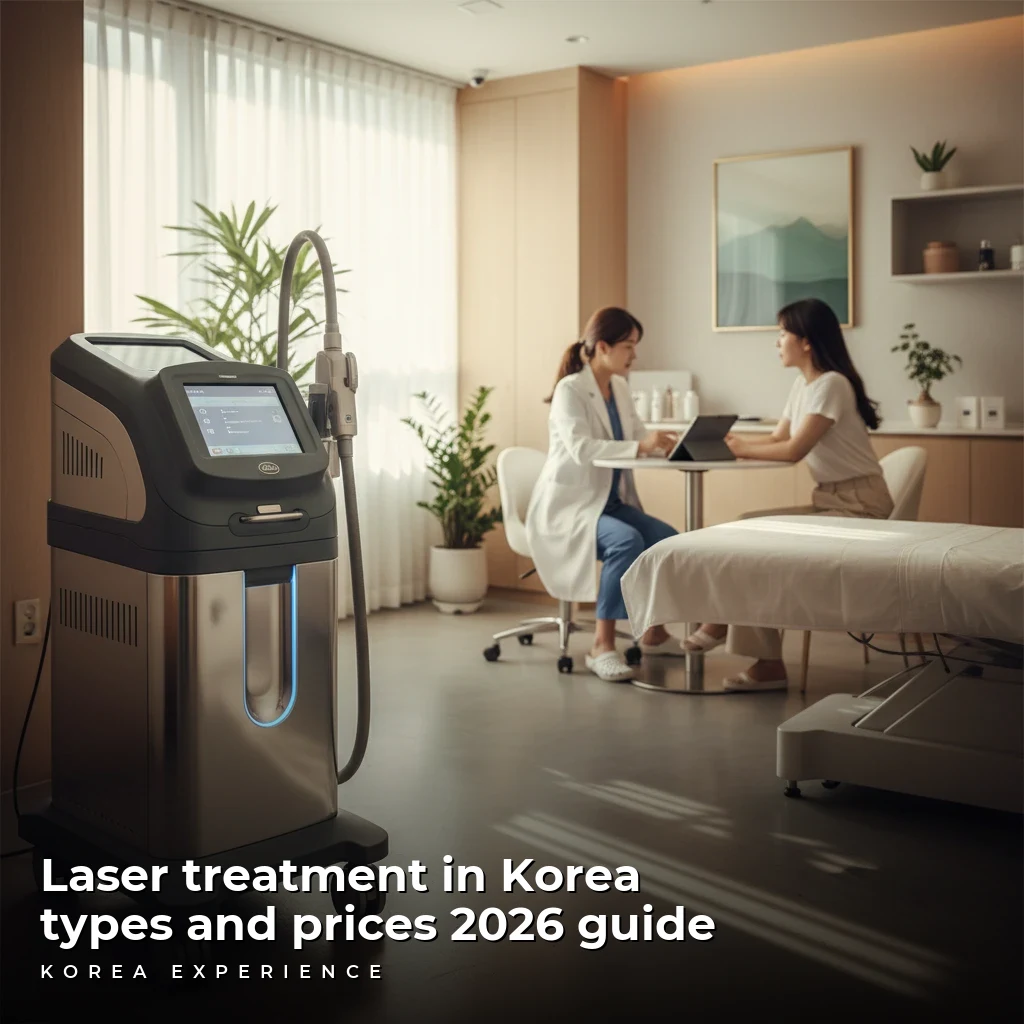
For international travelers seeking high-quality skincare at affordable rates, laser treatment in Korea offers a massive variety of options ranging from basic pigment toning to advanced anti-aging lifting, typically costing 30% to 50% less than equivalent procedures in the United States or Europe. The most common treatments in 2026 include "Laser Toning" for brightening (approx. ₩30,000–₩70,000 per session), Pico Laser for tattoo or scar removal (approx. ₩80,000–₩150,000), and lifting lasers like Shurink Universe (approx. ₩100,000 for 300 shots). Most clinics in major districts like Gangnam and Hongdae offer English services and tax refunds for tourists.
The short answer: Korea offers world-class laser technology like Potenza, Ulthera, and PicoSure at significantly reduced prices compared to the West, with walk-in friendly "factory clinics" making treatments accessible for under $50 USD per session.
Key Takeaways
- 1Basic laser toning starts as low as ₩30,000 ($22 USD) in competitive areas like Gangnam.
- 2Shurink Universe (Korean HIFU) is the most popular budget lifting treatment in 2026.
- 3Most treatments require 3 to 5 days of downtime, though non-ablative options allow immediate makeup.
- 4Foreign passport holders are eligible for a 7-10% VAT refund on cosmetic procedures over ₩30,000.
Why Korea is the Global Capital of Laser Skincare
South Korea, particularly Seoul, has earned the moniker of the "Plastic Surgery Capital of the World," but in 2026, non-invasive laser treatments have actually surpassed surgical procedures in volume. The sheer density of clinics—with over 500 dermatology and aesthetic clinics concentrated just within the Gangnam-gu district—has created a hyper-competitive market. This competition drives prices down while forcing clinics to constantly upgrade to the latest equipment to attract customers.
Unlike in many Western countries where a laser treatment is a luxury service booked weeks in advance, in Korea, it is viewed as routine maintenance, similar to a haircut. It is not uncommon for Seoul residents to visit a clinic every 1 to 2 weeks for "management" (gwan-li). This cultural normalization means that efficiency is paramount. A typical "factory style" clinic can process a patient from registration to post-procedure mask in under 75 minutes.
📊 Market Statistics 2026
For the international traveler, this presents a unique opportunity. You can access FDA and KFDA-approved technology—such as the Lutronic Genius, Cynosure PicoSure, or Solta Thermage FLX—at a fraction of the cost back home. For example, a full-face Thermage FLX (600 shots) treatment that might cost $3,500 in New York can often be found in Seoul for approximately ₩2,200,000 ($1,650), representing a savings of nearly 50% even before the tax refund.
Understanding the "Factory Clinic" vs. "Dermatologist"
Before diving into specific laser types, it is critical to understand the two main categories of providers in Korea, as this dictates both the price and the experience.
Factory Clinics (Network Clinics)
These are large chain clinics (brands like Muse, Toxnfill, PPEUM) that focus on volume.
- Price: Extremely low (e.g., ₩29,000 for laser toning).
- Consultation: Often done by a "counselor" (salesperson) rather than the doctor. The doctor enters the room only to perform the laser.
- Service: Self-service face washing is common. Wait times can be long (30-60 minutes) even with a reservation.
- Best for: Simple, routine procedures like Botox, hair removal, or basic toning where the protocol is standard.
Board-Certified Dermatologists (Skin Clinics)
These are private practices run by specialists who have passed the rigorous Korean Board of Dermatology exams (only about 2% of doctors in Korea).
- Price: Higher (e.g., ₩150,000+ for laser toning).
- Consultation: 1-on-1 with the doctor who analyzes your skin in depth.
- Service: Full service with private rooms and estheticians who wash your face.
- Best for: Complex skin issues like severe acne, melasma, or sensitive skin reactions.
Clinic Type Comparison
| Feature | Factory Clinic | Specialist Dermatologist |
|---|---|---|
| Avg. Toning Price | ₩30,000 - ₩50,000 | ₩100,000 - ₩200,000 |
| Consultation | Sales Counselor | Medical Doctor |
| Wait Time | 30-60 mins | 0-15 mins |
| Equipment | Standard Models | High-End / Latest |
For detailed recommendations on where to go, check out our guide to the best Korean skin clinics in Gangnam 2026.
Types of Laser Treatments: A Detailed Breakdown
The terminology in Korean clinics can be confusing. Here is a breakdown of the most popular laser categories available in 2026.
1. Pigmentation and Brightening (Toning)
"Laser Toning" is the most ubiquitous term you will hear. It generally refers to using a Q-Switched Nd:YAG laser at a low energy setting to gently break up pigment without damaging the skin surface.
- Common Machines: Revlite SI, Spectra, PicoSure, PicoWay.
- Target: Melasma, sun spots, uneven skin tone, general brightening.
- Pain Level: 2/10 (feels like warm rain or light snapping).
- Downtime: None. Immediate makeup is possible.
- Frequency: Koreans typically do this weekly for 10 weeks for "glass skin" results. For travelers, a stronger single session (often called "Whitening Laser") might be recommended, though it carries higher risks of temporary redness.
Pico Laser has largely superseded traditional nano-second lasers. "Pico" refers to picosecond pulse duration (one trillionth of a second). Because the pulse is so fast, it shatters pigment into dust-like particles using photo-acoustic energy rather than heat, reducing the risk of burns.
📋 Pico Toning Facts
2. Acne and Scar Treatment
Korea is famous for its aggressive and effective acne treatments. If you are struggling with active acne or deep rolling scars, the treatments here are often more varied than in the West. For a deeper dive, read about acne scar treatment options in Korea.
-
Potenza / Sylfirm X (RF Microneedling): These are currently the gold standard in 2026. They combine microneedling with radiofrequency energy. The needles penetrate the skin and release heat, killing sebaceous glands (stopping acne) and stimulating collagen (filling scars).
- Price: ₩250,000 – ₩400,000 per session.
- Pain: 6/10 (Numbing cream is mandatory).
-
Fraxel / CO2 Fractional: The "classic" resurfacing laser. It punches microscopic holes in the skin to force regeneration. It is highly effective for texture but has significant downtime (5-7 days of scabbing).
- Price: ₩100,000 – ₩200,000.
-
Agnes: A Korean invention specifically for recurring acne. It uses a micro-insulated needle to selectively destroy specific oil glands. Once destroyed, acne does not return to that specific pore.
Downtime Alert
Strong acne lasers like Fraxel or CO2 can leave your face red and scabbing for 5 to 7 days. Do not schedule this immediately before a special event or photoshoot.
3. Lifting and Tightening (HIFU and RF)
If your goal is anti-aging, V-line contouring, or fixing sagging jowls, this is the category for you.
-
Shurink Universe: The Korean version of Ultherapy (HIFU - High Intensity Focused Ultrasound). It is much cheaper and slightly less painful than the American original, though the effects may not last as long (3-4 months vs. 1 year). It is incredibly popular for a quick "V-line" fix.
- Price: ₩80,000 – ₩150,000 for 300 shots.
-
Ulthera: The American original. It includes ultrasound imaging to see exactly where the energy is being delivered, making it safer and more precise.
- Price: ₩1,000,000 – ₩1,500,000 for 300 shots.
-
InMode: A two-step RF treatment that melts fat (FX mode) and tightens skin (Forma mode). It is excellent for double chins. Note that the FX mode uses suction, which often leaves visible bruising (hickeys) on the jawline for 3-5 days.
4. Vascular Lasers (Redness/Rosacea)
For those with "red face," rosacea, or visible spider veins.
- Excel V: One of the most powerful vascular lasers. It cools the skin while delivering energy to collapse red blood vessels.
- V-Beam: Another gold standard for redness.
- Price: ₩150,000 – ₩300,000 per session.
Comprehensive Price Analysis 2026
Pricing in Korea is often transparent, with menus displayed on clinic websites or apps like Gangnam Unni. However, foreigners often face a "dual price" system in smaller clinics, whereas major network clinics usually have fixed pricing for everyone.
Below is a dualism price comparison for budget travelers vs. luxury seekers.
💵 Laser Price Comparison (Per Session)
PicoSure Pro + Genesis + Cryo soothing care by Board Certified MD
Genuine tip verification + sleeping anesthesia option
Basic Pico Toning (10 min laser only)
Standard mode, topical numbing cream only
Understanding "Event" Prices
When you see advertisements for "₩9,900 Laser Toning," this is almost always a "First Time Visit Event" price. It is legitimate, but valid only once. Subsequent treatments will revert to the standard price (usually 3-4x higher). If you are clinic-hopping, you can take advantage of these deals, but you lose the benefit of a doctor tracking your progress.
The Process: What to Expect Step-by-Step
Navigating a Korean clinic can be intimidating due to the language barrier and speed. Here is a typical timeline for a visit to a popular clinic like Muse or Lienjang.
Clinic Visit Timeline
Registration
Scan passport, fill out forms on iPad (English usually available).
Consultation
Discuss concerns with a counselor. They will recommend a package. Be firm on your budget.
Cleansing
Store bag in locker. In factory clinics, you wash your own face at a vanity station.
Numbing
Staff applies anesthetic cream if needed. You wait in a common area with cling wrap on your face.
Procedure
Move to laser room. Doctor confirms treatment name and performs laser (5-15 mins).
Soothing
Modeling mask pack applied to cool skin (sometimes an add-on cost).
Always bring your passport! Even if you are a resident, you need ID. For tourists, the passport is mandatory to generate the Tax Refund receipt. Without it, you pay the full 10% VAT.
Top Areas for Laser Treatments
While clinics exist everywhere, three neighborhoods stand out for international visitors.
Gangnam Station (Yeoksam-dong)
The epicenter of factory clinics.
- Vibe: Fast, crowded, efficient, cheapest prices.
- Target: Budget travelers, students, those wanting quick Botox/fillers.
- Access: Gangnam Station (Line 2/Sinbundang Line), Exits 10, 11, and 12.
Sinsa-dong / Garosu-gil
The hub for plastic surgery and higher-end dermatology.
- Vibe: Trendy, upscale, more English-speaking staff.
- Target: People looking for specific aesthetic changes or major surgeries.
- Access: Sinsa Station (Line 3/Sinbundang Line).
Hongdae (Mapo-gu)
A younger crowd with competitive pricing.
- Vibe: Hip, approachable, less intimidating than Gangnam.
- Target: Younger travelers, those staying in Hongdae guesthouses.
- Access: Hongik Univ. Station (Line 2).
Representative Factory Clinic Style(공장형 피부과)
Safety, Side Effects, and Aftercare
Despite the "lunch break procedure" reputation, lasers are medical devices. Burns, hyperpigmentation (PIH), and infections are possible.
Post-Inflammatory Hyperpigmentation (PIH)
Asian skin is prone to PIH. If a laser is too strong, the skin reacts by producing more pigment, leaving dark brown spots. This is why Korean doctors often prefer "low and slow" toning over 10 sessions rather than one aggressive blast.
Sun Protection is Non-Negotiable
After any laser treatment, your skin barrier is compromised. The UV index in Korea can be high, even on cloudy days. You must apply SPF 50+ PA++++ every 2-3 hours. Failure to do so can reverse the effects of the laser or cause permanent dark spots. For product recommendations, see our best Korean sunscreen guide.
📖 Post-Laser Care Routine
Step 1: Immediate Cooling
Use a sheet mask (specifically 'Cica' or 'Teatree') nightly to reduce heat.
Step 2: Moisturize
Use a barrier repair cream containing ceramides or panthenol.
Step 3: Sun Protection
Apply sunscreen liberally. Avoid direct sunlight between 12 PM and 2 PM.
Pain Management
Most clinics offer topical numbing cream (lidocaine) for free or a small fee (₩5,000). For painful procedures like Ulthera or Thermage, some clinics offer "sleeping anesthesia" (sedation), similar to what is used during a gastroscopy. This requires fasting for 4-6 hours beforehand and usually costs an extra ₩100,000 – ₩200,000.
Combining Treatments: The "Menu" Approach
Korean clinics excel at "combination therapies." Instead of selling just one laser, they will package treatments that work synergistically.
- The "All-Kill" Package: Often includes IPL (for surface pigment) + Toning (for deep pigment) + Vitamin C Ampoule.
- The "V-Line" Package: Shurink (HIFU lifting) + Jaw Botox (muscle reduction) + Fat Dissolving Injection.
- The "Glass Skin" Package: Aqua Peel (cleaning pores) + Pico Toning + Rejuran Healer (salmon DNA injection for skin barrier).
Rejuran Healer is particularly worth noting. It is not a laser but a skin booster injection that is painful but incredibly effective for repairing skin damaged by lasers or age. Many travelers combine Rejuran with laser treatments for maximum effect. You can read more about injectable options in our anti-aging treatments guide.
Booking and Apps
While you can just walk in, waiting times can be horrendous (2+ hours). It is highly recommended to book in advance.
- KakaoTalk: Almost every clinic has a KakaoTalk channel. You can message them in English (many use translation software effectively).
- Gangnam Unni (App): This is the holy grail of Korean cosmetic surgery apps. While the interface is primarily Korean, using a screen translator allows you to see real prices and reviews. The prices listed on the app are often "event prices" that you can claim.
- Instagram: Many clinics targeting foreigners run their booking via DM. Look for handles ending in
_globalor_eng.
Medical Disclaimer
Medical Disclaimer
The information provided in this article is for educational purposes only and does not constitute medical advice. Laser treatments carry risks including burns, scarring, and infection. Always consult with a qualified medical professional before undergoing any procedure. In case of a medical emergency in Korea, dial 119. For medical consulting in English, dial 1339.
FAQ: Common Questions About Laser Treatment in Korea
❓ Frequently Asked Questions
Have more questions?Contact us →
Conclusion
Getting laser treatment in Korea is a fantastic way to invest in your skin without breaking the bank. The combination of advanced technology, skilled practitioners, and competitive pricing makes Seoul a premier destination for medical tourism. Whether you opt for a quick 15-minute toning session in Gangnam or a full-day luxury lifting course in Cheongdam, the key is to manage your expectations regarding downtime and sun care.
Remember that "glass skin" is rarely achieved in a single day; it is the result of consistent maintenance. However, a trip to Korea is the perfect place to kickstart that journey. For more insights on blending beauty treatments with your travel itinerary, check out our guide to 24-hour Seoul itineraries.
About the Author
Korea Experience Team
Written by the Korea Experience editorial team - experts in Korean medical tourism, travel, and culture with years of research and firsthand experience.
⚠️ Medical Disclaimer
The information provided on this website is for general informational purposes only and does not constitute medical advice. Always consult with qualified healthcare professionals before making any medical decisions.
Explore more in Medical Tourism
World-class medical procedures at competitive prices. From plastic surgery and dermatology to dental care and health checkups — your complete guide to medical tourism in Korea.
Browse All Medical Tourism ArticlesContinue Reading
Explore more articles you might find interesting
Compare 2026 costs for Ultherapy ($800+), Shurink ($100+), and Thermage in Seoul. Expert guide to pain levels, results, and choosing the right clinic.
Comprehensive guide to vaginal rejuvenation in Seoul 2026. Compare costs (saving 30-50%), English-speaking clinics, laser treatments, and surgical options.
Compare Ultherapy, Thermage, and Shurink costs and results. Discover why Seoul offers treatments at 30-50% less than global rates with our 2026 guide.
Unlock the secrets to brighter skin in Korea. Compare Glutathione IV drips and topical treatments, including costs, effectiveness, and safety in Seoul clinics.
Compare scar treatment options silicone sheets vs laser in Korea. We analyze costs, efficacy, and why Seoul is the global capital for skin repair in 2026.
A comprehensive guide to FFS, VFS, and top surgery in Seoul for 2026. Includes costs, recovery times, and clinic recommendations for international patients.