Rent a car in Korea 2026: International license and navigation guide
Complete 2026 guide to renting a car in Korea. Learn IDP rules, Naver Map navigation, costs starting at ₩60,000/day, and specific driving laws.
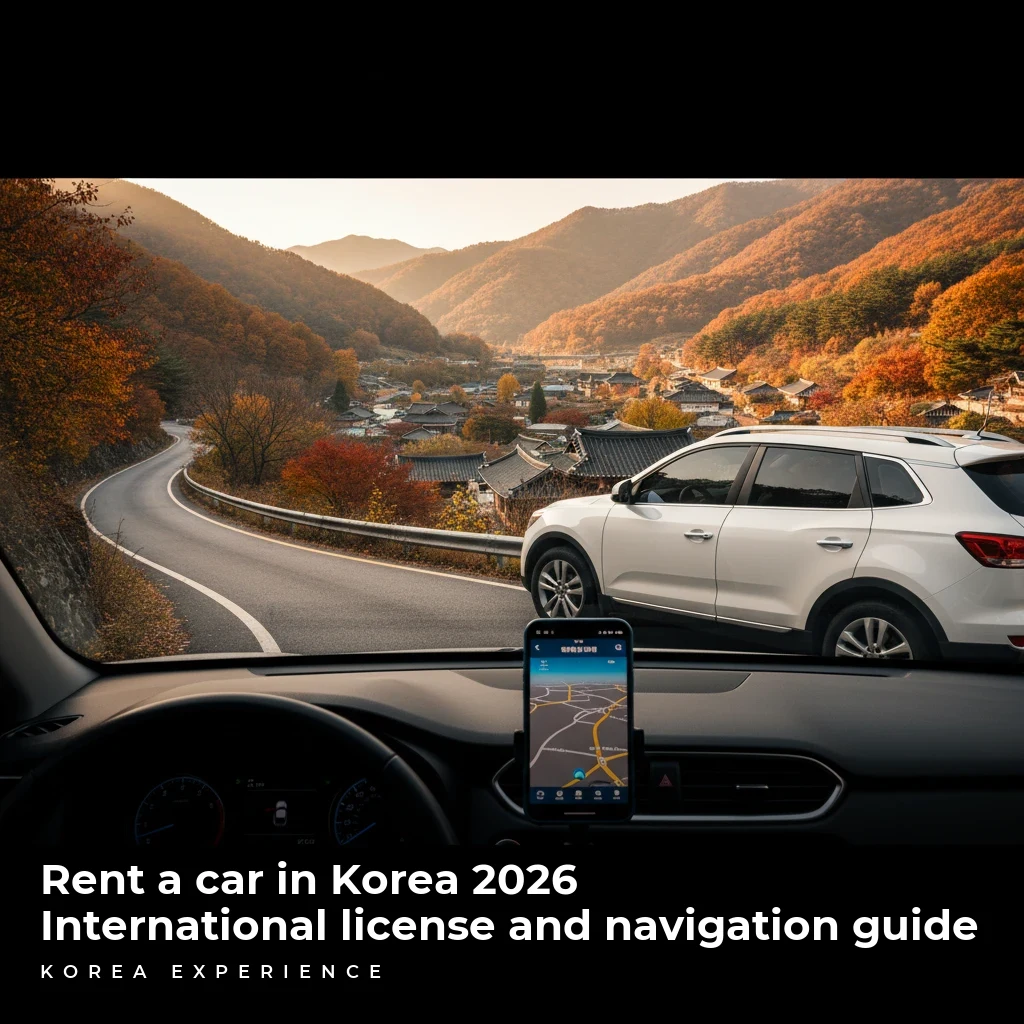
Renting a car in South Korea offers a level of freedom that public transportation simply cannot match, especially when exploring the coastal roads of Jeju Island, the mountainous terrain of Gangwon-do, or the historic sites of Gyeongju. However, driving in Korea comes with a unique set of challenges for international visitors, ranging from strict International Driving Permit (IDP) requirements to navigation apps that function differently than the Google Maps ecosystem you might be used to.
The short answer: To rent a car in Korea in 2026, you strictly need a physical International Driving Permit (1949 Geneva Convention) or a specialized license from an eligible country, a valid passport, and a credit card. You must use Naver Map or KakaoMap for navigation as Google Maps does not offer turn-by-turn directions.
Key Takeaways
- 1You must hold a physical International Driving Permit (IDP) issued under the 1949 Geneva Convention; digital versions are rarely accepted.
- 2Google Maps does not work for driving navigation; download Naver Map and search destinations by phone number.
- 3Rental costs for a standard compact car average ₩70,000–₩90,000 per day with full insurance coverage.
1. Prerequisites: License and Documentation
Before you even book a flight, you must ensure your paperwork is in order. South Korean rental agencies are notoriously strict about documentation. If you arrive at the counter without the exact required documents, you will be denied the car, regardless of your reservation status.
The International Driving Permit (IDP)
The most critical document is the International Driving Permit. Korea is a signatory to the 1949 Geneva Convention.
CRITICAL IDP WARNING
Korea generally does NOT accept IDPs issued under the 1968 Vienna Convention. You must check the front of your IDP booklet to ensure it references the "1949 Geneva Convention on Road Traffic." If you are from a country that issues both (like some European nations), specifically request the 1949 version.
Additionally, digital IDPs are not valid in Korea. You must present the physical gray booklet. The name on your IDP, your domestic driver's license, your passport, and your credit card must match exactly.
Validity and Age Requirements
- Driver's License: You must have held your domestic license for at least one full year.
- Age: The minimum age for renting is typically 21 years old for compact cars. For luxury vehicles, SUVs, or vans (more than 9 seats), the minimum age often jumps to 26 years old.
- Credit Card: A credit card in the main driver's name is mandatory for the deposit. Debit cards are frequently rejected at rental counters, even if they have a Visa/Mastercard logo.
📋 Rental Requirements at a Glance
2. Choosing a Rental Company
In 2026, the Korean car rental market is dominated by two major conglomerates, along with several smaller budget options. For international travelers, sticking to the major companies is highly recommended due to English support and reliable vehicle maintenance.
Major Rental Agencies
- Lotte Rent-a-Car: The market leader with the largest fleet. They have a seamless English website and dedicated foreign traveler desks at Incheon, Gimpo, and Jeju airports. They are generally pricier but offer the highest service standard.
- SK Rent-a-Car: The primary competitor to Lotte. Their fleet is modern, and they offer competitive rates. Their English support is solid, though their website UI can sometimes be slightly less intuitive than Lotte's.
- International Brands (Hertz/Avis): These usually operate through partnerships. For example, Hertz is often fulfilled by Lotte. Booking through the global Hertz site is possible, but you may pay a premium compared to booking directly with the Korean partner.
Rental Agency Comparison 2026
| Feature | Lotte Rent-a-Car | SK Rent-a-Car | Local Budget Agencies |
|---|---|---|---|
| English Website | ✅ | ✅ | ❌ |
| Airport Counter | ✅ | ✅ | Shuttle Required |
| Avg Daily Rate (Compact) | ₩90,000 | ₩85,000 | ₩60,000 |
| Foreign Credit Card | Accepted | Accepted | Hit or Miss |
Booking Platforms
While you can use aggregators like Rentalcars.com or Klook, booking directly usually ensures better communication regarding changes. If you are planning a trip to specialized areas, checking our guide on best day trips from Seoul can help you decide if a rental is necessary for the whole trip or just a day.
3. The Navigation Challenge: Naver Map vs. Google Maps
This is the single most common complaint from travelers driving in Korea. Due to security laws regarding map data exports, Google Maps does not provide turn-by-turn driving navigation in South Korea. It will show you bus routes and walking paths, but it will not talk to you while you drive.
You must download and learn to use a local app.
Naver Map (The Gold Standard)
Naver Map is the most foreigner-friendly option in 2026.
- English Interface: The menus are in English.
- English Voice: You can toggle the navigation voice to English.
- Search: It has the best database of English place names.
KakaoMap
KakaoMap is the main competitor. It is excellent and integrates well if you use KakaoTalk, but the English search functionality is slightly less forgiving of spelling errors than Naver.
The Magic of Phone Number Search
Typing English addresses in Korea can be a nightmare due to Romanization variations (e.g., "Busan" vs "Pusan"). The secret is Phone Number Search. In Naver Map, simply enter the venue's phone number (e.g., 02-3700-3900 for Gyeongbokgung) into the search bar. It will pinpoint the location with 100% accuracy.
📖 How to Configure Naver Map for English Navigation
Step 1: Download & Install
Download 'Naver Map' from the App Store or Google Play store.
Step 2: Set Language
Open Menu (≡) > Settings (gear icon) > Language > English. The app will restart.
Step 3: Set Navigation Voice
Go to Settings > Navigation > Voice > English. This ensures the spoken directions are in English.
Step 4: Test a Route
Search for 'Incheon Airport' to confirm the map displays in English and the voice guidance works.
For those relying on apps for their entire trip, having a robust data connection is vital. Consider reading about staying connected with our guide to Korea SIM cards.
4. Cost Breakdown: What to Expect
Budgeting for a car rental involves more than just the daily rate. Here is a realistic breakdown of costs for 2026.
Rental Fees
- Compact Car (Avante/K3): ₩70,000 – ₩100,000 per day.
- Mid-size Sedan (Sonata/K5): ₩100,000 – ₩140,000 per day.
- SUV (Tucson/Santa Fe): ₩130,000 – ₩180,000 per day.
- Jeju Island Rates: Prices in Jeju fluctuate wildly. In peak summer (July/August), rates can triple. In low season (November), you might find cars for as low as ₩30,000 per day.
Insurance (CDW)
Never skip the Collision Damage Waiver (CDW). Korean roads are busy, and minor scrapes are common in tight parking garages.
- Partial Waiver: You are liable for a deductible (usually ₩300,000 to ₩500,000). Cost: ~₩15,000/day.
- Full Waiver (Super CDW): Zero deductible. Highly recommended for peace of mind. Cost: ~₩25,000/day.
Fuel Costs
- Gasoline (Hwiballyu): Approximately ₩1,650 per liter.
- Diesel (Gyeongyu): Approximately ₩1,550 per liter.
- LPG: Common in rental cars, cheaper at roughly ₩980 per liter, but burns faster.
💵 Total Estimated Cost (3-Day Rental)
Kia K3, strictly necessary coverage, excludes gas/tolls.
Tolls
Korea has an extensive network of expressways, and almost all of them are toll roads. A drive from Seoul to Busan can incur roughly ₩30,000 in tolls one way.
- Hi-Pass: Most rental cars come equipped with a "Hi-Pass" device (similar to E-ZPass). You can drive through the blue lanes at toll booths without stopping. The rental company will charge the accumulated toll amount to your credit card upon return. Always check if your car has this before entering the Hi-Pass lane.
5. Driving Rules and Etiquette
Driving in Korea is generally safe, but the flow of traffic can feel aggressive to drivers from North America or Northern Europe.
The "Right Turn on Red" Rule
This law changed significantly in 2023 and is strictly enforced in 2026.
- If the traffic light facing you is RED, you must come to a COMPLETE STOP at the stop line.
- Look for pedestrians. If a pedestrian is crossing or about to cross, you must wait.
- If the crosswalk is clear, you may proceed with the right turn slowly.
- Green Arrow: If there is a dedicated right-turn traffic light, you must follow it strictly.
📊 Road Safety Stats 2026
Speed Cameras
Korea relies heavily on automated speed enforcement rather than police patrols. Cameras are everywhere—fixed boxes, overhead gantries, and "average speed zones" where your speed is calculated over a 10km distance.
- Navigation Warnings: Naver Map will beep incessantly to warn you of approaching cameras. Listen to the app. It knows where they are better than you do.
- Tolerance: There is essentially zero tolerance. 110km/h means 110km/h.
The "Hazard Light" Culture
This is an essential piece of cultural knowledge. In Korea, hazard lights (blinkers) are used to say "Thank You" or "I'm Sorry."
- If someone lets you cut into a busy lane, blink your hazards 2-3 times.
- If you accidentally cut someone off or brake hard, blink your hazards to apologize.
- It is a universal language on Korean roads that diffuses road rage instantly.
6. Parking: The Biggest Headache
If you are staying in Seoul, we generally recommend not renting a car for city driving. Parking is scarce and expensive.
- Cost: Gangnam parking can easily reach ₩6,000 to ₩8,000 per hour.
- Mechanical Parking: Many buildings use automated mechanical towers. You drive your car onto a pallet, get out, and the machine lifts it away. Note that large SUVs often do not fit in older mechanical towers.
If you are looking to explore the city without a car, check our 24-hour Seoul itinerary for efficient transit routes.
7. Electric Vehicles (EVs)
Korea is an EV paradise in terms of infrastructure. Renting an EV (like the IONIQ 5 or 6) is a great option to save on fuel.
- Charging Standard: DC Combo (CCS1) is the standard fast-charging port.
- Availability: Highway rest stops ("Hyugeso") are extremely well-equipped with high-speed chargers.
- Charging Cards: Rental agencies will often provide a charging card (similar to the Hi-Pass) that allows you to tap and charge, with the cost billed later.
"If you rent an EV in Jeju, you're in luck. The island has the highest density of chargers in the world. However, if you rent a Tesla, be careful. Tesla uses a proprietary connector. Ensure your rental agency provides the 'DC Combo Adapter' so you can use public chargers, otherwise, you are limited to Superchargers which can be crowded."
8. Renting in Jeju Island
Jeju is the exception to the "don't drive in cities" rule. In Jeju, a car is almost mandatory to see the best sites efficiently.
- Rental Hub: Jeju International Airport has a massive "Rent-a-Car House." You take a shuttle from Gate 5 to the rental complex.
- Speed Limits: Jeju has lower speed limits than the mainland (often 50km/h on main roads). Cameras are frequent.
- Insurance: Because 90% of tourists rent cars here, minor accidents are common. Take the full insurance.
For those planning a trip south, combining a drive with a food tour is popular. See our Busan seafood guide if you plan to ferry your car from Jeju to the mainland.
9. Breakdown and Emergencies
In the event of an accident:
- Stop immediately. Do not move the car unless it is blocking traffic dangerously (and even then, take photos first).
- Photos: Take pictures of the license plates, the damage, and the position of the cars.
- Call the Rental Company: There will be a sticker on the dashboard or windshield with the emergency number.
- Police: Dial 112 for Police. Translation services are available.
- Ambulance: Dial 119 for Medical Emergencies.
Accident Settlement Scams
If you have a minor accident with another driver, they might suggest settling with cash on the spot to avoid insurance. As a foreigner, do not do this. Insist on calling your rental company and the police. You have insurance for a reason; let the agency handle it.
10. Step-by-Step Rental Process Timeline
The Rental Journey
Reserve Online
Book 2-3 weeks in advance via Lotte or SK website. Print your voucher.
Counter Check-in
Present Passport, IDP (Geneva), and Credit Card. Sign contract.
Vehicle Inspection
Take video/photos of every existing scratch. Check gas level.
Tech Check
Connect Bluetooth, set Naver Map to English, check Hi-Pass card insertion.
Drop-off
Refill gas to original level. Pay tolls and any extra fees at the counter.
11. FAQ: Common Questions
❓ Frequently Asked Questions
Have more questions?Contact us →
Final Thoughts: Is it worth it?
Renting a car in Korea unlocks the "real" Korea found in the countryside—the hidden temples in the mountains, the coastal drives of the East Sea, and the ability to visit rest stops that are destinations in themselves. While the initial learning curve with navigation and IDP requirements can be steep, the freedom to explore at your own pace makes it a worthwhile investment for 2026 travelers.
If you are looking to save money while traveling, check out our guide on how to see Seoul for $50 a day to balance your budget after the car rental expense.
Safe driving!
About the Author
Korea Experience Team
Written by the Korea Experience editorial team - experts in Korean medical tourism, travel, and culture with years of research and firsthand experience.
Explore more in Travel & Tourism
From Seoul's neon-lit streets to Jeju's volcanic landscapes — discover the best of Korea with insider travel tips, itineraries, and seasonal guides.
Browse All Travel & Tourism ArticlesContinue Reading
Explore more articles you might find interesting
In 2026, you can absolutely rent a car in Jeju without an ARC—but only if you have an International Driving Permit (IDP) and navigate the new 'e-Arrival...
Complete guide to renting a car in Korea. Costs from ₩60,000/day, IDP requirements, and navigating Seoul to Jeju safely in 2026.
Can foreigners rent big bikes in Korea? A complete guide to licenses, the highway ban, costs (starting ₩50,000/day), and top routes for 2026.
A complete step-by-step guide to exchanging your foreign driving license in South Korea, including document requirements, costs, and exam details.
A complete guide to exchanging your foreign license or passing the Korean driving test in 2026, including costs, documents, and mobile IC card details.
Master Seoul transit in 2026. Learn why T-money costs 4,000 KRW, how to rent 1,000 KRW bikes without an ARC, and the truth about the Climate Card for tourists.