Korea photography guide: Best spots and golden hour times 2026
Discover the ultimate photography spots in Korea for 2026. From Seoul's neon nights to Jeju's sunrises, get precise golden hour times and expert gear tips.
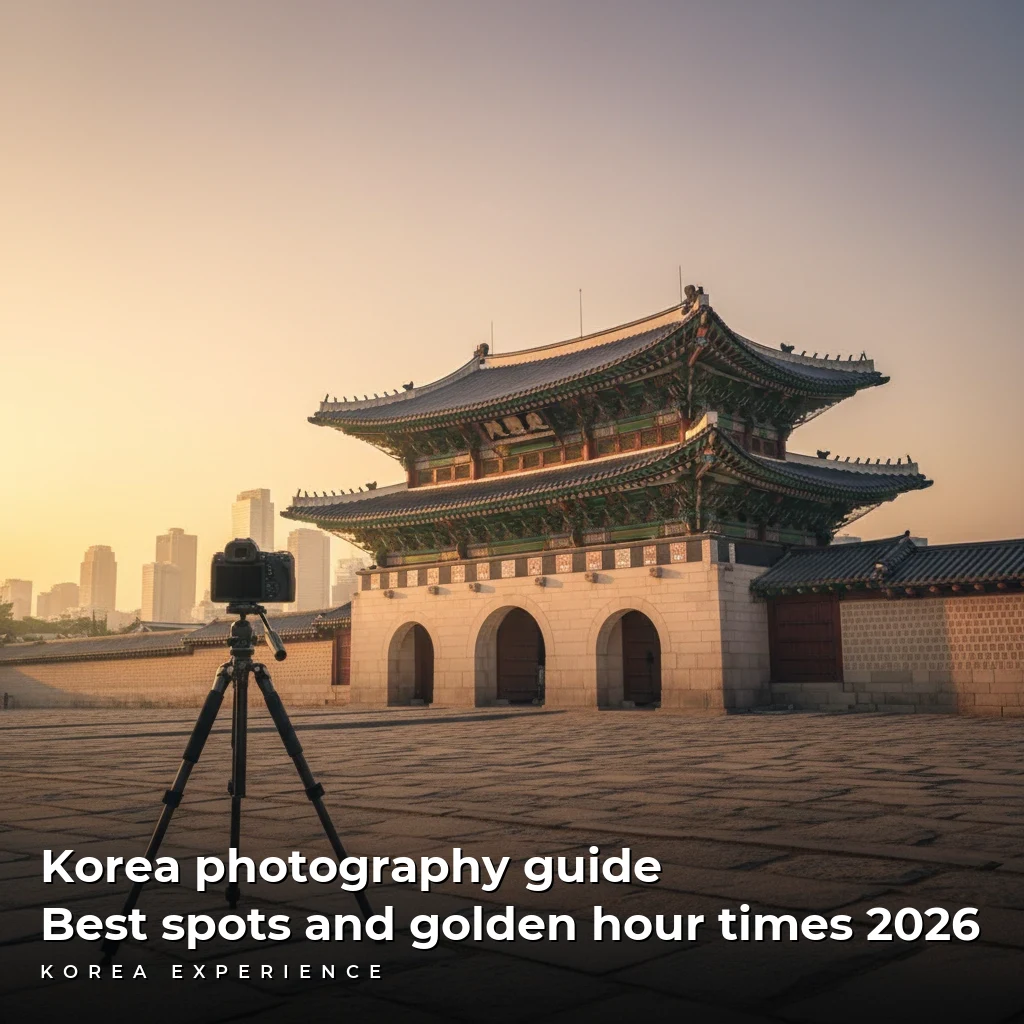
Capturing the essence of South Korea through a lens requires more than just a good camera; it requires an intimate understanding of light, timing, and the unique juxtaposition of ancient tradition against hyper-modern architecture. Whether you are chasing the elusive "blue hour" over the Han River or waiting for the morning mist to clear at a 600-year-old temple, Korea offers a visual density that is rare in other parts of the world. However, the window for perfect light can be fleeting, and navigating the dense urban sprawl to find the perfect vantage point takes planning.
The short answer: The best photography window in Korea is generally October to early November for high visibility and vibrant colors. In 2026, the prime golden hour in Seoul averages around 5:40 PM in spring and 5:20 PM in autumn. For the best shots, combine Gyeongbokgung Palace at 9:00 AM (for fewer crowds) with N Seoul Tower at sunset.
Key Takeaways
- 1Golden hour in Seoul shifts by roughly 1-2 minutes daily; verify specific sunset times for your travel month.
- 2Strict privacy laws exist in Korea; blurring faces of strangers in street photography is often legally required.
- 3Drone photography is heavily restricted in Seoul due to military zones; always use the 'Ready to Fly' app to check clearance.
Understanding Light in Korea: The Golden and Blue Hours
Photography is painting with light, and the quality of light in Korea changes drastically depending on the season and air quality. Before diving into specific locations, it is crucial to understand the atmospheric conditions you will face. Korea experiences a phenomenon often referred to as "Yellow Dust" in the spring (March-May), which can create a hazy, flat look in landscape photos. Conversely, the autumn months (September-November) offer the crispest air, allowing visibility up to 20 kilometers on clear days.
The "Golden Hour"—the first hour after sunrise and the last hour before sunset—provides soft, warm, directional light that creates long shadows and rich textures. The "Blue Hour"—the period of twilight roughly 20 to 40 minutes after sunset—is particularly spectacular in Korean cities, where the tungsten streetlights contrast beautifully with the deep indigo sky.
📋 Seoul Golden Hour Guide 2026
The Seasonal Impact on Lighting
In summer, the humidity can reach 80-90%, creating a heavy atmosphere that diffuses light. This is excellent for moody, cinematic street photography in rainy alleyways but less ideal for crisp cityscapes. In winter, the air is dry and sharp. While freezing—temperatures often drop to -10°C (14°F)—winter sunrises offer the cleanest gradients in the sky.
Pro Tip
For summer photography, invest in a Circular Polarizer (CPL) filter. It cuts through the summer haze and glare from wet pavement, deepening the blue of the sky and saturating the greenery.
Seoul: The Urban Jungle and Historic Palaces
Seoul is a city of layers. You can stand in a 14th-century palace courtyard and see a 123-story skyscraper in the background. This "dualism" is the heart of Seoul photography.
Gyeongbokgung Palace: The Classic Shot
Gyeongbokgung is the largest of the Five Grand Palaces. The main gate, Gwanghwamun, is iconic, but the real photographic treasures lie deeper inside. The reflection of the Gyeonghoeru Pavilion in the lotus pond is a staple shot. To capture this without the crowds, you must arrive exactly when the gates open (usually 9:00 AM).
Best Vantage Point: The Gyeonghoeru Pavilion reflection. Optimal Lens: 24-70mm standard zoom. Time: 9:00 AM - 10:00 AM. Cost: ₩3,000 for entry (Free if wearing a Hanbok).
Gyeongbokgung Palace(경복궁)
For those interested in the cinematic history of these locations, you might want to explore our guide on historic kdrama sets folk villages and palaces to see how these spots are used in media.
Namsan Park and N Seoul Tower
Rising 262 meters above the city, Namsan Mountain offers 360-degree views of Seoul. While the observation deck is popular, the best photography spots are actually the viewing platforms at the base of the tower and along the fortress wall hiking trail. From here, you can use a telephoto lens to compress the layers of the city—mountains, skyscrapers, and apartments stacked against each other.
The Shot: Sunset over the Han River looking west. Optimal Lens: 70-200mm telephoto. Time: Golden Hour through Blue Hour.
📖 How to Capture the Seoul Skyline from Namsan
Step 1: Arrive Early
Get to the base of the tower 45 minutes before sunset to secure a spot at the fence line. It gets crowded.
Step 2: Setup Tripod
Set up your tripod. If the railing is high, you may need a clamp mount or a tall tripod.
Step 3: Camera Settings
Set ISO to 100, aperture to f/8 or f/11 for depth of field. Use a 2-second timer to avoid shake.
Step 4: Wait for Lights
The best balance occurs when the city lights turn on but the sky still has color (approx. 20 mins after sunset).
Dongdaemun Design Plaza (DDP): Futuristic Curves
Designed by Zaha Hadid, the DDP is a spaceship-like structure that looks completely different by day and night. The silver aluminum panels reflect the sky during the day, but at night, the building glows with internal LED lights. This is a playground for wide-angle lenses and architectural photography.
The Shot: The sweeping curves of the Oullim Square or the LED Rose Garden (if seasonal). Optimal Lens: 14-24mm ultra-wide. Time: Blue Hour is essential here to balance the building's lights with the sky.
Beyond Seoul: Nature and Regional Spots
While Seoul offers urban density, the Korean countryside offers serene landscapes that look like traditional ink wash paintings.
Boseong Green Tea Fields (Daehan Dawon)
Located in the Jeolla province, roughly 4 hours south of Seoul, these terraced tea fields are world-famous. The rows of green tea bushes curve around the hillsides, creating mesmerizing geometric patterns.
The Shot: Morning mist rising from the tea fields. This requires arriving at dawn, often around 5:30 AM to 6:00 AM in spring (May is the harvest season). Logistics: The fields open early for photographers. Entrance is roughly ₩4,000. Getting There: Take a KTX to Gwangju-Songjeong, then a bus to Boseong.
Jeju Island: Seongsan Ilchulbong
Jeju Island is Korea's volcanic jewel. Seongsan Ilchulbong, or "Sunrise Peak," is a UNESCO World Heritage site. As the name suggests, it is famous for sunrises. The crater rises 182 meters out of the sea.
Jeju East Coast: Sunrise vs Sunset
The Dualism Concept: Experience the best of both worlds — premium luxury moments paired with authentic budget-friendly experiences in one route.
Seongsan Ilchulbong
Sunrise hike. Premium view, requires early taxi.
Seopjikoji Coast
Sunset walk. Free cliffs and lighthouse views.
Start your day with the strenuous hike for sunrise, relax mid-day, and catch the soft light at Seopjikoji in the evening.
If you are planning a trip to Jeju specifically for landscapes, checking the best time to visit Korea month by month weather is vital, as Jeju experiences heavy typhoon rains in late summer.
Street Photography: Markets and Neon Alleys
Korean street photography is vibrant, chaotic, and colorful. However, it comes with a major caveat regarding privacy.
Korea has strict portrait rights laws (Chosang-gwon). You cannot publish photos where a person is clearly identifiable without their permission, even if taken in public. If you are shooting candid street scenes, aim for backs of heads, silhouettes, or use a slow shutter speed to blur the crowd. If someone asks you to delete a photo, do it immediately and politely.
Gwangjang Market
This is one of the oldest traditional markets in Seoul. The steam rising from food stalls, the hanging incandescent bulbs, and the stacks of colorful banchan (side dishes) make for incredible environmental portraits.
- Best Time: 6:00 PM - 8:00 PM when the dinner crowd is peaking.
- Gear: 35mm or 50mm fast prime lens (f/1.8) to handle low light without a flash. Flash is disruptive and rude in tight dining spaces.
Busan’s Jagalchi Market
Korea’s largest seafood market offers a gritty, authentic look at port life. The outdoor section, with "Ajumma" (middle-aged women) selling fish under colorful umbrellas, is visually striking.
- Best Time: Early morning (5:00 AM - 7:00 AM) when the catch comes in.
- Gear: 24-70mm zoom to react quickly to the action. For a complete guide to food photography in Busan, see our article on Busan night markets guide best food and shopping spots 2026.
Seasonal Photography Guide
Korea has four distinct seasons, each offering a completely different color palette.
Spring (Late March - Mid April)
- Subject: Cherry Blossoms (Beot-kkot).
- Top Spots: Yeouido Park (Seoul), Jinhae Gunhangje Festival (near Busan), Gyeonghwa Station.
- Challenge: The crowds are immense.
- Strategy: Go at sunrise (6:00 AM) on a weekday. By 10:00 AM, the famous spots are un-photographable due to density.
Summer (July - August)
- Subject: Lotus flowers and lush greenery.
- Top Spots: Semiwon Garden (Yangpyeong), Buyeo Lotus Festival.
- Challenge: Heat and rain.
- Strategy: Shoot immediately after a rainstorm for dramatic clouds and saturated colors.
Autumn (Mid October - Early November)
- Subject: Ginkgo (yellow) and Maple (red) leaves.
- Top Spots: Secret Garden at Changdeokgung Palace (requires online booking months in advance), Naejangsan National Park.
- Note: This is widely considered the peak photography season in Korea. For hiking enthusiasts looking for fall foliage, our guide to autumn colors best hiking and photography spots covers the best trails.
Winter (January - February)
- Subject: Snow on traditional Hanok roofs.
- Top Spots: Bukchon Hanok Village, Daegwallyeong Sheep Ranch (Pyeongchang).
- Challenge: Battery drain due to cold.
- Strategy: Keep spare batteries in an inner pocket close to your body heat.
2026 Photography Seasonal Calendar
Cherry Blossoms
Peak bloom in Seoul
Green Tea Harvest
Boseong Fields at their greenest
Autumn Foliage
Peak colors in National Parks
Snow Scenery
Highest chance of snow in Gangwon-do
Technical Gear and Logistics
Traveling with camera gear in Korea is relatively easy due to the excellent public transport and safety. You can leave a camera bag on a cafe table, go to the bathroom, and it will likely be there when you return (though we don't recommend testing this!).
Drone Regulations
Drone laws in Korea are strict, especially in Seoul. The northern part of Seoul is a No-Fly Zone (P-73) due to its proximity to the Presidential office and the DMZ.
- App: Download "Ready to Fly" (Korean government app) to check zones.
- Limit: Max altitude 150m. Visual line of sight only.
- Fines: Fines for flying in restricted zones can reach ₩2,000,000 ($1,500 USD).
Rental and Repairs
If you need to rent a lens or fix a camera, the Namdaemun Camera Market and the Technomart at Gangbyeon Station are the hubs.
- Rentals: Shops like "SLR Rent" in Gangnam and Hongdae offer high-end gear (Sony, Canon, Arri). You will need a passport and a deposit.
- Film: Film photography is booming in Korea. Shops like "Filmlog" will develop and scan your rolls within 24 hours.
💵 Gear Rental vs. Purchase Costs (Seoul 2026)
Korean retail price
Ideal for short trips
Instagram vs. Professional Spots: The Hidden Gems
Social media has popularized certain spots to the point of saturation. Here is a comparison of the famous "Instagram" spots versus their quieter, often more photogenic alternatives.
Popular Spots vs. Hidden Gems
| Feature | Starfield Library (Coex) | Check_Grow Books (Mapo) |
|---|---|---|
| Crowd Level | Very High | Low to Medium |
| Lighting | Artificial/Indoor | Natural/Han River View |
| Access Cost | Free | Price of a Coffee (₩6,000) |
The Starfield Library at COEX is stunning, but it is impossible to get a clean shot without hundreds of people. Check_Grow, a book cafe overlooking the Han River near Mapo station, offers walls of books with a sunset view over the water—a much more unique composition.
Another example is the Bukchon Hanok Village. While beautiful, it is a residential area plagued by over-tourism. Instead, visit Eunpyeong Hanok Village. It is newer, located at the foot of Bukhansan mountain, and offers wider streets and cafes with panoramic terrace views of the Hanok roofs without the "Keep Quiet" signs every five meters.
Night Photography: The Cyberpunk Aesthetic
For those chasing the "Blade Runner" aesthetic, Seoul at night is a goldmine. The mix of English and Hangul neon signs, wet asphalt, and narrow vertical alleyways creates a cyberpunk vibe.
Top Spot: Euljiro. known as "Hipjiro," this area is a mix of old printing presses and trendy wine bars. The lighting is gritty and industrial. Top Spot: Gangnam Station Area. specifically the back alleys behind the main street. The sheer density of signage here is overwhelming. Settings: High ISO (1600-3200), wide aperture (f/1.4 - f/2.8). Do not be afraid of grain; it adds to the texture of the street photos.
Night Photography in Seoul
- ✓Incredible neon signs and light sources
- ✓Safe to walk around with expensive gear at 2 AM
- ✓Public transport runs late (until ~12:30 AM)
- ✗Complex mixed lighting (LED, Neon, Tungsten)
- ✗Drunk crowds on Friday/Saturday nights
- ✗Tripods can be hazardous on busy sidewalks
Conclusion
Korea offers a diverse playground for photographers, from the hyper-modern architecture of Songdo and Gangnam to the timeless silence of mountain temples. The key to a successful photography tour is planning around the light and the seasons. Whether you are waking up at 4:00 AM for a misty tea field shot or waiting for the city lights to flicker on at Namsan Tower, the effort is almost always rewarded with a unique image.
Remember to respect local laws regarding privacy, check the air quality index for fine dust, and venture beyond the top 10 lists to find your own unique perspective of the Land of the Morning Calm.
❓ Frequently Asked Questions
Have more questions?Contact us →
📊 Photography Statistics 2026
About the Author
Korea Experience Team
Written by the Korea Experience editorial team - experts in Korean medical tourism, travel, and culture with years of research and firsthand experience.
Explore more in Travel & Tourism
From Seoul's neon-lit streets to Jeju's volcanic landscapes — discover the best of Korea with insider travel tips, itineraries, and seasonal guides.
Browse All Travel & Tourism ArticlesContinue Reading
Explore more articles you might find interesting
Capture stunning sunsets in Seoul with our 2026 guide. Discover top locations like Namsan and Banpo Bridge, plus timing tips for the perfect shot.
The ultimate 2026 guide to spring in Korea. Discover bloom dates, Jinhae and Seoul festivals, budget tips, and photo spots. Expect to spend ₩50,000 daily.
Discover the top 30 Seoul Instagram spots for 2026. From the new Starfield Library to hidden Hanok cafes, get precise locations, lighting tips, and costs.
Discover the best photo spots at The Hyundai Seoul in 2026. Get 5-8% tax refunds on 15,000 KRW minimums and skip the 2-hour queues with our insider tips.
Discover the ultimate guide to savory pancakes and rice wine in Seoul. Top spots, craft brews, and local tips for a perfect rainy day experience.
Discover the most romantic dining spots in Seoul, from Michelin-starred venues to hidden Hanok gems, complete with reservation tips and pricing.