Renting a car in Korea with international license guide 2026
Complete guide to renting a car in Korea. Costs from ₩60,000/day, IDP requirements, and navigating Seoul to Jeju safely in 2026.
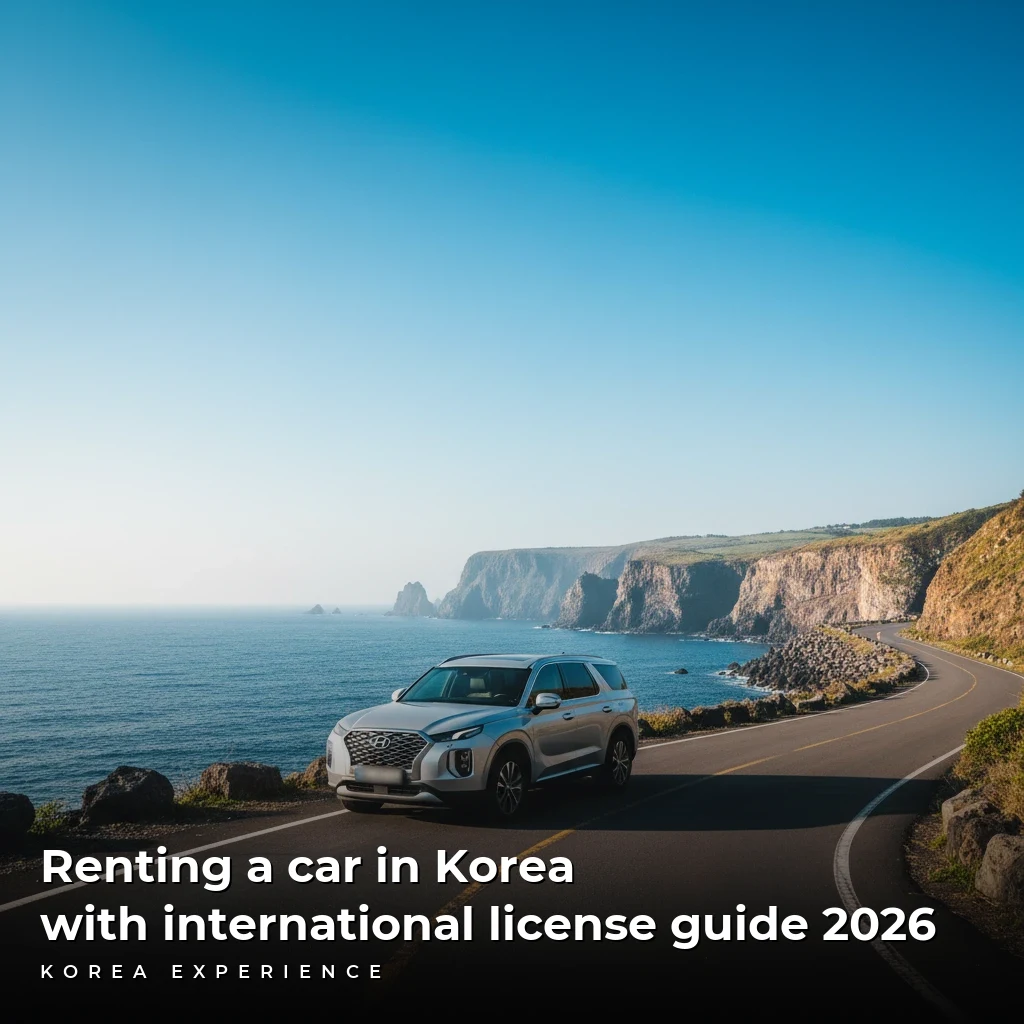
Can you rent a car in Korea with an international license? Yes, absolutely—but the bureaucratic hurdles can be surprisingly strict compared to other travel destinations. While Korea boasts one of the world's best public transportation systems, renting a car unlocks a side of the peninsula that the KTX and subway simply cannot reach. From the coastal highways of Gangwon-do to the volcanic landscapes of Jeju Island, driving offers freedom, though it comes with unique challenges like complex navigation apps and strict traffic enforcement.
The short answer: You must have a physical International Driving Permit (IDP) issued under the 1949 Geneva Convention, your home country's valid license, and a credit card in the driver's name. Digital IDPs are not accepted.
Key Takeaways
- 1Must have 1949 Geneva Convention IDP (Year valid: 1 year)
- 2Credit card must match the driver's name exactly
- 3Google Maps does not work for navigation; download Naver Map
- 4Jeju Island requires a car for 90% of tourists
- 5Strict 50km/h city and 30km/h school zone limits enforced by camera
Why Rent a Car in Korea? (And When Not To)
Before diving into the "how," it is crucial to address the "should." Korea is a country of extreme dualism when it comes to transportation. In Seoul, a car can be a liability. The average traffic speed in downtown Seoul during rush hour hovers around 24 km/h (15 mph), and parking fees in districts like Gangnam can exceed ₩6,000 ($4.50 USD) per hour.
However, once you leave the metropolitan heavyweights (Seoul, Busan, Daegu), the narrative changes. The Korean countryside is dotted with hidden temples, coastal cafes, and mountain pensions that are inaccessible by bus.
Car Rental vs. Public Transport
- ✓Access to remote areas in Gangwon and Jeolla provinces
- ✓Essential for Jeju Island travel
- ✓Convenience for families with luggage/strollers
- ✓Privacy and flexible schedule
- ✗Severe traffic congestion in Seoul and Busan
- ✗Parking is expensive and scarce in cities
- ✗Navigation apps require learning curve
- ✗Toll fees accumulate quickly (₩10,000+ per trip)
If you are planning to stick strictly to Seoul, we highly recommend using the subway. However, if you want to explore the outskirts, check out our guide to best day trips from Seoul 2026 for destinations where a car might be beneficial.
Critical Requirements: The International Driving Permit
This is the single most common point of failure for travelers. Korea is exceptionally strict about paperwork. You cannot rent a car with just your home country's license, nor can you use a "digital" IDP that you bought online for $20.
The 1949 Geneva Convention Rule
South Korea is a signatory to the 1949 Geneva Convention on Road Traffic. It is NOT a signatory to the 1968 Vienna Convention (unlike many European countries).
- US/Canada/Australia/UK Citizens: Your standard IDP issued by AAA (USA), CAA (Canada), or the Post Office (UK) is usually under the 1949 convention. You are safe.
- European Citizens: Many EU countries issue IDPs under the 1968 convention. You must specifically request the 1949 format from your local authority before traveling. If you show up with a 1968 IDP, the rental agent will deny you, and there are no exceptions.
IDP Warning
Do not forget the physical booklet. A photo of your IDP or a digital version on your phone is invalid in Korea. If you arrive at the Incheon Airport rental desk without the physical paper booklet, you will be turned away.
The "Three Documents" Rule
When you approach the counter, you must present these three items simultaneously:
- Original Driver's License: From your home country (must be valid, not expired).
- International Driving Permit (IDP): Physical booklet, 1949 Convention, valid for 1 year from issue.
- Passport: Must match the name on the license and IDP.
Age and Experience Requirements
- Minimum Age: Generally 21 years old for compact cars.
- Luxury/SUVs: Often requires age 26+.
- Driving Experience: You must have held your license for at least 1 year. If your renewed license shows a "date issued" of last week, bring your old expired license or a driving record abstract to prove you have driven for more than a year.
Choosing a Rental Company: Local vs. International
In 2026, the Korean car rental market is dominated by two domestic giants: Lotte Rent-a-Car and SK Rent-a-Car. While you can find Hertz or Avis, they usually just subcontract to Lotte or SK anyway.
Lotte Rent-a-Car
The largest provider. They have a seamless website in English and a dedicated desk at Incheon Airport T1 and T2.
- Pros: Real-time English booking, high vehicle quality, massive fleet.
- Cons: Slightly pricier than local mom-and-pop shops.
- Membership: If you sign up for a free membership on their website, you instantly get a 30-40% discount off the standard rate. Never pay the "non-member" price.
SK Rent-a-Car (formerly AJ)
The main competitor. Service and vehicle quality are comparable to Lotte.
- Pros: Often runs aggressive promotions for EV rentals (Hyundai Ioniq 5 / 6).
- Cons: English site navigation can sometimes be clunky.
SOCAR (Car Sharing)
You will see blue "SOCAR" vehicles everywhere. This is an app-based car-sharing service similar to Zipcar.
- Warning: As of 2026, registering for SOCAR requires a Korean Driver's License and a resident registration number (ARC). Short-term tourists generally cannot use this service. If you are a resident, check our guide on buying a used car in Korea vs renting.
Rental Agency Comparison 2026
| Feature | Lotte Rent-a-Car | SK Rent-a-Car | Small Local Agencies |
|---|---|---|---|
| English Website | ✅ | ✅ | ❌ |
| Airport Pick-up | ✅ | ✅ | Shuttle required |
| Foreign Card | ✅ | ✅ | Hit or miss |
| Avg Daily Cost | ₩80,000 | ₩75,000 | ₩55,000 |
Cost Analysis: What Will You Pay?
Car rental in Korea is moderately priced—cheaper than Japan or the US, but more expensive than Southeast Asia.
The Rental Fee
Prices fluctuate based on the season (July/August and Chuseok holidays are peak).
- Compact (Hyundai Avante/Kia K3): ₩60,000 - ₩90,000 per day.
- Mid-size (Hyundai Sonata/Kia K5): ₩90,000 - ₩130,000 per day.
- Luxury (Genesis G80): ₩200,000+ per day.
Insurance (CDW) - Don't Skip It
Korean rental agencies usually offer three tiers of CDW (Collision Damage Waiver):
- General: You pay a deductible of ₩500,000 ($375) in case of an accident.
- Super/Perfect: Deductible is ₩50,000 ($37) or zero.
- Complete: Covers everything including tire and wheel damage.
Zero Deductible
We strongly recommend paying the extra ₩10,000–₩20,000 per day for "Zero Deductible" (Full Coverage) insurance. Korean parking spaces are tight, and door dings or bumper scrapes are common. It saves you from paying for "loss of use" fees while the car is being repaired.
💵 Estimated Daily Rental Budget (24h)
Hyundai Sonata, Zero-Deductible Insurance, Fuel
The Pickup Process
When you arrive at Incheon Airport, the rental counters are located in the Arrival Hall (1F).
- Check-in: Present your 3 documents.
- Payment: You must use a credit card (Visa/Mastercard) in the driver's name. Debit cards are frequently rejected due to the inability to place a security hold.
- Shuttle: The cars are not parked right outside. You will take a free shuttle bus (approx. 5-10 mins) to the rental lot.
- Inspection: The staff will walk around the car with a tablet, marking scratches. Pro Tip: Take a video of the entire car, focusing on the wheels and lower bumper, before you drive off.
Navigation: The Google Maps Problem
If you open Google Maps in Korea, it will show you the map, but it will not give you turn-by-turn driving directions. Due to national security laws regarding map data, Google Maps is essentially useless for driving.
You must download one of these two apps:
- Naver Map: The gold standard. Supports English interface and English voice navigation.
- KakaoMap: Also excellent, slightly more user-friendly interface for some, but English address search can be finicky.
Don't try to type English addresses into the GPS. It often fails due to romanization differences. Instead, use the 'Phone Number Search' feature in the car's built-in GPS or Naver Map. Enter the destination's phone number (e.g., 02-3700-3900 for Gyeongbokgung), and it will route you directly to the parking lot.
To use these apps effectively, you need reliable data. Check our recommendations for best Korea SIM cards for long-term travelers to ensure you don't lose signal in the mountains.
Rules of the Road: Driving Etiquette and Laws
Driving in Korea is on the right side of the road (like the US/Europe). However, the driving culture has unique characteristics.
1. The Right Turn Rule (New in 2023/2024)
This law is strictly enforced. When turning right at an intersection:
- Step 1: You MUST come to a complete stop at the stop line before the crosswalk.
- Step 2: Look for pedestrians. If a pedestrian is stepping onto the crosswalk, you wait.
- Step 3: Only proceed when clear. Failing to stop results in a ₩60,000 fine and demerit points.
2. Speed Cameras Everywhere
Korea does not use police cars to catch speeders; it uses cameras. There is a camera roughly every 2-3 kilometers on highways.
- Fixed Cameras: The GPS will warn you: "Speed enforcement camera in 500 meters."
- Section Enforcement: These are tricky. A camera records your entry time and exit time over a 5-10km stretch to calculate your average speed. You must maintain the average limit (usually 100km/h) for the whole section.
📖 How to Handle Korean Speed Bumps
Step 1: Identify
Look for yellow and white stripes painted on the road.
Step 2: Slow Down
Reduce speed to 20-30km/h. Korean speed bumps are taller and sharper than Western ones.
3. School Zones (Min-sik Law)
School zones are marked with red road paint and yellow signs. The speed limit is 30 km/h (18 mph) strictly enforced. Fines for speeding here are doubled, and accidents involving children in these zones carry massive criminal penalties.
Parking and Tolls
The Hi-Pass System
Highways in Korea are toll roads. The electronic toll collection system is called Hi-Pass.
- Rental Cars: Most rental cars come equipped with a Hi-Pass device on the windshield.
- How to use: You can drive through the blue lanes marked "Hi-Pass" (하이패스). The machine will speak, telling you the toll amount.
- Payment: You do not pay instantly. When you return the car, the rental agency will check the Hi-Pass log and charge the total toll amount to your credit card.
- Cash: If your car doesn't have Hi-Pass, use the lanes marked "Cash" (현금) and pay the booth attendant.
Parking
In cities, free parking is non-existent.
- Public Lots (Gongyeong Juchajang): These are government-run and cheaper (approx ₩300 per 10 mins). Look for blue signs with a "P".
- Private Lots: Can be very expensive.
- Illegal Parking: Cameras on poles and roving enforcement vehicles automatically ticket cars parked illegally on roadsides. Fines start at ₩40,000.
📋 Cost Quick Reference
Jeju Island: The Driving Capital
If there is one place in Korea where renting a car is almost mandatory, it is Jeju Island. While buses exist, they run infrequently to the best scenic spots.
📊 Jeju Rental Market
Jeju is also the EV capital of Korea. Charging stations are more common than gas stations. We highly recommend renting an EV like the Hyundai Ioniq 5 or Kia EV6 for Jeju. Not only is it eco-friendly, but many public parking lots offer 50% discounts for electric vehicles.
Jeju Coastal Loop: Nature Meets Cafe Culture
The Dualism Concept: Experience the best of both worlds — premium luxury moments paired with authentic budget-friendly experiences in one route.
Aewol Cafe Street
Trendy oceanfront cafes, heavy traffic, valet parking.
Hyeopjae Beach
Free public parking, crystal clear water, food trucks.
Start early (8 AM) to avoid the rental car rush hour on the coastal road.
For the best weather conditions to drive in Jeju (avoiding typhoon season), consult our guide on the best time to visit Korea month by month.
Refueling Your Car
Most gas stations in Korea are self-service (Self-Ju-Yu-So / 셀프 주유소).
- Select Fuel Type:
- Gasoline (Hwi-bal-yu / 휘발유): ALWAYS the Yellow nozzle.
- Diesel (Gyeong-yu / 경유): ALWAYS the Blue or Green nozzle.
- Warning: Putting gasoline in a diesel car (or vice versa) is a common mistake for tourists. Check the fuel cap sticker!
- Payment: Insert credit card first, select amount (or "Full" - gadeuk / 가득), pump gas, take receipt.
- Gloves: Most stations provide plastic gloves to keep your hands clean.
Troubleshooting: Accidents and Breakdowns
If you have an accident, do not panic, but follow protocol strictly.
- Stop immediately. Do not move the car if it disrupts traffic significantly, but if it's minor, take photos first then move to the shoulder.
- Photos: Take photos of the scene, license plates, and damage from all angles.
- Call the Rental Company: There is a number on the dashboard sticker or key fob. They will send an insurance agent.
- Police: If there is an injury or a dispute, call 112. English interpretation is available.
Alcohol Limit
Korea has a zero-tolerance policy for drunk driving. The limit is 0.03% BAC. A single glass of beer can put you over the limit. Police conduct random roadblocks frequently. If caught, you face deportation and massive fines.
Alternatives to Driving
If this guide makes driving sound stressful, remember that Korea's intercity bus and train network is world-class.
- Express Buses: Reclining seats, cheaper than trains.
- KTX/SRT: High-speed trains connecting Seoul to Busan in 2.5 hours.
- Taxis: For short distances, Kakao T is incredibly convenient and cheap compared to Western taxi prices.
However, for those seeking the road less traveled—driving to the Boseong Green Tea Fields or the ridges of Seoraksan—a car is irreplaceable.
Frequently Asked Questions
❓ Car Rental FAQ
Have more questions?Contact us →
Driving in Korea requires preparation—specifically the correct IDP and a willingness to adapt to local driving styles. But once you cruise down the coastal highway of Jeju or navigate the winding roads of Jirisan National Park, you'll find the effort was well worth the reward.
For more insights on settling in or extended stays, check our guide on best neighborhoods for expats in Seoul. Safe travels!
About the Author
Korea Experience Team
Written by the Korea Experience editorial team - experts in Korean medical tourism, travel, and culture with years of research and firsthand experience.
Explore more in Travel & Tourism
From Seoul's neon-lit streets to Jeju's volcanic landscapes — discover the best of Korea with insider travel tips, itineraries, and seasonal guides.
Browse All Travel & Tourism ArticlesContinue Reading
Explore more articles you might find interesting
Complete 2026 guide to renting a car in Korea. Learn IDP rules, Naver Map navigation, costs starting at ₩60,000/day, and specific driving laws.
In 2026, you can absolutely rent a car in Jeju without an ARC—but only if you have an International Driving Permit (IDP) and navigate the new 'e-Arrival...
The complete 2026 guide to emergency medical care in Seoul. Find the best international hospitals, ER costs, and English-speaking services for travelers.
Navigating Seoul's international school landscape for your child's education can be complex. This 2026 guide simplifies choices for expat families.
A complete guide to securing medical second opinions in Seoul's top hospitals. Costs, required documents, and booking steps for 2026 travelers.
A complete guide to pediatric healthcare in Seoul for international families, covering top clinics, costs, and emergency protocols in 2026.