Saju vs modern psychology in Korea: 2026 mental health guide
Navigate mental wellness in South Korea in 2026. Compare traditional Saju readings for 30,000 KRW with modern therapy to beat the 6.7 percent depression rate.
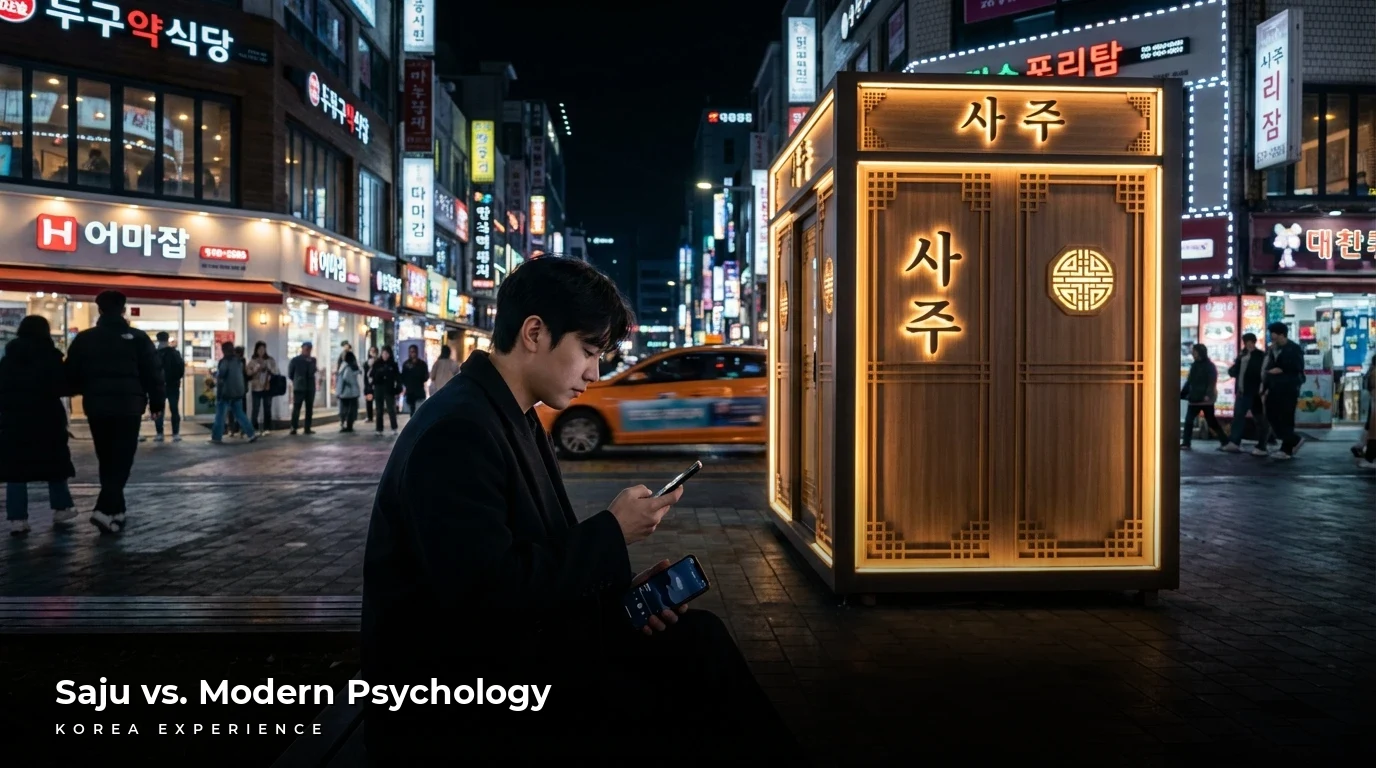
So, you are sitting in a cramped, brightly lit cafe in Hongdae, sipping an overpriced iced Americano. Across from you sits a middle-aged man furiously scribbling ancient Chinese characters onto a piece of paper, calculating your exact moment of birth. He looks up, adjusts his glasses, and tells you that your 'water energy' is clashing with the current year, which is exactly why your boss has been an absolute nightmare lately. You feel a massive wave of relief wash over you. It is not your fault! It is the universe!
Welcome to Saju, South Korea's centuries-old answer to stress, anxiety, and the existential dread of modern life.
Wondering whether to spill your guts to a therapist or let a traditional fortune-teller read your cosmic barcode? Here is the ultimate guide to navigating mental wellness, traditional Saju, and figuring out your life path in South Korea right now. The landscape of mental health in Korea is shifting rapidly as we move through 2026, blending ancient traditions with modern clinical practices in fascinating ways.
Key Takeaways
- 1Saju gives you a roadmap based on your birth date to explain why things are happening, while modern psychology helps you process the emotions and trauma of the journey.
- 2You can get a basic Saju reading for around ₩30,000 to ₩50,000, making it an incredibly accessible way to vent frustrations compared to a ₩150,000 therapy session.
- 3If you are going through a deep emotional crisis, skip the fortune-teller and book a licensed English-speaking therapist immediately.
- 4Locals frequently use both systems depending on what is stressing them out, using Saju for career or dating curiosity and therapy for clinical healing.
📋 Quick Facts
National diagnosed average
As of 2020 data
The Ultimate Korean Dilemma: Destiny vs. Therapy
Here is the million-dollar question for anyone living in Seoul: If you are struggling, feeling lost in your career, or dealing with major relationship drama in Korea, should you go sit in that Saju cafe, or should you book an appointment with a modern clinical psychologist? The short answer is that locals frequently use both, but for entirely different reasons. Saju gives you a roadmap based on your birth date to explain the mechanics of your life, while modern psychology helps you process the heavy emotions of the journey.
Look, we have to talk about the elephant in the room: the stigma surrounding mental health in South Korea. It is massive. Societal stigma acts as a giant brick wall preventing people from seeking actual mental health care. This stigma is deeply rooted in traditional Korean Confucianist values, which dictate strict unwritten social rules regarding how one should present themselves to the world. Under these old-school ideals, mental disorders are not really seen as medical issues; they are viewed as things that should simply be tolerated through intense self-discipline and sheer willpower. Going to a therapist is often perceived as a sign of weakness, or worse, something that causes you and your family to 'lose face' in society.
Because of this intense pressure, Saju has historically acted as a kind of 'stealth therapy.' Instead of telling your parents or your boss that you are going to a psychiatrist for your depression, you just tell them you are going to get your Saju read. Saju consultations are incredibly widespread in modern South Korea, and people routinely seek them out before major life decisions like marriage, naming their kids, or changing careers. It is cheap, it is culturally acceptable, and it completely removes the personal blame from the equation.
But things are shifting fast. In recent years, and specifically as we look toward 2026, there has been a huge push for better mental health awareness. The depression rates have been climbing—reaching 6.7 percent of the diagnosed population back in 2011, and that number has only grown with the modern pressures of Korea's fast-paced Pali-Pali culture. People are realizing that while Saju is fun and comforting, it does not cure clinical trauma. Understanding the line between a fun cultural fortune-telling session and the need for actual psychological intervention is key to surviving and thriving in Korea.
The Background Story: From Ancient Scholars to Modern Clinics
How did we even get to a point where fortune-telling tents sit literally next door to high-tech medical clinics? To understand this, you have to look at the incredibly fascinating history of how Koreans process hardship.
Let us rewind a bit. The system of Saju, which translates to the 'Four Pillars of Destiny,' is not just some random parlor trick. It is a complex calculation system that has been practiced in Korea since at least the Goryeo dynasty, which ran from 918 to 1392. The Korean system actually follows the same structural principles as the Chinese method of destiny calculation, but over the centuries, it incorporated interpretive traditions that developed completely independently within Korean culture. It is essentially an ancient algorithm. By taking the year, month, day, and hour of your birth, the master calculates your elemental makeup (Wood, Fire, Earth, Metal, Water) and maps out the flow of your life.
Goryeo Dynasty Adoption
The Four Pillars of Destiny system (Saju) began being widely practiced and adapted into Korean culture.
Asian Financial Crisis
Economic devastation caused a massive spike in mental health struggles, driving thousands to Saju masters for hope and reassurance.
Mental Health Care Gap
Public spending on mental health sat at a dismal 3 percent, with most funds going to inpatient hospitals rather than accessible outpatient therapy.
School Interventions
South Korean schools officially implemented annual mental health screenings and awareness programs for students to combat rising stress.
National Budget Boom
The national budget for mental health reached 301 billion KRW, a massive 49.5 percent increase from 2017 to combat rising anxiety and depression.
The Hybrid Era
Saju cafes and modern psychology clinics begin to coexist more openly, as younger generations reject traditional stigmas around seeking professional mental help.
For hundreds of years, this was how Koreans made sense of a chaotic world. But fast forward to the modern era, and South Korea faced unprecedented trauma. The 1997 Asian financial crisis absolutely devastated the country. Suddenly, lifelong jobs evaporated, families lost their savings overnight, and the suicide rate skyrocketed. Economic crises like this, and later the global pandemic, have been found to massively exacerbate mental health issues in the country.
During these crises, where did people turn? Not to therapists. Remember that Confucian stigma? Up until recently, the mental health infrastructure in Korea was surprisingly underdeveloped. Back in 2011, historical reports showed that public spending on mental health was shockingly low—around 3 percent of the budget—and most of that money was poured into scary inpatient hospitals rather than friendly outpatient therapy clinics. Going to the hospital for mental health meant you were 'crazy.' So, instead, people flocked to Saju tents. Saju provided comfort. It told a bankrupt businessman, 'Your chart is in a winter phase right now, but spring will come in two years.' That gave people the hope they needed to survive.
But the government eventually realized that fortune-telling is not a substitute for a mental healthcare system. Suicide became the leading cause of death for young people aged 9 to 24. South Korea's suicide rate had more than doubled between 2000 and 2011, completely blowing past the OECD average.
Things had to change. In the 2010s, the focus finally started shifting from locking people up in long-term hospitals to providing community-based healthcare. In 2012, schools began implementing annual mental health screenings to catch issues early. And the money finally followed: by 2020, the national budget for mental health shot up to 301 billion South Korean won, a 49.5 percent increase from 2017. The landscape is changing, and today, you have a real choice between the ancient comfort of Saju and the modern healing of psychology.
Breaking Down Your Options: Street Tents, Cafes, or Clinics?
Alright, let us get practical. If you are living in or visiting Korea and you are feeling overwhelmed, you basically have three main routes you can take. Let us break down exactly what you are getting yourself into with each option.
| Feature | Saju (Traditional) | Modern Psychology | AI Saju Apps |
|---|---|---|---|
| Cost | ₩30,000 - ₩50,000 | ₩100,000 - ₩200,000+ | Free - ₩10,000 |
| Processing Time | Instant (On the spot) | Weeks to Months | Instant (Seconds) |
| Duration | Yearly or lifetime | 50-minute weekly | Daily notifications |
| Requirements | Exact birth details | Self-reflection | Smartphone |
| Best For | Career, marriage timing | Trauma, depression | Daily entertainment |
| 2026 Changes | Trendy aesthetic cafes | Outpatient focus | Conversational AI |
Option A: The Street Saju Tent (The Budget / Authentic Option)
If you are walking around bustling areas like Hongdae or Tapgol Park, you will see small, transparent plastic tents lined up along the sidewalk. These are the frontline warriors of Saju, often called Ttarojip if they also do Tarot, or Sajubang.
- The Vibe: Gritty, authentic, and fast. You slide in, sit on a plastic stool, and hand over your birth time.
- Best For: Tourists wanting a quick, cheap thrill (if they have a translator), or locals who just want to know if they will pass their upcoming job exam.
- The Reality: The level of internalized stigma in South Korea is so high that many people prefer the anonymity of these tents. You pay in cash, there is no paper trail, and nobody knows you were there. Men, who historically perceive a higher level of mental health stigma than women, often prefer this quick, transaction-style advice.
Option B: The Saju Cafe (The Social / Trendy Option)
This is where traditional destiny meets Gen Z aesthetics. Saju cafes are actual coffee shops where you can order a matcha latte and a piece of cake, and a resident Saju master will come to your table.
- The Vibe: Comfortable, chatty, and very social.
- Best For: Groups of friends, couples on a date checking their compatibility (Gunghap), or expats who need to bring a bilingual friend along. It is much easier to sit in a spacious cafe for an hour to translate than squishing into a freezing street tent in January.
- The Reality: It is a bit more expensive than the street, but you get a longer, more conversational reading. It feels less like a mystical reading and more like a quirky life-coaching session over coffee.
Option C: Modern Clinical Therapy (The Real Deal)
If you are dealing with genuine trauma, clinical depression, or severe anxiety, skip the tents. You need Option C.
- The Vibe: Exactly what you would expect back home. Private offices, comfortable chairs, and clinical confidentiality.
- Best For: Deep emotional processing. Interestingly, there is a specific dynamic with the elderly in Korea. Factors like eating alone as a solo diner, financial hardship, and the breakdown of traditional family care have pushed elderly depression rates to between 17.8 percent and 27.9 percent. They need actual clinical help, though sadly, individuals over 70 are less likely to seek consultation due to old-school ideals.
- The Reality: South Korea has universal health coverage that makes medicine affordable. However—and this is wild—many locals explicitly choose to pay for therapy entirely out-of-pocket in cash. Why? To avoid having mental health services recorded on their national insurance records, which could lead to workplace discrimination. As an expat, you will likely be paying out-of-pocket anyway if you see an English-speaking therapist, which can run you ₩100,000 to ₩200,000 a session.
Pros
- ✓Cultural Immersion: Getting a Saju reading gives you a profound look into traditional Korean thought processes and how locals have handled stress for centuries.
- ✓Guilt-Free Explanations: Saju tells you that sometimes things are just 'in your chart' and out of your control, which can be incredibly relieving.
- ✓Deep Clinical Healing: While Saju provides a quick band-aid, modern therapy actually gives you the coping mechanisms to handle the root of your problems.
Cons
- ✗The Language Barrier: Finding a Saju master who speaks fluent English is incredibly difficult, meaning you will almost certainly need a bilingual friend.
- ✗High Costs of Therapy: English-speaking therapists in Korea are usually private practice and out-of-network, meaning high out-of-pocket costs.
- ✗Saju Fatalism: Sometimes a Saju master will tell you something negative which can stick in your head and cause totally unnecessary anxiety.
Top Locations for Saju and Therapy in Seoul
If you are ready to take the plunge, here are three highly-rated spots in Seoul that cater to different needs, from budget-friendly student cafes to premium expat counseling centers.
1. Fun Saju Cafe (Hongdae Area) Located at 24 Wausan-ro 21-gil in Mapo-gu, this is a staple for university students. Operating from 13:00 to 22:30, it offers a comfortable booth setting where you can grab a drink while getting your reading. It is famous among locals and boasts a 4.3 out of 5 rating on Naver. Insider Tip: They have specific masters who specialize in Tarot if Saju feels too intense; just remember to bring a Korean friend to translate!
2. Seoul Counseling Center (Gangnam Area) If you need professional, trauma-informed care, this psychology clinic at 11F, 33 Gangnam-daero 53-gil is the gold standard for expats. Open from 09:00 to 21:00, they feature fully fluent English staff and specialized expat counseling. While it falls into the luxury price range (₩180,000+), they hold a stellar 4.8 out of 5 rating on Google. Insider Tip: They can help you with documentation if you need to file a claim with your home country's insurance.
3. Eros Saju Cafe (Ewha Women's University Area) For a quirky, retro vibe, head to 56 Ewhayeodae-gil in Seodaemun-gu. Open from 11:00 to 22:00, this budget-friendly spot specializes in dating compatibility (Gunghap). It has a 4.1 rating on Naver. Insider Tip: It gets super crowded during exam seasons and Valentine's week, so try to visit on a weekday morning.
The Complete How-To: Navigating Your First Session
So you have decided which route to take. Awesome. But how do you actually do this without looking like a totally confused tourist? Here is your step-by-step survival guide to getting a Saju reading.
📖 How to Get Your First Saju Reading in Seoul
Step 1: Track Down Your Exact Birth Details
Before you even step foot outside, you need to find out your exact birth time. Saju is completely based on the year, month, day, and time you were born. Without the time, the reading is considered incomplete and way less accurate.
Step 2: Choose Your Vibe (Street Tent vs. Cafe)
Head out to Hongdae, Gangnam, or Myeongdong. You will see little plastic tents lined up on the street. If you want something more comfortable, look for a Saju Cafe where you can buy an iced Americano and sit in a nice booth.
Step 3: The Reading Process
Sit down and hand over your birth details. The master will usually pull out a thick, ancient-looking book (or nowadays, an iPad!) to calculate your Four Pillars and Eight Characters. They will start writing down Chinese characters on a piece of paper.
Step 4: Ask the Right Questions
Once they give you the general overview, it is your turn. Have 2-3 specific questions ready. The most common things Koreans ask about are career changes, whether they should move, and when they will get married.
How to Find an English-Speaking Therapist: If you are reading this and thinking, 'Actually, I think I just need real therapy,' here is exactly what you do. Do not just walk into a random Korean psychiatric hospital. The language barrier for nuanced psychological concepts is too high.
Step one: Search for specific expat-focused centers like the Seoul Counseling Center, AHS (Adaptable Human Solutions), or YPsc. Step two: Check if they have clinicians licensed in your home country (like US or UK licensed therapists). This is crucial because it means their therapeutic style will match what you are culturally used to. Step three: Ask about insurance. As mentioned, most international clinics operate out-of-network. You will pay upfront (usually by card or bank transfer) and they will give you an English invoice with specific diagnostic codes to submit to your international insurance provider for reimbursement.
I have expats come into my clinic feeling completely defeated because a Saju reader told them their \'fire element\' was burning up their career prospects. I always tell them: Saju is a cultural weather forecast, not a life sentence. Use it to understand how Koreans historically framed unpredictability, but use therapy to actually build the umbrella you need for the storm.
The Stuff Nobody Tells You
Alright, let us get into the insider secrets—the stuff you only figure out after living here for a few years and making a bunch of awkward mistakes.
First, we need to talk about the biggest 'stealth' issue in Korea: Alcohol. South Korea has the highest rate of alcohol use disorder in the world, with nearly 7.0 percent of the population affected. Why is this relevant? Because instead of going to therapy, or even going to a Saju master, a huge portion of the population self-medicates with Soju. This is driven by intense business expectations for heavy drinking with colleagues, using alcohol as the primary stress-relief method. If you are an expat working here, you will absolutely feel this pressure. If you find yourself drinking four nights a week just to cope with your boss, skip the Saju cafe and go straight to a counselor.
Second, let us talk about the youth. If you are a student or young expat, you should know that 'internet addiction disorder' is a massive concern here. Over 10 percent of Seoul adolescents are at high risk, usually tied to online gaming for guys and social media for girls. Because of this, the mental health landscape is evolving rapidly. Instead of physical Saju cafes, Gen Z is obsessed with Saju and Tarot apps like Jeomshin. They literally wake up, check their daily Saju fortune on their phone, and use it as a mini mental-health check-in. It is fascinating.
No Korean Phone or ARC? Here is What To Do
Look, getting anything done in Korea without an Alien Registration Card (ARC) or a local phone number verified by a telecom company is a massive headache. If you are a tourist needing a Saju reading, you cannot book most popular cafes through Naver Reservations. Instead, walk into a street tent in Hongdae—they operate strictly on cash and walk-ins, no phone number required! If you need mental health support as a tourist, international clinics like Itaewon Global Village Center or specialized English hotlines do not require an ARC to provide emergency counseling resources.
A Warning on Dating Compatibility
Do not take Saju compatibility (Gunghap) too seriously if you are dating a Korean! Many cross-cultural couples get told their charts are a 'terrible match' simply because foreign birth dates and locations can sometimes confuse the traditional calculation methods. Do not break up over a ₩30,000 reading!
Frequently Asked Questions
❓ Frequently Asked Questions
Have more questions?Contact us →
Your Action Plan
Look, living in or traveling through South Korea is an incredible, fast-paced, and sometimes totally overwhelming experience. The pressure to succeed here is palpable, and it is perfectly normal to feel the weight of it. Navigating the Confucian bowing etiquette, the intense work culture, and the language barrier can take a toll on anyone.
If you are just looking for some clarity on a career move, a fun cultural experience to share with your friends, or you want to see how an ancient algorithm interprets your personality, definitely go get your Saju read. Grab a coffee in Hongdae, hand over your birth time, and enjoy the ride. It is a fascinating window into how Korean society has processed uncertainty for a thousand years.
But if the stress is keeping you awake at night, if the workplace drinking culture is taking a toll, or if you are dealing with real trauma—take the modern route. Do not let the lingering cultural stigmas hold you back. The mental health resources in Korea have improved drastically over the last decade. Book a session with an English-speaking therapist, get the support you actually need, and take care of your mind. You have got this!
Sources:
- Wikipedia - Four Pillars of Destiny: History of Saju, Goryeo dynasty integration, and comparison to Chinese systems.
- Wikipedia - Mental Health in South Korea: Data on mental health stigma, Confucian values, 2020 budget increases, and out-of-pocket payment trends.
- Ministry of Health and Welfare South Korea: General health policies and public healthcare structures.
- Korea Tourism Organization: Information on cultural practices and tourist locations like Hongdae and Myeongdong.
- The Korea Herald: News reporting on modern cultural trends, youth habits, and the rise of Saju cafes in modern society.
About the Author
Korea Experience Team
Written by the Korea Experience editorial team - experts in Korean medical tourism, travel, and culture with years of research and firsthand experience.
Explore more in K-Culture
K-Pop, K-Drama, traditional arts, and modern culture — dive deep into the cultural phenomena that have captivated the world.
Browse All K-Culture ArticlesContinue Reading
Explore more articles you might find interesting
Discover why market vendors give free food. Learn how to navigate 24000 stalls in 2026 using WOWPASS and experience the 16 percent sales boom firsthand.
A deep dive into Korean fortune telling culture in Sinsa-dong, comparing traditional Saju with modern Tarot including prices and English options.
Comprehensive guide to mental health resources for medical tourists in Korea. Find English-speaking counselors, recovery centers, and costs in 2026.
Managing expectations for plastic surgery in Korea reduces post-op depression by 40%.
A complete guide to finding English-speaking therapy in Seoul. Covers costs, insurance, top clinics, and mental health resources for expats in 2026.
A comprehensive guide to navigating Korea's advanced recovery landscape, from traditional kiln saunas to modern cryotherapy clinics.