Seoul Transportation Guide 2026: Subway, Bus, and T-Money
Master Seoul's 2026 transit system. From the Climate Card saving you ₩62,000 to new AREX schedules, here is everything tourists need to navigate like a local.
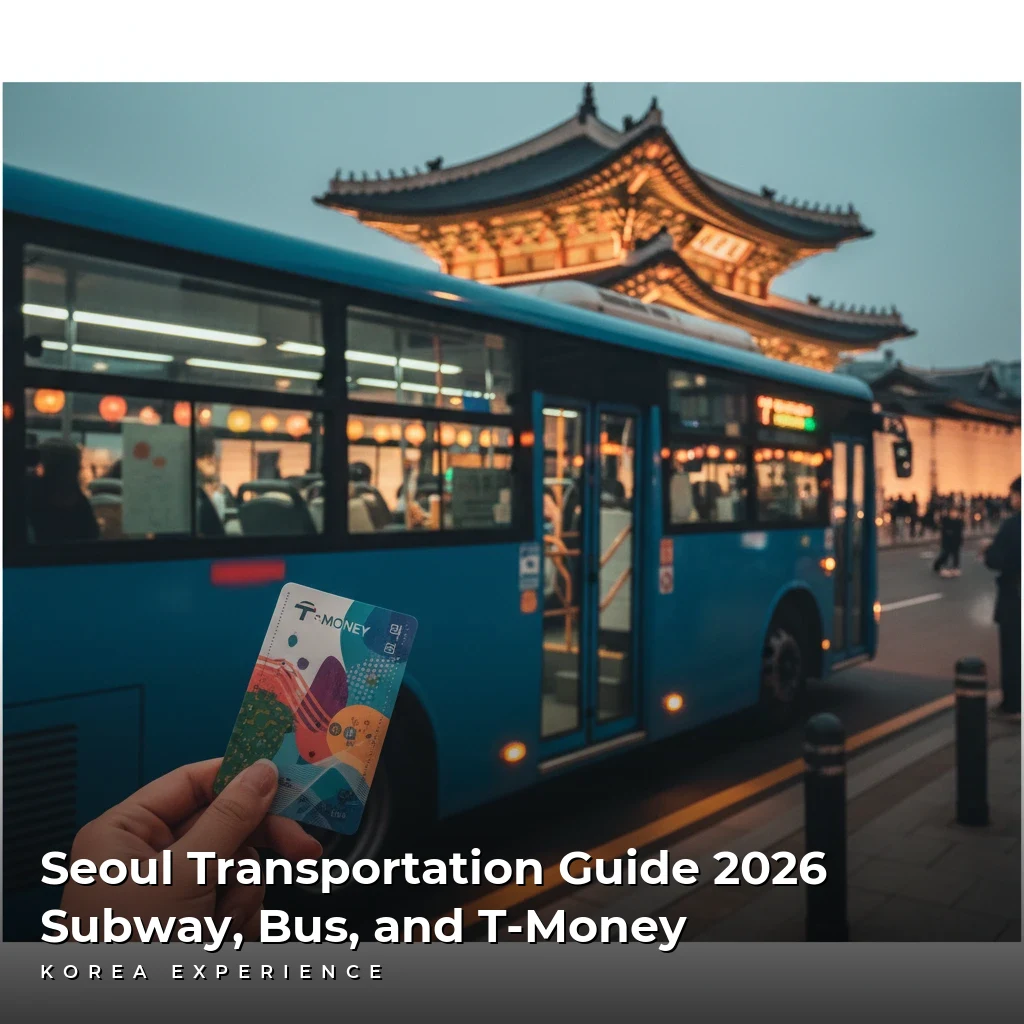
Navigating Seoul’s transportation system is efficient, affordable, and surprisingly easy once you understand the logic behind the color-coded lines and the universal payment system. Whether you are landing at Incheon International Airport for the first time or trying to get from a Gangnam club back to Hongdae at 3 AM, the city offers a solution that rarely costs more than a cup of coffee.
The short answer: To get around Seoul in 2026, you simply need a T-Money card (purchasable at any convenience store for ₩3,000-4,000) or the new Tourist Climate Card for unlimited rides. The subway is the fastest option during the day, while Kakao T remains the essential app for hailing taxis.
Key Takeaways
- 1The new Climate Card offers unlimited transit for roughly ₩65,000/month, now available in short-term tourist versions.
- 2Always 'tap out' when exiting buses to avoid double charges on your next ride.
- 3Subway service generally stops around 12:00 AM; late-night travel requires Owl Buses (N-Bus) or taxis.
The Golden Key: T-Money and The Climate Card
Before you step onto a single bus or train, you must sort out your payment method. Cash is practically obsolete in Seoul's transit system in 2026. In fact, many buses are now completely "cashless," meaning you cannot board without a card.
The T-Money Card
The T-Money card is a rechargeable IC card that works on subways, buses, and taxis throughout South Korea, not just Seoul. You can also use it to pay for items at convenience stores (CU, GS25, 7-Eleven, Emart24).
- Cost: The empty card costs between ₩2,500 and ₩4,000 depending on the design (K-Pop/character designs cost more).
- Where to buy: Any convenience store or subway station vending machine.
- Reloading: You can reload with cash (Korean Won only) at ticket machines in stations or at convenience store counters.
- Refunds: If you have a balance under ₩20,000 left at the end of your trip, you can get a refund at convenience stores (minus a ₩500 service fee).
📖 How to Buy and Load a T-Money Card
Step 1: Find a Convenience Store
Locate a GS25, CU, or 7-Eleven. They are on almost every corner in Seoul.
Step 2: Purchase the Card
Ask the clerk for a T-Money card. Say: 'T-Money card juseyo.' Pay ₩3,000-4,000 for the card itself.
Step 3: Load Balance
Hand the clerk cash (e.g., ₩20,000) and say: 'Chung-jeon hae-juseyo' (Please recharge it).
The Climate Card (Giho Card)
Introduced fully in 2024 and expanded by 2026, the Climate Card (Giho Card) is a game-changer for travelers staying longer than a few days or those who plan to move around aggressively.
- Standard Pass: Approximately ₩62,000 for 30 days of unlimited subway and bus rides.
- Plus Pass: Approximately ₩65,000 for 30 days, including unlimited use of Ttareungi (Seoul Public Bikes).
- Tourist Passes (New for 2026): Short-term variants (1-day, 3-day, 5-day) are now available at major tourist information centers and Seoul Station, priced between ₩5,000 and ₩15,000 depending on duration.
Pro Tip: Transfer Discounts
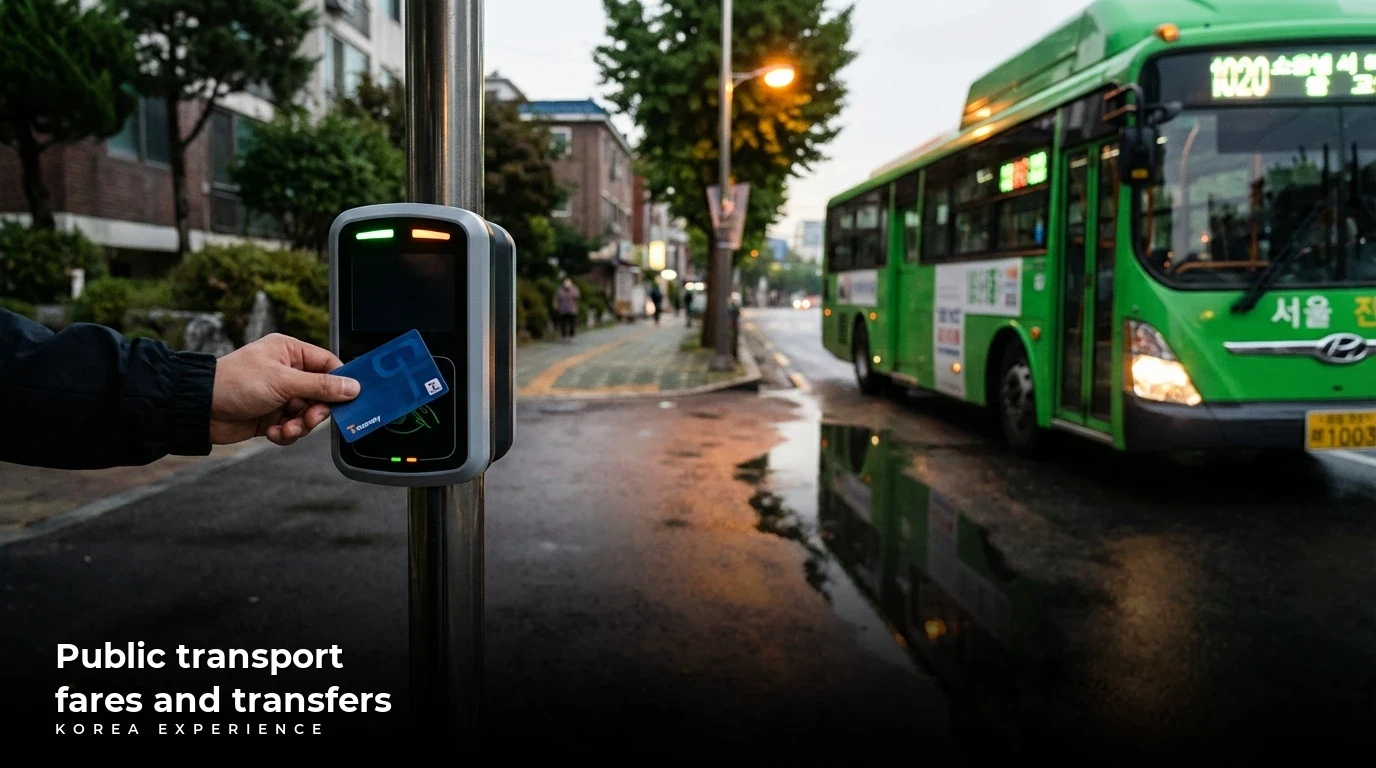
Seoul uses a transfer system. If you transfer between a bus and subway, or bus and bus, within 30 minutes (1 hour between 9 PM and 7 AM), you are not charged a new base fare. You only pay for the extra distance. You MUST tap your card when exiting the bus to trigger this discount.
Airport to City: The First Leg
Arriving at Incheon International Airport (ICN) can be overwhelming. You are roughly 48-60 kilometers away from central Seoul (Myeongdong/Hongdae/Gangnam). You have three primary options: The AREX Train, the Airport Limousine Bus, or a Taxi.
1. AREX (Airport Railroad Express)
This is generally the most reliable option as it is immune to Seoul's notorious traffic jams.
- Express Train: Non-stop to Seoul Station.
- Time: 43 minutes (Terminal 1), 51 minutes (Terminal 2).
- Cost: ₩11,000 (often discounted to ~₩9,500 if booked online via Klook or Trazy).
- Seat: Assigned seating, comfortable, free Wi-Fi.
- All-Stop Train: Stops at 13 stations including Hongik Univ. (Hongdae) and Gimpo Airport.
- Time: 59 minutes to Seoul Station.
- Cost: ₩4,150 - ₩4,750 (use your T-Money card).
- Seat: Subway-style bench seating. Can get very crowded during rush hour.
For a deeper dive into this specific choice, read our guide on Airport Limousine Bus vs AREX Express Train.
2. Airport Limousine Bus
These represent luxury buses that drop you closer to major hotels and tourist districts.
- Cost: ₩17,000 - ₩18,000.
- Comfort: Reclining leather seats, luggage handling by the driver.
- Route: Diverse routes covering Gangnam, Myeongdong, Dongdaemun, and Jamsil.
- Time: 70 to 100 minutes (highly dependent on traffic).
Incheon Airport to Seoul Station
| Feature | AREX Express | AREX All-Stop | Limousine Bus | Taxi |
|---|---|---|---|---|
| Cost | ₩11,000 | ₩5,000 | ₩18,000 | ₩70,000+ |
| Time | 43 mins | 59 mins | 70-90 mins | 60-80 mins |
| Comfort | High | Low (Crowded) | Very High | High |
| Traffic Risk | None | None | High | High |
The Seoul Subway: The Backbone of the City
The Seoul Metropolitan Subway is massive. With over 23 lines and hundreds of stations, it connects every corner of the capital and extends deep into Gyeonggi-do province.
Pricing Structure (2026)
- Base Fare: ₩1,400 (using T-Money) / ₩1,500 (single journey cash ticket).
- Distance Charge: Additional ₩100 for every 5km past the initial 10km.
- Deposit: If buying a single-journey ticket, you pay a ₩500 deposit, which you reclaim at a "Deposit Refund Device" at your destination station.
Key Lines for Tourists
- Line 2 (Green Line): The Circle Line. It connects the north (Hongdae, Ewha, City Hall) with the south (Gangnam, Jamsil, Samseong). It is the busiest line.
- Line 3 (Orange Line): The Culture Line. Connects Gyeongbokgung Palace, Bukchon Hanok Village (Anguk Station), Sinsa-dong (Garosu-gil), and Express Bus Terminal.
- Line 4 (Light Blue Line): Connects Myeongdong, Dongdaemun Design Plaza, and Seoul Station.
📊 Subway Scale
Navigation Tips
- Exits Matter: Seoul subway stations are underground cities. Gangnam Station has 12 exits; COEX (Samseong Station) has exits that lead directly into malls. Taking the wrong exit can mean a 20-minute walk above ground to cross a major intersection. Always check the map for your numbered exit.
- Color Coding: The floor of the station often has colored lines painted on it. Follow the green line to find the transfer to Line 2.
- Rush Hour: Avoid Line 2 and Line 9 (Express) between 8:00 AM - 9:00 AM and 6:00 PM - 7:00 PM unless you want to experience the "Hell Train" squeeze.
If you are planning a full day of sightseeing, check out our 24-hour Seoul itinerary to see how to chain these lines together effectively.
The Bus System: The Veins of the City
While the subway is great for long distances, buses are better for short hops and seeing the city views.
Bus Colors Explained
- Blue Buses (Main Line): Connect outer districts to the city center. Fare: ₩1,500.
- Green Buses (Branch Line): Connect residential areas to subway stations. Fare: ₩1,500.
- Yellow Buses (Circulation): Circle central business districts and tourist areas (like Namsan Tower). Fare: ₩1,400.
- Red Buses (Rapid): Express buses connecting Seoul to satellite cities (Bundang, Ilsan). Fare: ₩3,000+.
- Night Buses (Owl Bus - N): Run from 11:30 PM to 6:00 AM. Fare: ₩2,500. Essential for post-clubbing travel when subways are closed.
Bus Etiquette
- Boarding: Board at the front door, exit at the back door.
- Tapping: Tap your T-Money card upon entry AND exit. If you don't tap out, you won't get the transfer discount on your next ride, and you might be charged the maximum distance fare.
- Stopping: Press the red "Stop" button before your stop approaches. Korean bus drivers are notoriously fast; hold onto the handles tightly.
📋 Bus Essentials
Taxis and Ride-Hailing: Comfort & Convenience
Taxis in Korea are inexpensive compared to Tokyo or London. In 2026, the base fare has stabilized around ₩4,800 for standard taxis.
Types of Taxis
- Standard (Silver/Orange): Most common. Drivers may speak limited English.
- International/Black (Black with Gold Stripe): Premium service. Drivers speak English/Japanese/Chinese. No surcharge for late-night trips, but higher base fare (starts around ₩7,000-8,000).
- Large (Van): For groups of 5+.
Hailing a Taxi
You can flag them down on the street (look for a red LED sign in the window meaning "Empty" - Bin-cha), but using an app is vastly superior to avoid language barriers and destination confusion.
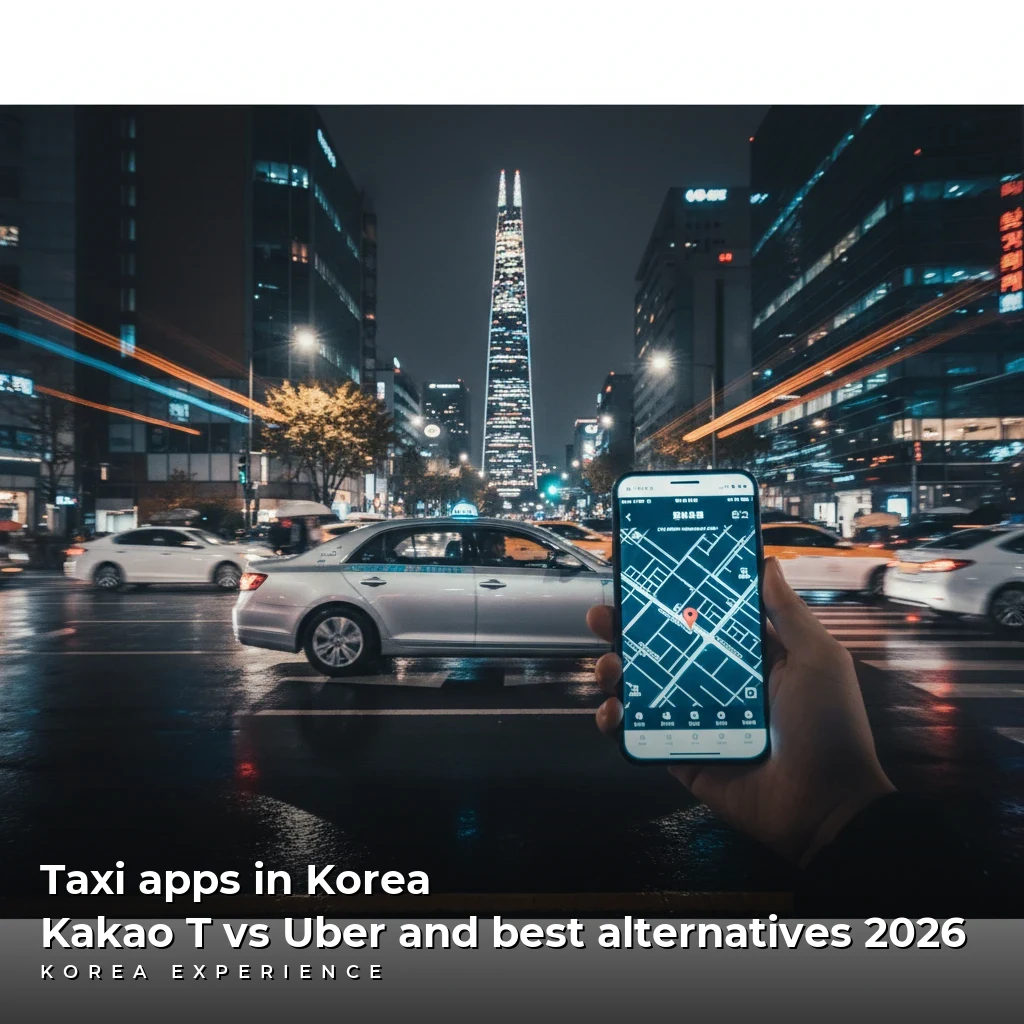
- Kakao T: The Uber of Korea. You do not need a Korean phone number anymore, but you usually need to register a card or select "Pay to Driver" if your foreign card gets rejected.
- Uber (UT): Uber operates in Korea as UT. It taps into the taxi network. If you already have the Uber app, it works seamlessly here, often making it the easiest choice for tourists.
💵 Taxi Fare Structure (2026 Estimates)
Orange/Silver cars. +20% surcharge 10PM-4AM.
Premium black cars. No night surcharge. Better service.
The 11 PM - 2 AM Crisis
Catching a taxi in Gangnam or Hongdae on a Friday or Saturday night between 11 PM and 2 AM is extremely difficult. Demand outstrips supply by a massive margin. Use the subway before it closes (approx 12 AM), or be prepared to wait 40+ minutes for a Kakao T assignment.
Navigation Apps: Google Maps vs. Naver Map
This is the most common pitfall for tourists. Google Maps does not work well for walking or driving directions in South Korea. Due to security laws regarding map data and North Korea, Google's data is limited and often outdated.
The Solution: Naver Map or KakaoMap
You must download Naver Map or KakaoMap. Both have English interfaces in 2026.
Naver Map Pros:
- Best for finding restaurant reviews and precise bus timings.
- Shows which subway car is closest to your transfer stairs (e.g., "Car 4-2").
- Indoor maps for COEX and large malls.
KakaoMap Pros:
- Often has a slightly cleaner English interface.
- Integrates well if you use KakaoTalk.
Naver Map for Tourists
- ✓Real-time bus arrivals
- ✓Subway exit details
- ✓English menu search
- ✓Street View is current
- ✗Requires learning UI quirks
- ✗Some place names still in Hangul
- ✗Review translation quality varies
Last Mile: Bikes and Scooters
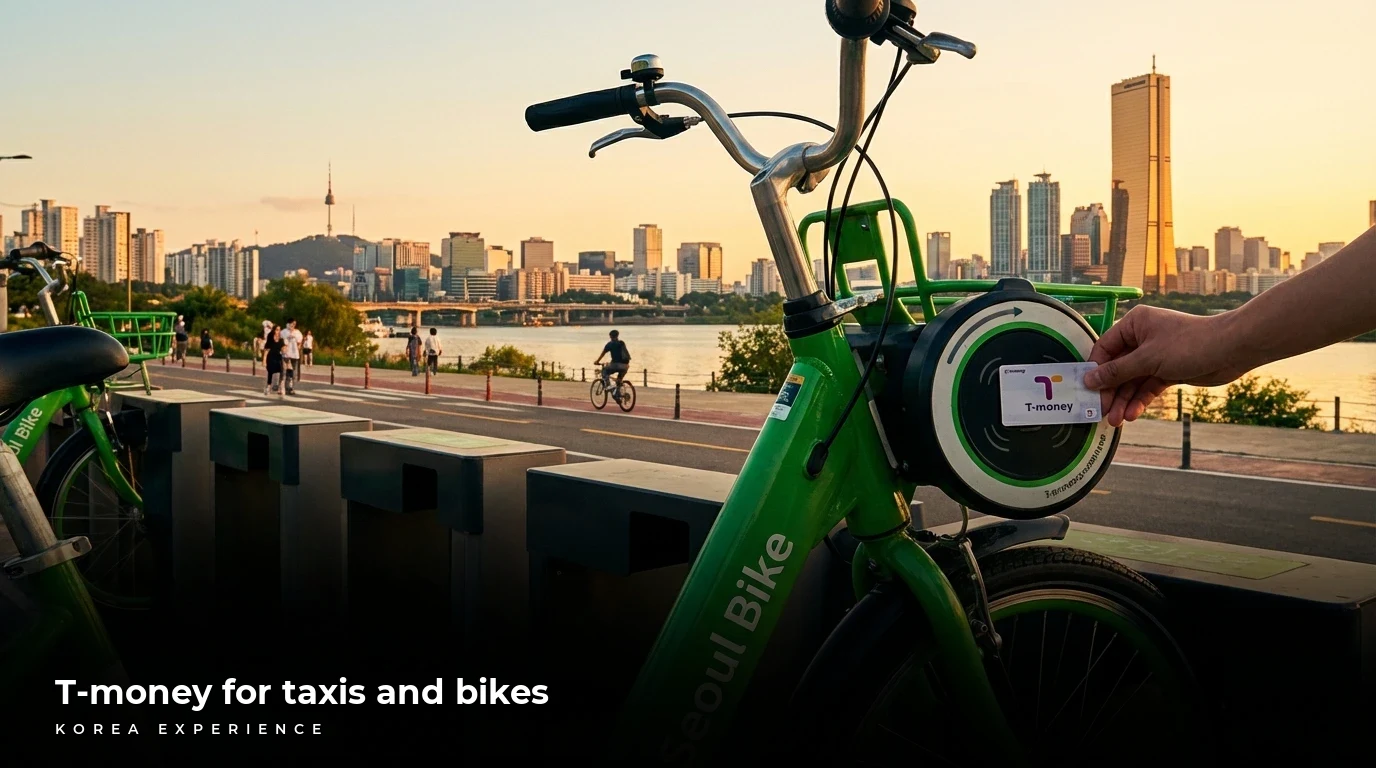
For short distances, or simply for a romantic ride along the Han River, Seoul's public bike system is phenomenal.
Ttareungi (Seoul Bike)
These are the green and white bikes docked all over the city.
- Cost: ₩1,000 for 1 hour.
- How to use: Download the "Seoul Public Bike" app. You can buy a pass as a "Non-member/Foreigner" using a credit card.
- Expert Tip: Purchase the 24-hour pass if you plan to ride along the Han River parks.
For a scenic route, check out our guide on bicycle rental systems in Seoul, Busan, and Jeju.
Electric Scooters (Kickboards)
Brands like Swing, Beam, and Deer are everywhere.
- Requirement: You legally need a valid driver's license (International Driving Permit) and a helmet. Police crackdowns in 2025 and 2026 have become strict. Fines for riding without a helmet or on sidewalks are ₩20,000 - ₩100,000. Use with caution.
Accessibility for Limited Mobility
Seoul has made massive strides in accessibility. By 2026, 96% of subway stations have elevators.
- Subway: Look for the wheelchair icon on Naver Map directions. It will route you to elevators rather than stairs.
- Buses: Low-floor buses (Blue/Green) are common. Yellow waiting zones at bus stops indicate where the wheelchair ramp will deploy.
- Taxis: "Wheelchair Taxis" can be booked via 120 (Dasan Call Center), though wait times can be long for non-residents.
For a comprehensive guide, read our dedicated article on accessible Seoul routes for wheelchair and limited mobility.
Intercity Travel: Leaving Seoul
If you are planning day trips to Suwon, Nami Island, or Busan, the system changes slightly.
- KTX/SRT (Bullet Trains): Fast, expensive. Seoul to Busan takes 2.5 hours and costs ~₩60,000. Book tickets 2-3 weeks in advance for weekends.
- Intercity Buses: Cheap, comfortable "Premium" buses with lay-flat seats.
- ITX-Cheongchun: The double-decker train to Chuncheon (Nami Island).
Looking for inspiration? Check our best day trips from Seoul 2026 guide.
Sample Route: A Day in Seoul
Here is how a typical day of transit looks and costs.
A Day Across the River: Hongdae to Gangnam
The Dualism Concept: Experience the best of both worlds — premium luxury moments paired with authentic budget-friendly experiences in one route.
Morning: Hongdae to Gyeongbokgung
Subway Line 2 → Line 3
Lunch: Gyeongbokgung to Insadong
Walking
Afternoon: Insadong to Gangnam
Bus 470 (Blue)
Night: Gangnam to Hongdae
Taxi (Late Night)
Use the subway during the day to beat traffic, but budget for a taxi home if staying out past midnight.
Expert Tips for 2026 Travelers
Don't throw away your receipt when topping up T-Money! If the machine malfunctions (rare, but it happens), that receipt is the only way to get your cash back from the station office. Also, on the subway, even if the "Pink Seats" (Pregnant Women) are empty and the train is packed, do not sit there. You will get dirty looks.
Frequently Asked Questions
❓ Seoul Transportation FAQ
Have more questions?Contact us →
Seoul's transportation system is a marvel of modern engineering—clean, punctual, and safe. While the map looks like a bowl of spaghetti initially, you will find that the color-coded logic and English signage make it one of the easiest systems in the world to master. Grab your T-Money card, download Naver Map, and explore the city with confidence.
About the Author
Korea Experience Team
Written by the Korea Experience editorial team - experts in Korean medical tourism, travel, and culture with years of research and firsthand experience.
Explore more in Travel & Tourism
From Seoul's neon-lit streets to Jeju's volcanic landscapes — discover the best of Korea with insider travel tips, itineraries, and seasonal guides.
Browse All Travel & Tourism ArticlesContinue Reading
Explore more articles you might find interesting
Master Seoul transit in 2026. Learn why T-money costs 4,000 KRW, how to rent 1,000 KRW bikes without an ARC, and the truth about the Climate Card for tourists.

Compare Wowpass vs. Namane for 2026. Learn why the 1,550 KRW subway fare means you need a Climate Card Tourist Pass to save money in Seoul.
Compare Kakao T and Uber in Korea for 2026. Discover prices starting at ₩4,800, foreign card tips, and how to navigate Seoul like a local.
Discover 2026 Seoul transit updates including the 1,550 won base fare and new Climate Card options that save money for travelers taking over 3 rides daily.
Save money in Seoul with the 2026 Climate Card. We analyze if the 62,000 KRW monthly pass beats T-Money for your 30-day stay based on 40 rides.
If you're planning to hit more than three spots a day in Seoul, the Climate Card is your absolute best friend.