5 Hidden Hanok Villages in South Korea: 2026 Travel Guide
Escape the crowds with our 2026 guide to 5 secret hanok villages. Discover 6000m of historic walls and authentic stays starting at just ₩50,000 per night.
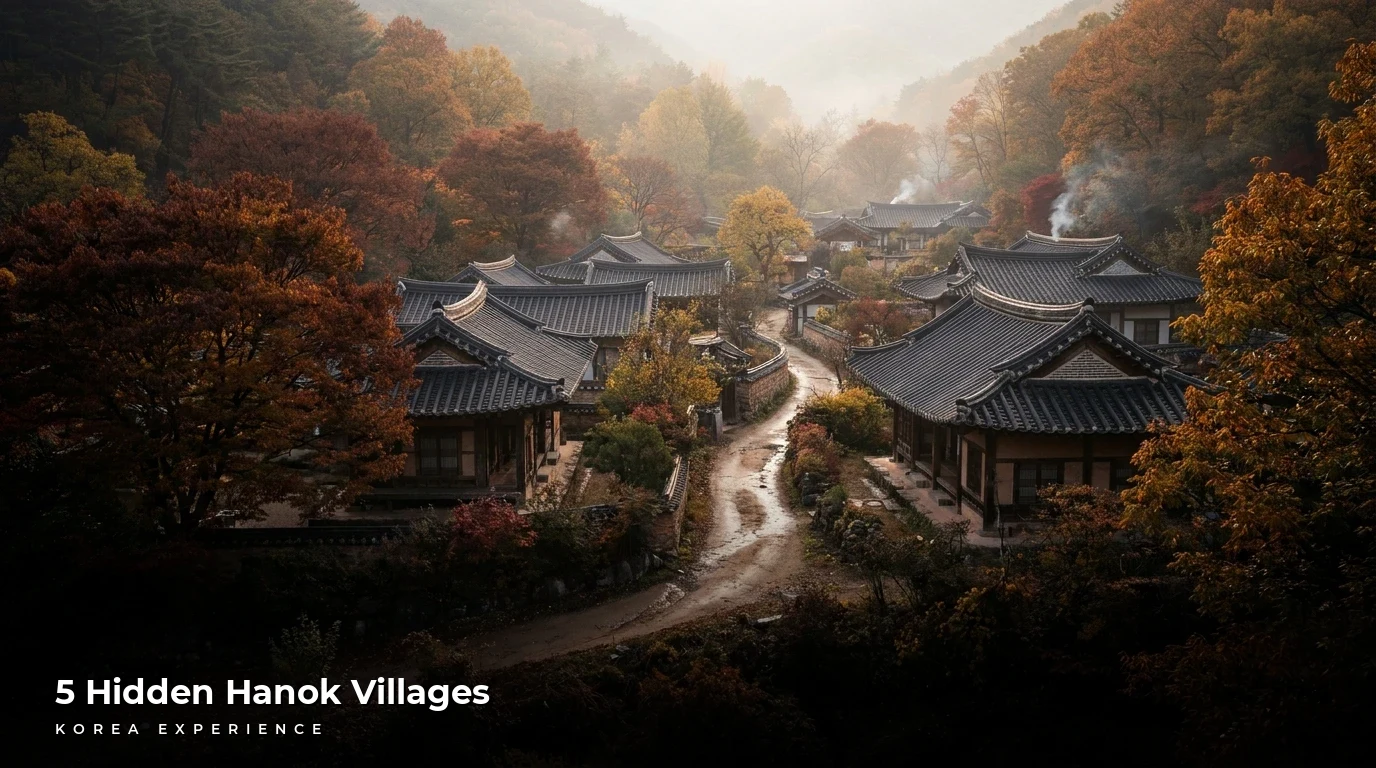
So you want to experience a traditional Korean hanok village without fighting thousands of tourists for a single photo? Grab a cup of coffee, because we are about to show you five secret, history-packed villages where time literally stands still—and tell you exactly how to get there.
South Korea's hidden hanok villages offer authentic alternatives to overcrowded tourist hotspots. While Seoul's Bukchon Hanok Village remains a staple on every standard itinerary, extreme overtourism has led to resident fatigue, restricted visiting hours, and a highly commercialized atmosphere. Rural hanok villages, on the other hand, provide immersive historical experiences. Villages like Oeam, Wanggok, Gurim, and Hangae are living museums where descendants of original clans still reside, offering unparalleled insights into Joseon-era architecture and daily life.
For time-strapped travelers, modern alternatives also exist. Eunpyeong Hanok Village, established in 2014, provides a tranquil, neo-hanok experience within Seoul city limits, perfectly blending traditional aesthetics with modern comforts. However, preparation is crucial for rural Korean travel. Navigating to these hidden gems requires familiarity with local transit apps, an understanding of traditional accommodations like ondol floor heating, and solutions for travelers without a Korean Resident Card. Let us dive into the ultimate guide to exploring these architectural wonders in 2026.
Key Takeaways
- 1Escape central Seoul to discover massive traditional estates where real people still live and preserve ancient culture without the screaming crowds.
- 2Wander through 6,000 meters of gorgeous ivy-covered stone walls in Oeam Folk Village, enjoying Joseon-era aesthetics almost entirely to yourself.
- 3Download Naver Map and Kakao T immediately, as these two apps are your ultimate lifelines for finding regional buses and calling taxis in the countryside.
📋 Quick Facts
Skip the Bukchon Crowds (Here is the Answer!)
The short answer is this: If you want to experience the true magic of traditional Korean architecture in 2026, you need to skip the overcrowded streets of Seoul's Bukchon and head to Korea's hidden, rural hanok villages. Look, we get it. You have seen the aesthetic photos on social media. You have pictured yourself wandering down a steep hill bordered by elegant swooping roofs, dressed in a colorful hanbok, with the N Seoul Tower glittering in the distance. Bukchon Hanok Village is absolutely gorgeous, and for decades, it has been the undisputed king of cultural tourism in South Korea.
But here is the reality nobody tells you on social media: Bukchon is suffering from massive over-tourism. It is a residential neighborhood that was never actually designed to handle tens of thousands of international tourists daily. The noise, the litter, and the sheer volume of people have led to strict curfews, fines for tourists, and frustrated locals holding up signs begging visitors to keep their voices down. Taking a peaceful stroll is almost impossible when you are bumping elbows with a dozen different tour groups all fighting for the exact same photo spot.
So, what is the alternative? Enter the hidden hanok villages. South Korea is dotted with incredible, living, breathing traditional villages that tourists rarely visit. We are talking about places like Oeam Folk Village in Asan, Wanggok Village up by the East Sea, the ancient Gurim Village down south, the spiritually aligned Hangae Village in Seongju, and even the modern, peaceful Eunpyeong Hanok Village right on the edge of Seoul. If you want to explore even more options, check out our comprehensive Historic Hanok Villages Beyond Bukchon: 2026 Travel Guide.
These aren't just empty museum exhibits or highly commercialized tourist traps. For the rural villages, these are genuine communities where descendants of the original founding clans still live today. They still farm the land. They still re-thatch their roofs by hand every single year. They still dry red peppers on bamboo mats in the sun. And best of all? They are remarkably quiet.
When you step into a village like Oeam, you are greeted by an incredible 6,000 meters of ivy-covered stone walls. You hear the croaking of frogs in the nearby lotus ponds and the gentle trickling of water through ancient irrigation streams. It is a completely different atmosphere. You aren't just observing Korean history; you are standing inside it.
Furthermore, exploring these hidden gems is surprisingly budget-friendly. While a trendy hanok stay in central Seoul might cost you hundreds of dollars, rural stays can be booked for as little as ₩50,000 to ₩80,000 a night. That is the price of a budget hotel, but you get to sleep in a 500-year-old estate! If you are willing to navigate a few regional buses and step slightly outside your comfort zone, these five hidden villages will give you the authentic Korean experience you originally came looking for. Trust us on this one—leave Bukchon to the masses and head for the hills.
Gurim Village Foundations
The area around Gurim Village began its incredible history, making it one of the oldest continuously inhabited spaces in the country.
Wanggok Village Settled
The Ham and Choi clans settled in the Goseong area, building unique northern-style houses to survive the brutal winters.
Hangae Village Established
Yi U of the Seongsan Yi Clan settled in Seongju, establishing a village strictly designed around traditional feng shui principles.
Oeam Village Expands
Scholar Yi Gan and the Yean Yi Clan settled at the foot of Seolhwasan Mountain, shaping the village we see today.
Eunpyeong Hanok Village Built
Seoul completed its massive neo-hanok project at the base of Bukhansan Mountain, creating a modern alternative to Bukchon.
Travel Trends Shift
With Bukchon implementing stricter tourist curfews, travelers actively seek out rural, lesser-known villages for authentic stays.
The Fascinating Background Story
To really appreciate these hidden villages, you have to understand a little bit about how they survived the relentless march of time. Let us tell you, Korean history is anything but boring. It is a rollercoaster of brilliant dynasties, devastating invasions, rapid modernization, and a deep, enduring respect for the land.
Let us start with the absolute granddaddy of them all: Gurim Village in Yeongam. While most hanok villages date back to the Joseon Dynasty (1392–1910), Gurim’s history stretches back a mind-boggling 2,200 years. This place has been continuously inhabited since the Three Han States period! It was here that Dr. Wangin, a legendary Baekje scholar, packed his bags over 1,600 years ago, took the Thousand-Character Text, and sailed off to Japan to spread writing, culture, and art. Gurim is also home to the site of Korea's oldest known glazed pottery kilns. Walking through Gurim isn't just looking at old houses; it is walking on the foundational bedrock of Korean civilization.
Fast forward to the Joseon Dynasty, the era that birthed the classic hanok aesthetic we know today. During this time, powerful noble clans began establishing deeply rooted communities based on strict Confucian and feng shui principles. Take Hangae Village in Seongju, for example. In the 15th century, a high-ranking official named Yi U settled here. His descendants, the Seongsan Yi Clan, meticulously laid out the village to harmonize with the surrounding mountains and streams. The layout was so pristine and energetically sound that King Sejong the Great—the beloved king who invented the Korean alphabet—chose a nearby peak to build placenta chambers for 18 of his sons. Yes, you read that right. Royal placenta chambers. It was believed that storing them in this highly auspicious area would ensure the prosperity of the royal lineage.
Over in Asan, the Yean Yi Clan was doing something similar around the 16th century. A brilliant scholar named Yi Gan, whose pen name was Oeam, helped shape what is now Oeam Folk Village. What makes Oeam so fascinating historically is its rigid social structure frozen in time. You can walk down the dirt paths and literally see the class divide: the massive, sprawling estates with sweeping tile roofs (giwa) belonged to the nobility, while the smaller, charming houses with thatched roofs (chogajip) belonged to the commoners and farmers. Yet, they all lived together, utilizing a brilliant shared waterway system that connected every garden to a main stream.
But it wasn't all peaceful farming and poetry. Korea's history is scarred by invasions, notably the devastating Japanese invasions in the late 1500s (the Imjin War) and the Korean War in the 1950s. Many traditional villages were completely wiped off the map. Wanggok Village, located way up the East Coast in Goseong, managed to survive mostly because it was geographically hidden. Nestled in a valley surrounded by five distinct mountain peaks, Wanggok was literally shielded from wars and even mountain wildfires. Because of this isolation, the Ham and Choi clans preserved a very unique northern style of architecture, building double-winged houses to trap heat during the brutal coastal winters.
And then there is Eunpyeong. Unlike the others, Eunpyeong Hanok Village is a baby. It was established in 2014 by the Seoul city government. Why? Because the city realized people loved hanoks, but living in a 500-year-old drafty house in the modern age can be miserable. Eunpyeong was an experiment in neo-hanoks—building homes that look 100% traditional on the outside but feature modern insulation, plumbing, and double-paned windows on the inside. It is a fascinating modern chapter in the ongoing story of Korean architecture.
| Feature | Eunpyeong (Seoul) | Oeam (Asan) | Gurim (Yeongam) |
|---|---|---|---|
| Cost | High (Premium cafes) | Budget-friendly | Mid-range rural |
| Travel Time | 40 mins from central Seoul | 1.5 hours via KTX | 4 hours via KTX to Mokpo |
| Ideal Duration | Half-day trip | Full day or 1 night | 2-3 day deep dive |
| Requirements | T-Money card | Basic phrases help | Car rental or bus planning |
| Best For | Time-strapped tourists | Drama fans & families | Deep history buffs |
| 2026 Changes | Increased gallery spaces | Interactive workshops | Expanded English signage |
Breaking Down Your Options
So, which hidden hanok village is right for you? It completely depends on what kind of traveler you are, how much time you have, and what kind of aesthetic you are chasing. Let us break down your options so you do not waste a single day of your trip.
1. The Time-Strapped Aesthete: Eunpyeong Hanok Village (Seoul)
If you are only staying in Korea for 3 or 4 days, let us be realistic: you do not have time to take a cross-country bus to a remote farming village. Eunpyeong is your savior. Located at the foot of the breathtaking Bukhansan Mountain, it is still technically inside Seoul. You just hop on Subway Line 3 to Gupabal Station, take a 10-minute bus (Bus 7723), and you are there. The vibe here is pristine, upscale, and incredibly photogenic. Because these are neo-hanoks, you will not see rustic thatched roofs; instead, you get rows of immaculately clean, towering tile-roofed mansions.
The highlight? The 1in1jan cafe. Buy a coffee, head to the top floor, and look down over the village with the jagged mountain peaks in the background. It is also home to the Eunpyeong History Hanok Museum and the gorgeous wooden trails leading to Jingwansa Temple. It is the ultimate half-day trip. If you are looking to spend 24 hours here, you can mix luxury and budget options. Start with a $15 premium artisanal coffee at 1in1jan, spend $1 at the History Museum, take a free walk up the valley to Jingwansa Temple, and if you want to splurge, check into a premium neo-hanok boutique guesthouse for $250+ a night. For more on traditional cafe culture in the city, read our Insadong Tea Houses 2026 Hidden Hanoks & Traditional Brews Guide.
2. The K-Drama Enthusiast: Oeam Folk Village (Asan)
If you loved watching historical dramas and want to feel like you have time-traveled to the Joseon era, Oeam is your spot. Located about 1.5 hours south of Seoul, it is incredibly accessible for a day trip. You can take the KTX to Cheonan-Asan Station, followed by a local bus or a 25-minute taxi ride. This is a living museum, making it a favorite filming location for movies like Taegukgi and dramas like Missing: The Other Side 2.
What you will love here are the 6,000 meters of meandering stone walls and the juxtaposition of noble mansions next to humble thatched-roof cottages. If you are visiting in summer, the lotus flower ponds are mind-blowing. Make sure to grab some bukkumi (sweet pan-fried rice cakes) from a local vendor. Entry is incredibly cheap, usually around ₩2,000 (about $1.50), and the village is open from 09:00 to 18:00 in the summer.
3. The Coastal Road-Tripper: Wanggok Village (Goseong)
For travelers renting a car to explore Korea's rugged East Coast, Wanggok is a mandatory pit stop. Tucked away in Gangwon province near the famous Songjiho Beach, this village feels like a secret hideaway. You can reach it by taking an intercity bus to Goseong, then a 15-minute taxi ride. If you are exploring this northern region, you might also find our DMZ Visit Guide 2026: Tours, Tips & What to Expect highly useful.
What makes Wanggok special is the architecture. Because it gets freezing up north, the houses here have a unique double-winged shape and feature barns built right into the front of the kitchen so the livestock could share the heat. You will also notice the weird, jar-shaped chimneys—these were designed specifically so sparks would not fly up and set the thatched roofs on fire. It is quiet, rustic, and incredibly atmospheric. Just remember to keep your voices down at night; the village echoes and real families sleep here!
4. The Deep History Buff: Gurim Traditional Hanok Village (Yeongam)
If you want to go deep—like, 2,200 years deep—you head south to Gurim in Jeollanam-do. This is for the slow traveler who wants to spend a few days exploring. Nestled by the stunning Wolchulsan National Park, Gurim is vast and unpretentious. You can take a bus to Yeongam Terminal, then transfer to local transit.
Here, you can visit the Yeongam Pottery Museum, explore 12 historic pavilions, and hike up to Dogapsa Temple. If you visit in April during the Wangin Culture Festival, the entire area erupts in a tunnel of white cherry blossoms. It is a long journey from Seoul, but deeply rewarding. You can even book a rural minbak (guesthouse) for around ₩50,000 a night for a basic, authentic floor-sleeping experience in a local family's traditional home.
5. The Soul Searcher: Hangae Village (Seongju)
Located in Gyeongsangbuk-do, Hangae is for the traveler who wants utter peace and quiet. The village is built purely on feng shui principles, so walking its ancient clay and stone paths just feels incredibly grounding. You can reach it by taking a bus to Seongju Terminal, followed by a local taxi.
It is far less commercialized than other famous villages. Here, you can rent a hanbok from the village shop, wander the serene pathways, and actually book a stay in the Sarangchae (guest quarters) of a 600-year-old mansion like Jinsa's House for around ₩80,000 a night. It is a place to turn off your phone, read a book, and listen to the wind.
Pros
- ✓Experience authentic peace and quiet without the overwhelming crowds found in central tourist hotspots.
- ✓Save serious money with basic rural stays costing half of what you would pay in the city.
- ✓Immerse yourself in living history by walking past actual residents farming and preserving their ancestral homes.
Cons
- ✗Navigating intercity buses and rural transit requires patience and reliable mapping apps.
- ✗Creature comforts are limited to traditional floor mattresses and sometimes shared bathroom facilities.
- ✗The language barrier is significant outside the city, requiring heavy reliance on translation apps.
The Complete How-To
Alright, you have picked your village. Now, how do you actually pull this off? Traveling through rural Korea in 2026 is vastly easier than it was a decade ago, but it still requires a specific playbook.
📖 How to Plan and Execute a Rural Hanok Stay in 2026
Step 1: Choose Your Vibe and Region
Decide if you want a quick photoshoot with mountain backdrops, coastal breezes, or deep history. Match your village choice to your existing itinerary.
Step 2: Secure Your Transportation Apps
Download Naver Map for navigation and Kakao T for hailing taxis. Use Papago for the most accurate translations.
Step 3: Book Your Hanok Stay
Use platforms like Trazy or Klook for pre-packaged tours, or ask your hotel concierge to call the village administration office to reserve a room.
Step 4: Pack Like a Local
Bring mosquito repellent, slip-on shoes for easy entry into buildings, and extra snacks since rural areas lack convenience stores.
I cannot stress this enough: delete Google Maps from your brain while you are here. Because of national security laws, Google Maps cannot provide accurate walking or driving directions in South Korea. You must download Naver Map or KakaoMap. Both have excellent English interfaces now. If you are going to Oeam Village, you type the romanized or translated name into Naver Map, and it will tell you exactly which KTX train to take to Cheonan-Asan Station, and which local green bus will drop you at the village entrance.
If you are heading to Gurim or Wanggok, you need to ride the fantastic Korean intercity bus network. You have two options here. You can use the T-Money Go app to book tickets, but sometimes it gets finicky with foreign credit cards. The foolproof method? Take the subway to the Express Bus Terminal in Seoul (or Dong Seoul Terminal), walk up to the automated kiosks, select English, and buy your ticket with your physical Visa or Mastercard. The buses are cheap, incredibly punctual, and the Premium class buses literally have reclining leather seats that feel like first-class airplane pods.
Booking the hanok stay is where it gets slightly tricky. Eunpyeong has luxury hanoks listed on international booking sites. But for rural stays in places like Hangae or Gurim, the listings are usually on local Korean websites. If you do not speak Korean, do not panic. You can use platforms like Klook or Trazy, which frequently offer overnight tour packages to these exact villages. If you want to do it independently, call the 1330 Korea Travel Hotline. This is a free, government-run service. An English-speaking operator will literally call the hanok owner in Seongju or Yeongam, check availability, and make the reservation for you. For more tips on using this incredible service, read our guide on the 1330 Travel Helpline: Your Secret Weapon for Surviving Korea (2026).
When you arrive at a living village like Oeam or Wanggok, remember that this isn't a theme park. People live here. Take your shoes off before stepping onto the wooden porch (maru) of any building. Keep your voices low, especially after sunset. Rural Korea goes to bed early. And when it comes to food, do not expect a menu with 50 items. You will likely walk into a local village restaurant, hold up two fingers, and the grandmother running the place will bring you whatever she cooked that day—usually a spectacular array of side dishes (banchan), some soybean paste stew (doenjang jjigae), and perfectly fermented kimchi. Eat it all, smile, and say "Jal meok-get-seum-ni-da" (I will eat well).
Everyone rushes to Bukchon for that one iconic downhill photo, but the real magic of Korea's architecture is how it harmonizes with raw nature. When you stay in a place like Wanggok or Hangae, you are forced to slow down. Waking up to the smell of woodsmoke and misty mountains, with zero traffic noise, completely changes how you understand this country's soul.
The Stuff Nobody Tells You
Let us have a real talk about what staying in a traditional Korean hanok is actually like, because the aesthetic social media reels leave out a few crucial details.
First, let us talk about the floor. Traditional hanoks do not have Western beds. You will be sleeping on a yo, which is a traditional quilted mattress placed directly on the floor. If you are staying in a luxury neo-hanok in Eunpyeong, that mattress might be thick and plush. If you are staying in a budget rural minbak (guesthouse) in Gurim or Hangae, it might be shockingly thin. If you have severe back issues, you need to mentally prepare for this.
However, the floor is also the greatest part of the hanok experience because of ondol. Ondol is the traditional Korean underfloor heating system. In the old days, they lit a fire under the house and the smoke traveled through flues under the stone floor. Today, it is mostly done with hot water pipes or electricity, but the result is the same: the floor gets radiantly, beautifully warm. In winter, coming inside from the freezing cold and laying your back flat on a baking hot ondol floor is one of the greatest feelings on earth. Just be warned: locals like their ondol hot. You might wake up sweating in January!
Next: nature. Hanoks are built to harmonize with nature, which means nature will sometimes come inside. In the summer, villages like Oeam and Wanggok are incredibly lush, surrounded by streams and rice paddies. This means mosquitoes, spiders, and the occasional frog. You are in the countryside. Embrace it, but pack some bug spray.
Also, be prepared for the bathroom situation. While almost all tourist hanoks now feature modernized, indoor plumbing, they are often wet rooms—meaning the showerhead is attached to the sink and sprays directly onto the bathroom floor. There is no bathtub or glass shower enclosure. This is standard across much of Korea, but it can catch Western tourists off guard. Bring waterproof slippers!
No Resident Card? Here is What To Do
If you are a tourist without an Alien Registration Card (ARC) or a local Korean phone number, booking rural transport and accommodations can be a nightmare because many local websites require identity verification to process payments.
The Solution:
- For Transport: Buy the Korea Tour Card (a tourist-exclusive transit card) at the airport. For intercity buses, go to the bus terminal in person to buy tickets with cash or a foreign credit card instead of trying to use local apps that block foreign cards.
- For Booking: Use international concierge services or ask the 1330 Korea Travel Hotline (a free, 24/7 government-run multilingual tourist service available via app or phone) to help you call rural hanok owners and secure your booking. They are absolute lifesavers!
If you are stuck in a rural village and need a taxi, but the local ride-hailing app will not let you register your foreign card, what do you do? First, ask your hanok host to call a local taxi dispatcher for you. Second, carry physical cash. Rural taxi drivers vastly prefer cash anyway. Third, always have your destination written down in the local alphabet on a piece of paper or saved as a screenshot. The English name of the village means nothing to a 70-year-old taxi driver in Asan. If you are just arriving in the country and need to get your bearings on transport cards and cash, read our Incheon Airport Survival Guide 2026: Tips for First-Time Arrivals.
❓ Frequently Asked Questions
Have more questions?Contact us →
Conclusion: Your Action Plan
So, what should you do right now? If you are planning a trip to Korea in 2026, take one day out of your crowded city itinerary and dedicate it to a hidden hanok village.
If you are nervous about leaving the city, start easy. Take the subway to Eunpyeong Hanok Village. Grab a coffee, walk the mountain trails, and soak in the modern traditional architecture without the stress of massive crowds. But if you have an adventurous spirit? Book a KTX ticket, head down to Asan to walk the stone walls of Oeam, or journey to the East Coast to see the unique chimneys of Wanggok.
Download your mapping apps, embrace the warm ondol floors, and get ready to experience a side of Korean history that most tourists never even realize exists. Have an amazing trip, and do not forget to try the local food!
Sources:
- Visit Korea (Official Tourism) - Entry fees, hours, and filming locations for Oeam and Wanggok.
- Korea By Bike - History of Wanggok village, double-winged houses, and overturned jar chimneys.
- Visit Seoul (Official) - Information on Eunpyeong Hanok Village, 1in1jan cafe, and Jingwansa temple.
- Interesting Korea - History of Hangae village, Seongbaksup forest, and feng shui layout.
- TripPose - Details on Gurim village, Dr. Wangin, and the cherry blossom festival.
- The Wandering Whittens - Details on Oeam Folk Village's history, stone walls, and local cuisine.
About the Author
Korea Experience Team
Written by the Korea Experience editorial team - experts in Korean medical tourism, travel, and culture with years of research and firsthand experience.
Explore more in Travel & Tourism
From Seoul's neon-lit streets to Jeju's volcanic landscapes — discover the best of Korea with insider travel tips, itineraries, and seasonal guides.
Browse All Travel & Tourism ArticlesContinue Reading
Explore more articles you might find interesting
Discover 5 authentic Hanok villages beyond Bukchon. Explore Eunpyeong, Jeonju, and Andong with full price guides, travel times, and stay tips for 2026.

Discover Korea's best farm stays for 2026. From strawberry picking in Nonsan to Hanok stays in Andong, find prices starting at ₩50,000 per night.

Escape Seoul's crowds to Incheon's hidden islands. Discover Deokjeokdo, Seonjaedo, and more with ferry schedules, ₩50,000 budgets, and travel tips.

Discover how traveling to Korea in January or July cuts costs by 40% with flight deals under $800 and luxury stays for ₩150,000.

Discover 10 secret autumn spots in Korea away from crowds. Includes 2026 peak foliage dates, transport costs, and specific hiking routes for the perfect trip.

Discover why 57% of 2025 medical tourists chose dermatology and how recovering in a luxury Hanok for $250 a night is the ultimate 2026 healing hack.