DMZ vs JSA vs Tunnel tours: Which is the best choice for 2026?
Compare DMZ Tunnel tours ($50) vs JSA Panmunjom ($120). Discover the best Korean border experience, booking rules, and passport requirements for 2026.
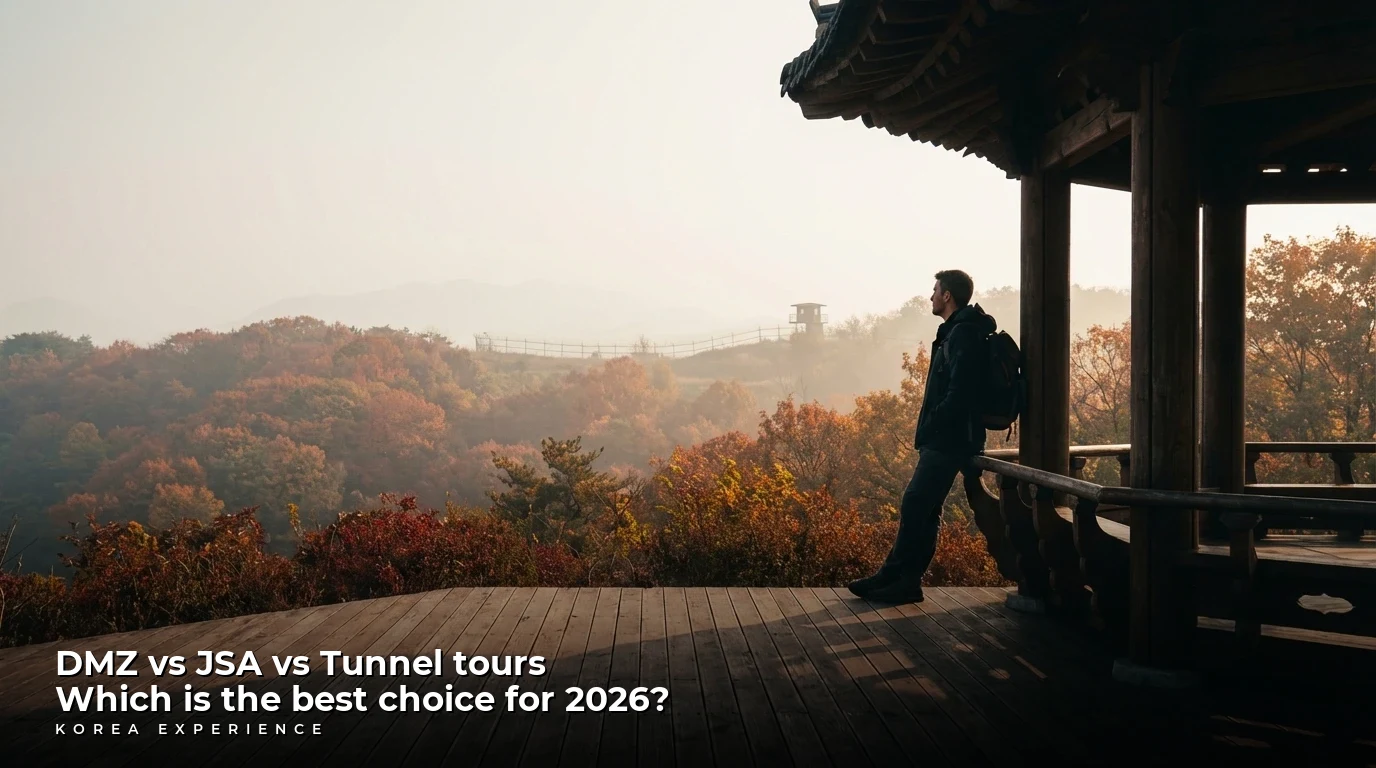
Deciding between a standard DMZ (Demilitarized Zone) tour that includes the Third Infiltration Tunnel and the more elusive JSA (Joint Security Area) Panmunjom tour is the most common dilemma for travelers visiting Korea in 2026.
The short answer: The "Third Tunnel & Dora Observatory" tour is the most reliable and physically active option for 2026, costing around $45–$60 USD and requiring 1–2 weeks' advance booking. The JSA (Panmunjom) offers a more intense, historical experience where you stand feet away from North Korean soldiers, but it is frequently suspended due to geopolitical tensions, costs significantly more ($100+ USD), and often requires booking 2–3 months in advance.
For 90% of travelers in 2026, the Third Tunnel tour is the "better" choice simply because it is consistently open, whereas the JSA remains a high-risk gamble regarding availability. However, if the JSA is open during your visit, it remains the gold standard for "dark tourism" globally.
Key Takeaways
- 1JSA tours allow you to step slightly into North Korea but are frequently cancelled in 2026
- 2The Third Tunnel tour is physically demanding with a 350m steep walk but is reliably open
- 3Book DMZ tours at least 10 days in advance; JSA requires 2-3 months lead time
Understanding the Geography: DMZ, JSA, and the Tunnel
To make an informed decision, you must first understand that these terms are often used interchangeably by tourists but refer to vastly different geographic and logistic experiences. The DMZ is the 4km-wide buffer zone running across the Korean peninsula. Inside this zone, there are specific points of interest.
1. The DMZ (Demilitarized Zone)
This is the general buffer strip established in 1953. It is 250km (160 miles) long and 4km (2.5 miles) wide. Civilians cannot enter the DMZ freely; you must be on an authorized tour. Most "DMZ Tours" actually take you to the edge of the DMZ (the Civilian Control Line) and specific secure sites within it.
2. The JSA (Joint Security Area / Panmunjom)
This is the famous blue-building area often seen on the news where summits are held. It is the only place where North and South Korean forces stand face-to-face. It is located inside the DMZ. A tour here is strictly controlled by the United Nations Command (UNC).
3. The Third Infiltration Tunnel
Discovered in 1978, this is a tunnel dug by North Korea to invade the South. It is located near Paju, about 52km (32 miles) from Seoul. A "Tunnel Tour" usually includes the Dora Observatory and Dorasan Station.
2026 Status Update
As of early 2026, JSA tours are operating on a limited schedule due to lingering security protocols following border incidents in previous years. Cancellations can occur as late as the morning of the tour. Always have a "Plan B" if you book the JSA.
Option A: The Third Infiltration Tunnel Tour (The Standard Choice)
The Third Infiltration Tunnel tour is the bread and butter of Korean border tourism. It is efficient, educational, and offers a physical connection to the history of the conflict.
What to Expect
This tour typically departs from Seoul around 7:00 AM or 8:00 AM. The drive to Imjingak Park (the staging ground) takes approximately 60 minutes. From there, you board a designated DMZ shuttle bus or continue with your approved tour bus into the Civilian Control Zone (CCZ).
The highlight is the tunnel itself. It is located 73 meters (240 feet) underground. You will don a hard hat and walk down a steep 350-meter intercept tunnel before reaching the actual infiltration tunnel. The total length of the tunnel is 1,635 meters, but tourists can only walk about 265 meters of it until they reach the first concrete barricade.
📋 Tunnel Tour Specs
The Physical Reality
The walk back up is strenuous. It is a steady, steep incline that leaves many visitors out of breath. There is a monorail option for those with limited mobility, but tickets for the monorail are limited and often sell out immediately upon the ticket office opening at 9:00 AM.
Dora Observatory
Included in this tour is the Dora Observatory. In 2026, the observatory features high-powered digital binoculars (some free, some coin-operated at ₩500). From here, you can clearly see the North Korean propaganda village of Kijong-dong, the Kaesong Industrial Complex, and the bronze statue of Kim Il-sung on a clear day. The distance to Kijong-dong is only about 1.2 kilometers.
Dorasan Station
This is the northernmost railway station in South Korea, completed in 2002. It stands empty, waiting for the day trains might run to Pyongyang (205km away) and eventually onto the Trans-Siberian Railway. It is a hauntingly beautiful, modern, yet silent facility.
Tunnel Tour Analysis
- ✓High reliability (rarely cancelled)
- ✓No dress code restrictions
- ✓Includes Imjingak Park and Freedom Bridge
- ✓Can be booked 1-2 weeks in advance
- ✗Physically demanding walk (steep slope)
- ✗Crowded with large tour groups
- ✗You do not see North Korean soldiers close up
- ✗No photography allowed inside the actual tunnel
Option B: The JSA / Panmunjom Tour (The Premium Choice)
The Joint Security Area tour is fundamentally different. It is not about hiking or physical exertion; it is about tension, history, and psychological weight.
The Experience
The tour begins with a briefing at Camp Bonifas by UN Command or South Korean military personnel. You are then bused into the JSA. The atmosphere is serious. You will sign a waiver acknowledging that you are entering a hostile area where injury or death could result from enemy action.
The climax is standing in the Conference Row. You will see the famous blue T2 and T3 buildings. If the situation permits, you may be allowed inside the T2 building. Inside, a conference table straddles the Military Demarcation Line (MDL). By walking to the far side of the table, you are technically standing inside North Korean territory.
The View
Outside, you will stand on the steps of the Freedom House and look directly at the Panmun Pavilion (the North Korean building). You will likely see North Korean soldiers looking back at you with binoculars. The distance is less than 100 meters. The silence is palpable.
Restrictions in 2026
The rules for the JSA have tightened.
- Nationality: Citizens of certain countries require additional background checks taking up to 4 weeks.
- Dress Code: Strictly enforced. No ripped jeans, no sandals, no military-style clothing, no sports jerseys.
- Age: Children under 11 (sometimes 12, depending on the operator) are typically not allowed.
"In the JSA, never point your finger or make gestures towards the North Korean side. They photograph everything. Your casual gesture could be used in propaganda to show 'American imperialist aggression.' Stand still, listen to your escort, and only take photos when explicitly told."
Detailed Cost and Value Comparison
When planning your budget for 2026, it is important to realize that the "DMZ" is not a single ticket. It is a package sold by private tour operators authorized by the government.
💵 2026 Tour Price Comparison
Premium, high-tension history tour. Includes lunch.
Standard half-day tour. Bus transport included.
The JSA tour is significantly more expensive due to the specialized military escorts, insurance requirements, and the limited number of daily slots (often capped at fewer than 200 people per day for the whole industry). The Tunnel tour handles thousands of visitors daily, allowing for economies of scale.
Time Investment
- Tunnel Tour: Usually a half-day trip (8:00 AM – 2:00 PM). You can be back in Seoul for a late lunch.
- JSA Tour: Usually a full-day commitment (8:00 AM – 4:00 PM or later), often combined with lunch near the unification bridge.
- Combined Tour: Some operators offer a "DMZ + JSA" combo. This is an exhausting 10-hour day, costing upwards of $200 USD.
For travelers looking to maximize their time, the Tunnel tour allows you to fit in an evening activity, perhaps exploring the night markets of Seoul or a nice dinner.
Booking Logistics: The Hard Reality of 2026
Booking a DMZ tour is not like booking a Namsan Tower ticket. You cannot just show up.
Passport is Mandatory
You absolutely must bring your physical passport on the day of the tour. A photocopy or a photo on your phone is not accepted by the military checkpoint at the Unification Bridge (Tongil-daegyo). If you forget it, you will be left at the bridge while the bus continues.
The "Sold Out" Phenomenon
Since the pandemic recovery, tourism to Korea has surged.
- JSA: Slots open 2–3 months in advance and often sell out within hours for peak dates (April, May, October).
- Tunnel: While capacity is higher, morning slots for the monorail are highly competitive. Private tours often secure these, while budget bus tours utilize the walking entrance.
📖 How to Secure a JSA Tour Slot
Step 1: Identify Authorized Agencies
Only a few agencies like USO/Koridoor are authorized. Check their schedules 3 months out.
Step 2: Submit Passport Data
Send a clear color scan of your passport info page immediately upon booking.
Step 3: Monitor Email
Security cancellations happen. Check your email 24 hours before the tour.
For those who cannot secure a JSA slot, don't despair. The Tunnel tour provides excellent context. If you are looking for other day trips, consider checking our guide on best day trips from Seoul for alternatives like Suwon Hwaseong Fortress.
Alternative DMZ Experiences
While Paju (Western Front) is the most famous entry point, the DMZ stretches across the peninsula. In 2026, the Cheorwon (Central Front) and Goseong (Eastern Front) sections are gaining popularity for repeat visitors or those wanting fewer crowds.
Cheorwon: The Second Tunnel
Cheorwon is about 20km further north than Seoul relative to the border. It feels colder and more rugged.
- The Second Tunnel: Discovered in 1975, it is wider than the Third Tunnel.
- Peace Observatory: Offers a view of the Pyonggang plains in North Korea.
- Labor Party Headquarters: A ruined building from the pre-war era that looks like something out of post-apocalyptic fiction.
Goseong: The DMZ Museum
Located on the east coast, this area is stunningly beautiful with mountains meeting the sea. The Goseong Unification Observatory offers views of North Korea's Diamond Mountains (Mt. Geumgang).
Paju vs. Cheorwon DMZ
| Feature | Paju (Seoul Area) | Cheorwon (Central) |
|---|---|---|
| Travel Time | 1 Hour | 2 Hours |
| Crowds | Very High | Low |
| Tunnel Width | Narrow | Wide |
| Vibe | Commercial | Raw/Rugged |
What to Wear and Bring
The military controls these areas, and they care about appearances, particularly at the JSA.
Strict Dress Code (JSA Only)
The UNC regulations prohibit "unkempt" clothing because North Korean soldiers photograph tourists and use images of ripped jeans to tell their citizens that "Westerners are too poor to buy whole pants."
- Prohibited: Ripped jeans, shorts, sleeveless shirts, sandals/flip-flops, camouflage, sports tracksuits, oversized logos.
- Allowed: Collared shirts, clean jeans (no holes), sneakers, dress shoes.
Tunnel Tour Attire
There is no dress code for the Tunnel tour, but function is key.
- Footwear: Wear shoes with good grip. The tunnel floor is often damp with condensation, and the slope is 11 degrees.
- Temperature: It is cool underground (11°C/52°F) year-round, but you will sweat walking back up. Layers are best.
📊 Tourist Volume 2026
Itinerary: A Perfect DMZ Day Trip
If you take the standard Tunnel tour (since JSA availability is tricky), here is how to structure your day to make it a full experience. We recommend combining the morning DMZ tour with an afternoon in the nearby Heyri Art Village or Paju Premium Outlets.
Paju: Conflict & Creativity
The Dualism Concept: Experience the best of both worlds — premium luxury moments paired with authentic budget-friendly experiences in one route.
DMZ Tunnel Tour
Morning history and hiking
Jangdan Soybean Tofu
Famous local lunch specialty
Heyri Art Village
Afternoon coffee and architecture
After the heavy atmosphere of the DMZ, the artistic vibe of Heyri provides a perfect mental reset.
Lunch Recommendation: Jangdan Kong (Soybeans)
Paju is famous for its soybeans, grown in the clean air near the DMZ. After your tour, ask your guide or driver to drop you at a "Jangdan Kong" restaurant. The soft tofu stews here are legendary. This connects deeply with Korean regional food culture; for more on regional specialties, check our guide to Korean regional flavors.
Is it Safe? (The 2026 Perspective)
This is the question on every mother's mind when their child travels to Korea. "Is it safe to go to the border?"
The answer is overwhelmingly yes. The DMZ is ironically one of the safest places in Korea because it is the most heavily guarded. South Korea hosts millions of tourists annually without incident at the border. The 2023 incident involving a US soldier running across the border was a massive anomaly, not the norm for tourists.
However, accidents involving mines are non-existent for tourists as long as you stay on the paved path. The areas you visit are sanitized zones. Do not wander into the woods at Imjingak Park. Signs with "Mine" (red triangles) are real.
Photography Rules
At the Civilian Control Line, your guide will tell you strictly when you can and cannot take photos. On the bus, you usually cannot take photos out the front window (showing the checkpoint layout) but can take photos out the side. At Dora Observatory, you can photograph North Korea, but you cannot photograph the South Korean military installations directly below the observatory deck.
Conclusion: Which Should You Choose?
If you are visiting Korea in 2026, here is the final verdict.
Book the Third Infiltration Tunnel Tour if:
- You have a tight schedule and cannot risk a last-minute cancellation.
- You want to get some exercise and physically enter a tactical tunnel.
- You are traveling with young children (under 11).
- You are on a budget (under $60 USD).
Book the JSA / Panmunjom Tour if:
- It is actually open and accepting reservations.
- You are a history buff who wants the ultimate "Cold War" experience.
- You are willing to pay $100+ and dedicate a full day.
- You are comfortable with strict military protocols and dress codes.
Regardless of your choice, visiting the DMZ remains one of the most unique travel experiences in the world. It is a sobering reminder of a war that technically never ended, set against a backdrop of stunning natural beauty that has flourished in the absence of human development.
Before you head out to the rough terrain of the border, make sure you're prepared for the rest of your trip. If you're visiting in the colder months (when the DMZ is brutally windy), check our guide on the best time to visit Korea to pack appropriately.
❓ Frequently Asked Questions
Have more questions?Contact us →
About the Author
Korea Experience Team
Written by the Korea Experience editorial team - experts in Korean medical tourism, travel, and culture with years of research and firsthand experience.
Explore more in Travel & Tourism
From Seoul's neon-lit streets to Jeju's volcanic landscapes — discover the best of Korea with insider travel tips, itineraries, and seasonal guides.
Browse All Travel & Tourism ArticlesContinue Reading
Explore more articles you might find interesting
Compare Korean glamping ($150+) vs traditional camping ($30) in 2026. Discover booking tips, best seasons, and amenities for the perfect outdoor stay.
Train like an idol in Seoul for just 30,000 KRW. Discover top studios like 1Million and MuDoctor, visa rules, and the 2026 trainee reality.
Master the rules of Yutnori and Jegichagi. Discover the history, gameplay strategies, and best places to experience traditional Korean culture.
Compare Taekwondo vs Taekkyeon in Korea for 2026. Discover costs, cultural differences, and where to train for an authentic martial arts experience.

Discover the best Korean cooking classes in Seoul for 2026. From market tours to kimchi making, find the perfect culinary experience for your trip.
Discover how to book a Korean temple stay in 2026 without being Buddhist. Experience 1,700 years of history and vegan meals for just 70,000 KRW per night.