How to read a Korean medical prescription a guide for foreigners 2026
Decode your Korean medicine packets with our comprehensive 2026 guide. Learn to read dosage instructions, identify pills, and understand pharmacy costs.
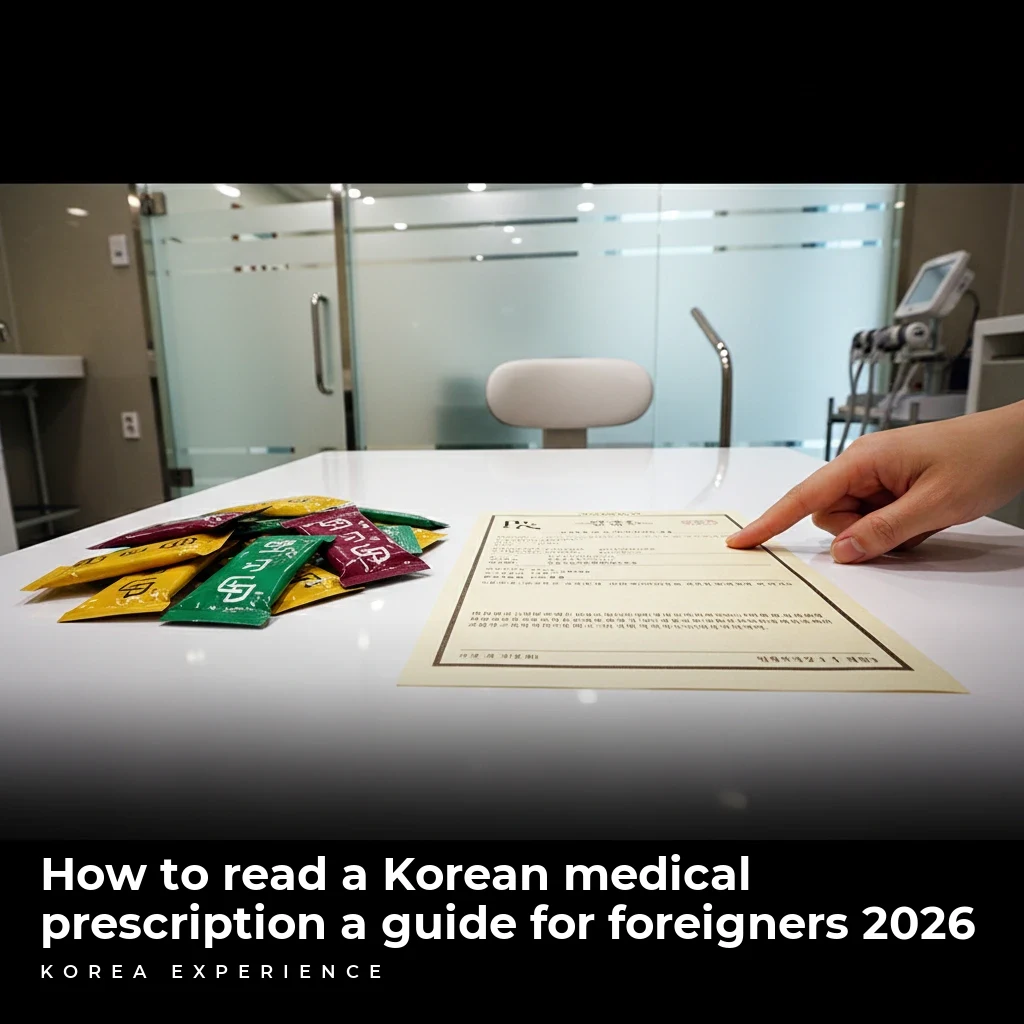
Navigating the healthcare system in a foreign country can be daunting, but in South Korea, the challenge often continues even after you leave the doctor's office. You are handed a paper prescription, you walk into a pharmacy, and instead of a familiar amber bottle with a clear English label, you are given a paper envelope or a long strip of plastic packets containing a colorful assortment of pills. For many international travelers and expats, this is the moment of confusion. Understanding exactly what you are taking and how to take it is crucial for your health and recovery.
The short answer: Korean prescriptions are typically dispensed in individual paper or plastic packets (one packet per dose) rather than bottles. The standard instruction is "30 minutes after a meal," and the exterior envelope contains your detailed dosage information, drug names, and pharmacy contact details.
Key Takeaways
- 1Korean pharmacies (Yak-guk) dispense pills in pre-sorted meal-time packets, not bottles
- 2The '30 minutes after meal' rule is the standard default for most prescriptions in 2026
- 3Prescriptions are valid for a limited time, usually 3 to 7 days depending on the condition
- 4Foreigners without NHIS insurance pay 100% of the drug cost, averaging ₩15,000-50,000 per visit
The Korean Pharmacy System: Understanding the Basics
Before decoding the paper itself, it is essential to understand how the system works. Since the "Separation of Prescribing and Dispensing" reform in 2000, doctors in Korea (with few exceptions) cannot dispense medication directly. You must take a written or electronic prescription from the clinic to a separate pharmacy.
In 2026, South Korea boasts over 24,000 operating pharmacies, meaning you will rarely walk more than 200 meters from a clinic without seeing a "Yak" (Medicine) sign. Unlike in the US or UK, where general retailers might have a pharmacy counter, Korean pharmacies are standalone businesses.
Pro Tip
Look for the "Yak" sign. It often features a red cross or a mortar and pestle symbol. Most clinics are located in buildings that have a pharmacy on the ground floor specifically to service those patients.
When you hand over your prescription, the pharmacist does not just count pills into a bottle. They use an automated machine to seal your specific cocktail of tablets into individual packets—one for morning, one for lunch, and one for dinner. This system is incredibly convenient for compliance but can be confusing if you need to identify which pill is which.
Decoding the Prescription Envelope (The Yak-bong-ji)
The most critical information is printed on the large paper envelope or the flat paper bag that holds your strip of pill packets. In 2026, most major pharmacies in tourist areas like Myeongdong or Gangnam print these in a standardized format, and some even offer English translations if requested, though this is not guaranteed.
The exterior bag typically contains three vital sections:
- Patient Information: Your name and age.
- Dosage Instructions: When and how often to take the medicine.
- Drug Information: A list of the medications included, often with their effects.
📖 How to read the Medicine Envelope
Step 1: Identify the Frequency
Look for the number of times per day. usually denoted as '1 Il 3 Hoe' (1 day, 3 times).
Step 2: Check the Timing
Look for 'Sik-hu 30 Bun' (30 minutes after a meal). This is the most common instruction.
Step 3: Count the Days
Find the duration, usually marked as '3 Il Bun' (3 days worth).
The "30 Minutes After Meal" Rule
You will almost certainly see the instruction to take medication "30 minutes after a meal." In Western medicine, the guidance is often "take with food" or "on an empty stomach." In Korea, the 30-minute rule is a cultural and medical standard designed to minimize gastric irritation and ensure you don't forget your dose.
Recent guidelines in 2026 suggest that for most common cold medicines or painkillers, taking them immediately after a meal is also acceptable if waiting 30 minutes causes you to forget. However, the printed text will likely still say "30 minutes."
📋 Common Dosage Timings
Visual Identification of Pills
One drawback of the packet system is that all your pills—antibiotics, anti-inflammatories, and digestive aids—are mixed together in one sachet. If you have an allergic reaction or want to skip the painkiller but keep the antibiotic, you need to know which is which.
By law, all tablets in Korea must have unique identification codes or markings. The pharmacy envelope usually prints the name of the drug, its shape, color, and a brief description of its purpose (e.g., "Cough suppressant," "Antibiotic").
If you are visiting one of the best dermatology clinics in seoul for foreigners, you might receive a mix of oral antibiotics and topical creams. The creams will be in boxes, but the oral meds will be in the packet strip.
Drug Identification Guide
| Type | Common Shape | Common Color | Typical Code |
|---|---|---|---|
| Antibiotics | Capsule/Oval | White/Blue | Pharm initials |
| Painkillers (NSAIDs) | Round/Oval | White/Pink | Score line |
| Digestive Aids | Small Round | Green/White | ST/D |
| Antihistamines | Tiny Round | Yellow/White | Small letters |
Medical Disclaimer
The visual guide above is for general reference only. Pharmaceutical companies frequently change pill designs. Always use a translation app on the printed drug list on your envelope or ask the pharmacist specifically: "Which one is the antibiotic?"
Cost and Insurance for Travelers
For medical tourists and travelers, cost is a significant factor. South Korea's National Health Insurance Service (NHIS) covers roughly 70% of medical costs for subscribers. However, as a short-term visitor, you are likely uninsured in Korea (unless you have specific travel insurance that reimburses you later).
Even without insurance, drug prices in Korea are government-regulated and generally affordable compared to the US. A typical 3-day course of cold medicine might cost ₩15,000 to ₩25,000 (approx. $11-19 USD) without insurance, whereas insured residents might pay ₩4,000 ($3 USD).
For those interested in general living costs, check our cost of living in Seoul vs Busan comparison to see how healthcare pricing fits into the broader budget.
💵 Prescription Cost Estimates (3-Day Supply)
Standard copay for residents
Full price for visitors
Over-the-Counter (OTC) vs. Prescription
Not everything requires a doctor's visit. In 2026, Korea continues to expand its selection of Safe Household Medicines available at convenience stores like CU, GS25, and 7-Eleven. This is crucial if you get a headache at midnight when pharmacies are closed.
However, the selection is strictly limited to about 13 items, including Tylenol (acetaminophen), basic cold medicine like Panpyrin, and digestive drinks. Stronger painkillers (like ibuprofen in high doses) or antibiotics always require a visit to a clinic and a pharmacy.
If you are looking for late-night snacks along with your Tylenol, our guide to best Korean convenience store food offers some comforting options.
Pharmacy vs. Convenience Store
- ✓Professional advice from a pharmacist
- ✓Access to stronger, more effective meds
- ✓Tailored dosage packets
- ✓Wide variety of supplements
- ✗Limited operating hours (usually close by 7-8 PM)
- ✗Requires a clinic prescription for antibiotics
- ✗Wait times during lunch hours
The Digital Shift: Electronic Prescriptions in 2026
By 2026, the Korean government has piloted full-scale electronic prescriptions (QR code based) to reduce paper waste. While the paper envelope is still the norm for the physical pills, the transfer of data from clinic to pharmacy is increasingly digital.
Many clinics in Gangnam and medical tourism zones now send a QR code to your KakaoTalk or text message. You simply show this code at the pharmacy. This reduces errors in reading handwriting (though most prescriptions are printed) and allows for better tracking.
The Modern Prescription Journey
Clinic Consultation
Doctor enters prescription into the EMR system.
Digital/Paper Script
Receive a QR code or printed paper to take to the pharmacy.
Pharmacy Submission
Hand over script; pharmacist checks for contraindications.
Dispensing
Machine sorts pills into packets; pharmacist explains dosage.
Emergency Access and Night Pharmacies
One of the most frequent panic points for travelers is getting sick at night. Most Korean pharmacies operate roughly from 9:00 AM to 7:00 PM, with Saturdays often being half-days (closing around 1:00 PM or 3:00 PM). Sundays and holidays are often closed, except for rotating duty pharmacies.
However, the "Public Night Pharmacy" initiative has expanded significantly by 2026. These designated pharmacies stay open typically from 10:00 PM to 1:00 AM. You can find these by searching "Night Pharmacy" on Naver Maps or looking for the specific logo on the storefront.
📊 Pharmacy Availability 2026
Emergency Numbers
If you have a severe allergic reaction to medication or a medical emergency, dial 119 immediately for an ambulance. For non-emergency medical consultation in English, dial 1339.
Practical Tips for the Pharmacy Visit
When you enter a pharmacy ("Yak-guk"), you will notice it is quite different from a CVS or Boots. It is a small, specialized shop. Here is how to navigate the experience like a local expert.
First, do not be surprised if the pharmacist offers you a small vitamin drink (like Vita500 or Bacchus) while you wait or as a "service" (free gift). This is a common gesture of goodwill in smaller neighborhood pharmacies.
Second, many pharmacies sell high-quality skincare products that are different from what you find in Olive Young. These are "pharmaceutical grade" cosmetics, often excellent for sensitive skin or post-procedure care. If you have undergone treatment at one of the best skin clinics in Gangnam, the pharmacy downstairs will stock the specific repair creams you need.
"Many foreigners worry about the 'digestive medicine' we include. We almost always add a digestive aid to prescription packets to prevent stomach upset from antibiotics or painkillers. It's usually the small, round green or white pill. It is safe and helps protect your stomach lining, so please don't throw it away!"
Managing Chronic Conditions and Refills
If you are living in Korea long-term or traveling for an extended period, you might need refills for chronic conditions. Unlike in some countries where a prescription might be valid for a year with multiple refills, Korean prescriptions are usually for a one-time dispense only.
If you need more medicine, you must see the doctor again. This is why clinics and pharmacies are so closely linked geographically. For simple refills (like blood pressure meds), the doctor consultation is very fast, but it is a mandatory step.
Furthermore, if you are recovering from surgery, perhaps after visiting a plastic surgery clinic, your prescription will be tailored to reduce swelling and prevent infection. Proper nutrition is also key to recovery. We recommend checking our guide on best Korean healing foods for surgery recovery to complement your medication.
Navigating Language Barriers
While many doctors in major cities speak English, pharmacists' English levels can vary. In 2026, translation apps like Papago are indispensable.
However, visual aids are better. If you have a specific symptom, pointing to the area is effective. If you are buying OTC medicine, showing a picture of the product (e.g., "Tylenol" or "Gaviscon") works instantly as brand names are often the same or very similar.
W-Store Pharmacy (Example Chain)(W스토어 약국)
Conclusion
Reading a Korean medical prescription might seem like deciphering a secret code initially, but the logic is grounded in patient care and convenience. The packet system ensures you never have to remember if you took your morning pills—if the "morning" packet is gone, you took it.
By understanding the "30 minutes after meal" rule, recognizing the packet system, and knowing how to find a night pharmacy, you can handle health issues in Korea with confidence. Whether you are here for a K-Pop tour or medical treatment, navigating the pharmacy is a manageable and culturally interesting part of the experience.
❓ Frequently Asked Questions
Have more questions?Contact us →
About the Author
Korea Experience Team
Written by the Korea Experience editorial team - experts in Korean medical tourism, travel, and culture with years of research and firsthand experience.
⚠️ Medical Disclaimer
The information provided on this website is for general informational purposes only and does not constitute medical advice. Always consult with qualified healthcare professionals before making any medical decisions.
Explore more in Medical Tourism
World-class medical procedures at competitive prices. From plastic surgery and dermatology to dental care and health checkups — your complete guide to medical tourism in Korea.
Browse All Medical Tourism ArticlesContinue Reading
Explore more articles you might find interesting
A comprehensive guide to anesthesia types in Korean medical tourism, costs, safety protocols, and what to expect during surgery. Average read time 15 mins.
Explore breast augmentation in Korea 2026: understand costs, find top clinics, learn about recovery, and get practical tips for your medical journey.
Discover Korea's 2026 stem cell medical tourism boom. Learn how new laws unlock anti-aging and joint treatments at 50% lower costs than the US, from $8,000.
Comprehensive guide to mental health resources for medical tourists in Korea. Find English-speaking counselors, recovery centers, and costs in 2026.
A comprehensive guide to Korea's strict medical cannabis laws and advanced alternative pain management treatments available to foreigners in 2026.
A comprehensive guide to FFS, VFS, and top surgery in Seoul for 2026. Includes costs, recovery times, and clinic recommendations for international patients.