Korea Intercity Bus Guide 2026: Booking Apps, Routes & Tips
Complete 2026 guide to Korean intercity buses. Compare Express vs. Intercity, master T-Money GO & Kobus apps, and find routes starting from ₩15,000.
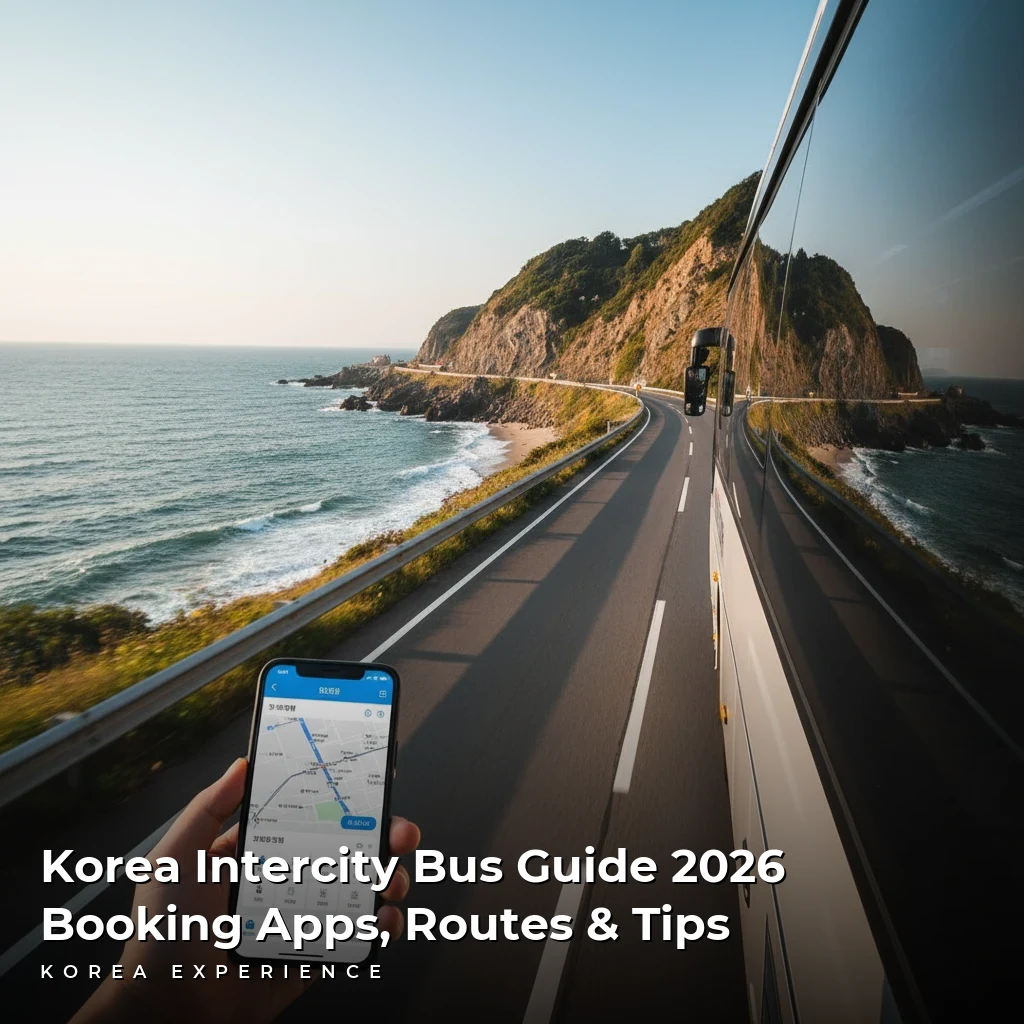
Navigating South Korea's extensive bus network is the most affordable and often the most scenic way to explore the peninsula, yet the distinction between "Express" and "Intercity" buses often confuses first-time visitors.
The short answer: For long-distance travel between major cities (e.g., Seoul to Busan), use Express Buses booked via the "T-Money GO" or "Express Bus Mobile" apps. For smaller towns, use Intercity Buses via "Bustago" or "TxBus." Prices are typically 30-40% cheaper than the KTX train, with Premium buses offering business-class comfort.
Key Takeaways
- 1Express Buses (Gosok) connect major hubs with few stops; Intercity (Sioe) serve smaller towns
- 2Premium Gold buses offer 160-degree reclining seats for ~₩40,000-50,000 on long routes
- 3Foreign credit cards work best on the Kobus website rather than apps due to verification issues
- 4Always screenshot your mobile ticket QR code in case of data connectivity issues
Understanding the Korean Bus System
Korea's bus infrastructure is world-class, handling over 100 million passengers annually. However, the system is bifurcated into two main categories that utilize different terminals and booking engines. Understanding this duality is the first step to a smooth journey.
Express Buses (Gosok Bus)
Express buses are the heavy lifters of Korean transit. They operate on highways with minimal stops, connecting major metropolitan areas.
- Speed: They prioritize speed, strictly adhering to the 100-110 km/h speed limits on expressways.
- Terminals: In Seoul, they primarily use the Seoul Express Bus Terminal (Gyeongbu/Yeongdong lines) and Central City Terminal (Honam line).
- Comfort: This category features the highest tier of buses, including the "Premium Gold" class.
Intercity Buses (Sioe Bus)
"Sioe" literally means "outside the city." These buses cover the routes that Express buses miss.
- Routes: They connect smaller cities, rural counties, and tourist destinations that lack train stations (like Sokcho or Namhae).
- Stops: They may stop at multiple towns along the way to pick up or drop off passengers.
- Speed: Generally slower due to more frequent stops and travel on national roads rather than just expressways.
Terminal Confusion Warning
In many Korean cities, the Express Bus Terminal ( 고속버스터미널) and Intercity Bus Terminal (시외버스터미널) are in completely different locations. For example, in Gyeongju, they are side-by-side, but in Seoul, they can be 40 minutes apart by subway. Always check your specific departure terminal on Naver Maps.
The Best Booking Apps and Websites for 2026
Digital integration has improved significantly by 2026, but payment gateways remain a hurdle for international travelers without a Korean Resident Registration Number. Here is the breakdown of the digital tools you need.
1. T-Money GO (The Super App)
In 2026, T-Money GO has consolidated much of the transit data. It aggregates schedules for both Express and some Intercity routes.
- Pros: English interface, combines multiple transport modes (bikes, buses).
- Cons: Often requires a Korean phone number for verification to unlock full payment features.
- Best For: Expats and travelers with a local SIM card.
2. Express Bus Mobile (Official Kobus App)
This is the dedicated app for the Express Bus network.
- Functionality: Real-time seat selection, mobile ticketing (QR code), and schedule checking.
- Payment: Accepts international cards (Visa/Mastercard), though 3D Secure verification is strict.
- Data Point: Covers roughly 70% of major tourist routes (Seoul-Busan, Seoul-Gwangju).
3. Bustago and TxBus
These are the two competing networks for Intercity buses.
- Complexity: Some routes appear only on Bustago, others only on TxBus. It depends on the specific bus company operating the route.
- Recommendation: If you can't find a route on the Express apps, check Bustago. The English website versions are functional for checking schedules, but on-site ticketing is often easier for Intercity routes to avoid payment errors.
Booking Platform Comparison 2026
| Feature | T-Money GO / Kobus | Bustago / TxBus | Station Kiosk |
|---|---|---|---|
| Route Type | Express (Major Cities) | Intercity (Rural/Towns) | All Routes |
| English Support | Excellent | Moderate | Good |
| Foreign Card Success | High | Low/Glitchy | 100% |
| Mobile Ticket | Yes (QR) | Varies | Paper Ticket |
Bus Classes: Budget vs. Luxury
One of the biggest advantages of bus travel in Korea is the "Premium" class, which rivals first-class airline seats at a fraction of the cost.
Premium Gold Class
Introduced in the late 2010s and perfected by 2026, these buses are a travel hack for comfort seekers.
- Specs: 21 seats total (1-2 configuration).
- Features: Privacy curtains for every seat, 160-degree electric recline, wireless phone charging, personal entertainment monitors, and tray tables.
- Price: Approximately 30% higher than standard buses but 20% cheaper than KTX.
- Example Cost: Seoul to Busan (Premium) is roughly ₩48,000-53,000.
Excellent (Udeung) Class
The standard "good" bus.
- Specs: 28 seats (1-2 configuration).
- Comfort: Generous legroom and significant recline. Before Premium Gold arrived, this was the luxury standard.
- Value: This offers the best balance of price and comfort.
- Example Cost: Seoul to Busan (Excellent) is roughly ₩36,000-40,000.
General (Ilban) Class
The budget option, usually used for shorter distances or by students.
- Specs: 45 seats (2-2 configuration).
- Comfort: Tight legroom, similar to an economy flight. Not recommended for trips over 2 hours.
- Example Cost: Seoul to Busan (General) is roughly ₩26,000-29,000.
💵 Seoul to Busan: Travel Mode Comparison
Speed over comfort, economy seating.
Lie-flat seats, privacy curtains.
Step-by-Step Guide: How to Book Tickets
If you are struggling with the apps, booking via the official websites (kobus.co.kr for Express, bustago.or.kr for Intercity) is often more stable for foreign credit cards.
📖 Booking via KOBUS Website (English)
Step 1: Access the Site
Go to kobus.co.kr and select 'English' from the top right menu.
Step 2: Search Route
Select Departure (e.g., Seoul Gyeongbu) and Destination. Choose Date and Time.
Step 3: Select Bus Class
Look for 'Premium', 'Excellent', or 'Economy'. Click 'Select' on your preferred time.
Step 4: Choose Seats
Click on the specific seats you want. White seats are available; grey are taken.
Step 5: Payment
Select 'Non-Member'. Enter your card details. For 'Card Password', enter the first 2 digits of your PIN.
Step 6: Save Ticket
Print the 'Home Ticket' or save the reservation number to retrieve it at the station kiosk.
If the online payment keeps failing (Common Error: '3D Secure Verification Failed'), don't panic. Simply go to the bus terminal 30 minutes early. Except for major holidays like Chuseok or Seollal, buses rarely sell out completely. You can buy tickets at the unmanned kiosks using the same foreign credit card that was rejected online.
Popular Routes and Itineraries
Korea's bus network opens up destinations that trains cannot reach. Here are the most vital routes for travelers, including specific data on distances and pricing.
1. Seoul to Sokcho (The East Coast Route)
Sokcho is famous for Seoraksan National Park and its beaches. Since there is no direct KTX train to Sokcho yet (scheduled for future development), the bus is the primary mode of transport.
- Departure: Seoul Express Bus Terminal (Gyeongbu) or Dong Seoul Terminal.
- Distance: Approximately 190 km.
- Duration: 2 hours 20 minutes (varies by traffic).
- Frequency: Departures every 20-30 minutes.
- Fare: ~₩22,000 (Excellent Class) to ₩28,000 (Premium).
- Scenic Highlight: The route cuts through the mountains of Gangwon province, offering spectacular views, especially in autumn.
2. Seoul to Jeonju (The Foodie Route)
While the KTX goes to Jeonju, the bus terminal is arguably more centrally located to the Hanok Village, and the Premium bus experience sets the mood for a relaxing trip.
- Departure: Central City Terminal (Honam Line).
- Distance: Approximately 220 km.
- Duration: 2 hours 40 minutes.
- Fare: ~₩23,000 (Excellent) to ₩30,000 (Premium).
- Comparison: KTX takes 1.5 hours but costs ~₩35,000 and requires a taxi/bus ride from the train station to the tourist area.
For those interested in exploring beyond the main cities, the bus allows you to connect to places like Andong. Read our guide on Andong Hahoe Village to see why this trip is worth the bus ride.
3. Busan to Gyeongju (The History Hop)
A very short but essential route for travelers doing the "Golden Triangle" of Korea.
- Departure: Busan Central Bus Terminal (Nopo-dong).
- Distance: Approximately 50 km.
- Duration: 50 minutes.
- Fare: ~₩6,000-8,000.
- Note: This is an Intercity route. Buses leave every 15 minutes, operating almost like a subway service.
4. Seoul to Gwangju (The Art & Culture Hub)
Gwangju is the gateway to the Jeolla province.
- Departure: Central City Terminal.
- Distance: 290 km.
- Duration: 3 hours 20 minutes.
- Fare: ~₩38,000 (Excellent) to ₩49,000 (Premium).
The East Coast Journey: Gangneung to Busan
The Dualism Concept: Experience the best of both worlds — premium luxury moments paired with authentic budget-friendly experiences in one route.
Ocean View
The bus route follows the coastline closely.
Rest Stop Snacks
Udon and Walnut Cakes at the halfway stop.
This is widely considered the most beautiful bus route in Korea, hugging the East Sea coastline.
The "Hyu-ge-so" (Rest Stop) Culture
A bus trip in Korea is incomplete without experiencing the Hyu-ge-so (Rest Stop). Unlike the grim service stations found in some countries, Korean rest stops are vibrant culinary destinations.
The 15-Minute Rule
On any trip longer than 2 hours, the bus will make a mandatory 15-minute stop.
- Announcement: The driver will announce the break time (usually "Sibo-bun" - 15 minutes).
- Display: Many buses have an LED clock at the front that the driver will set to the departure time.
- Safety: Note your bus license plate number or take a photo of your bus before walking away. Hundreds of buses look identical.
Must-Try Rest Stop Foods
- Hodugwaja (Walnut Cakes): Warm, walnut-shaped pastries filled with red bean paste and actual walnut chunks. Price: ~₩3,000-5,000 per bag.
- Sotteok Sotteok: A skewer alternating between sausage and rice cake (tteok), glazed in a sweet and spicy sauce. Made famous by Korean TV show "Omniscient Interfering View." Price: ~₩4,500.
- Hot Bar: Various fish cakes on a stick. Price: ~₩4,000.
- Al-Gamja: Roasted baby potatoes tossed in butter and salt. Price: ~₩5,000.
📋 Rest Stop Survival Guide
Navigating the Major Terminals in Seoul
Seoul does not have a single central bus station. Going to the wrong terminal is the most common mistake travelers make.
Seoul Express Bus Terminal (Gyeongbu/Yeongdong Line)
- Location: Gangnam area (Subway Lines 3, 7, 9).
- Destinations: Busan, Daegu, Gyeongju, Sokcho (Yeongdong line), Gangneung.
- Vibe: Huge, modern, connected to Shinsegae Department Store and Goto Mall (underground shopping).
Central City Terminal (Honam Line)
- Location: Connected to the Express Bus Terminal (same building complex, different ticketing wing).
- Destinations: Jeonju, Gwangju, Mokpo, Jeolla Province.
- Vibe: Upscale, numerous restaurants and cafes (Famille Station).
Dong Seoul Terminal (East Seoul)
- Location: Gangbyeon Station (Subway Line 2).
- Destinations: Gangwon Province (Sokcho, Yangyang), and some southern cities.
- Vibe: Older, more chaotic, but convenient for those staying in Eastern Seoul (Jamsil/Seongsu).
Nambu Terminal (South Seoul)
- Location: Nambu Bus Terminal Station (Subway Line 3).
- Destinations: Southern Gyeonggi province, some parts of Chungcheong province.
- Vibe: Smaller, functional.
If you are planning a trip out of Seoul, make sure you know exactly how to get to the terminal. For tips on navigating the city to catch your bus, check our 24-hour Seoul itinerary.
Practical Tips for a Smooth Journey
Luggage Rules
Unlike airlines, Korean buses are lenient.
- Hold Luggage: You can generally put 1-2 large suitcases in the under-bus storage. There is no extra fee and no weigh-in.
- Carry-on: Small backpacks can go in overhead bins or on your lap.
- Self-Service: You load and unload your own bags. The driver usually does not assist unless you are elderly or disabled.
Connectivity
- Wi-Fi: Most Premium and Excellent buses have free public Wi-Fi (often named "Public WiFi Free" or the bus company name). However, it can be spotty in mountain tunnels.
- Charging: Premium buses have USB ports. Excellent buses sometimes have them, but don't count on it. Bring a power bank. To ensure you are always connected for maps and translation, read our guide on best Korea SIM cards.
Refund Policy
If you miss your bus, don't throw away the ticket.
- Before Departure: Free cancellation or small fee (10%) depending on how close to departure time it is.
- After Departure: If you miss the bus, you can usually get a refund of 30-50% of the ticket price if you process it at the window within a few hours (policies vary by company).
📊 Premium Bus Satisfaction
Troubleshooting Common Issues
Problem: "I can't find my destination on the App."
- Solution: You might be searching an Express app for an Intercity route. Try switching apps. Or, search for a larger nearby city. For example, if going to a tiny village in Hadong, book a ticket to Hadong Terminal first, then buy a local ticket there.
Problem: "My credit card doesn't work at the kiosk."
- Solution: Look for a kiosk that says "Global Card" or go to the manned ticket window (labeled 매표소 - Maepyoso). Show the staff your destination written in Korean (Papago app is great for this).
Problem: "The bus left without me at the rest stop."
- Solution: This is a nightmare scenario. Call the number on your ticket (or have a Korean speaker help you). If that fails, speak to the information desk at the rest stop. They can sometimes arrange for the next bus from the same company to pick you up, though you may have to stand.
Seasonal Considerations
Bus travel changes with the seasons in Korea.
- Chuseok (Autumn) & Seollal (Lunar New Year): Tickets sell out exactly 30 days in advance. Highway traffic is horrendous; a 4-hour trip can turn into 9 hours. Avoid bus travel on these specific dates if possible.
- Summer (July-August): Buses to beach destinations (Gangneung, Busan, Boryeong) fill up fast. Book 2 weeks ahead.
- Winter: Buses are well-heated (sometimes too well-heated). Dress in layers so you can strip down once seated.
To plan your trip around the best weather, consult our guide on the best time to visit Korea.
Final Thoughts: Why Choose the Bus?
While the KTX is a marvel of engineering, the Korean intercity bus system offers a different kind of luxury: the luxury of seeing the country intimately. From the comfortable recline of a Premium Gold seat, watching the rice paddies, mountains, and concrete jungles roll by gives you a true sense of the peninsula's geography.
Whether you are saving money on a trip to Busan or venturing off the beaten path to a remote hiking trail, mastering the bus system unlocks 100% of Korea, not just the cities on the train line.
❓ Frequently Asked Questions
Have more questions?Contact us →
About the Author
Korea Experience Team
Written by the Korea Experience editorial team - experts in Korean medical tourism, travel, and culture with years of research and firsthand experience.
Explore more in Travel & Tourism
From Seoul's neon-lit streets to Jeju's volcanic landscapes — discover the best of Korea with insider travel tips, itineraries, and seasonal guides.
Browse All Travel & Tourism ArticlesContinue Reading
Explore more articles you might find interesting
Compare Kakao T and Uber in Korea for 2026. Discover prices starting at ₩4,800, foreign card tips, and how to navigate Seoul like a local.

Discover why Korea ranks high for safety in 2026. Complete guide to 5 best areas, emergency apps, and daily budgets starting at ₩85,000.
Master Seoul's royal history in 2026. Compare Gyeongbokgung (₩3,000) and Changdeokgung (₩3,000) with our complete walking guide and Secret Garden tips.

Find 2026 ferry schedules for Jeju, Ulleungdo, and more. Compare ticket prices starting at ₩15,000 and learn how to book online without a Korean number.

Comprehensive 2026 guide to DMZ tours from Seoul. Includes booking tips, JSA status updates, dress codes, and price comparisons starting at ₩55,000.
Compare KakaoMetro vs. Seoul Subway apps for 2026. Learn about the 1,550 KRW base fare, Climate Card savings, and why Google Maps fails in Korea.