Korea's Best Hidden Fall Foliage Spots: 10 Crowds-Free Gems 2026
Discover 10 secret autumn spots in Korea away from crowds. Includes 2026 peak foliage dates, transport costs, and specific hiking routes for the perfect trip.
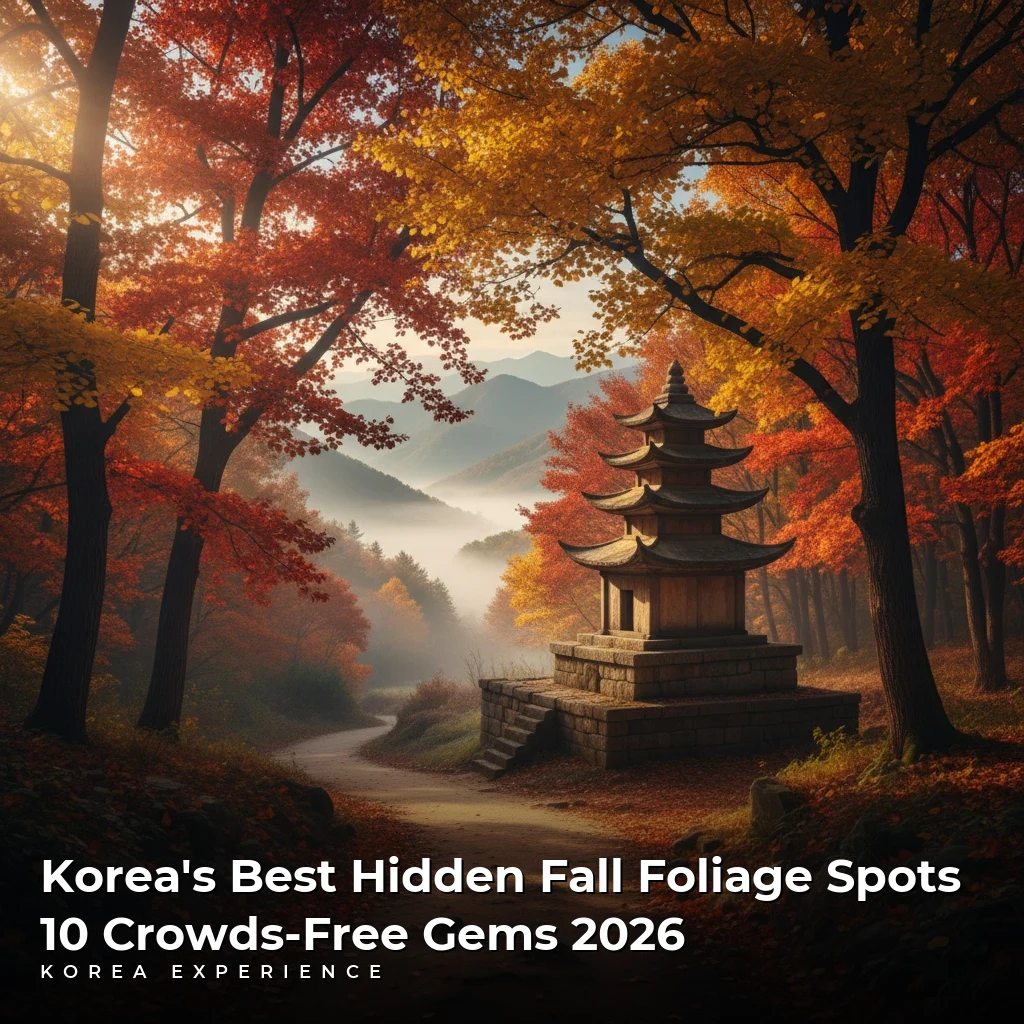
Finding the perfect fall foliage spot in Korea often feels like a battle against millions of other visitors. While famous sites like Seoraksan National Park and Nami Island offer spectacular views, they are frequently gridlocked with traffic and overcrowded with tour buses by 9:00 AM. For the discerning traveler seeking tranquility and unobstructed photography, the secret lies in visiting "second-tier" fame locations—sites that are just as beautiful but slightly less accessible or overshadowed by a famous neighbor. The best quiet spots for 2026 include the Sangwonsa Course at Odaesan, the reflective waters of Jusanji Pond, and the hidden Metasequoia lanes of Yangjae Citizens' Forest.
The short answer: To escape the autumn crowds in Korea, skip Seoraksan and Nami Island in favor of Odaesan National Park (Sangwonsa), Jusanji Pond in Cheongsong, or the secret garden of Changdeokgung (with a reservation). Peak season for these hidden gems is typically October 20 to November 5.
Key Takeaways
- 1The 2026 peak foliage season is predicted for Oct 25 - Nov 5 due to warmer September temperatures.
- 2Odaesan offers similar views to Seoraksan but with 60% fewer visitors on weekdays.
- 3Renting a car (approx ₩80,000/day) unlocks remote spots like Bangtaesan that tour buses cannot reach.
Understanding the 2026 Autumn Forecast
Before diving into specific locations, it is crucial to understand the timing. In recent years, Korea’s autumn has shifted later due to global climate trends. For 2026, meteorological data suggests a slightly delayed onset of peak colors.
The foliage "wave" starts in the northern mountains (Gangwon-do) and moves south at a speed of approximately 20-25 kilometers per day. While Seoraksan might peak around October 18th, the southern regions and city centers like Seoul and Daegu won't see full vibrancy until late October or early November.
📊 2026 Peak Foliage Forecast
Traveling during the "shoulder" of the peak—either 3 days before or after the absolute maximum color—can often result in significantly thinner crowds while still offering 90% of the visual splendor.
For a broader understanding of Korea's seasonal shifts, check out our guide on the best time to visit Korea.
Seoul's Secret Gardens: Urban Escapes
You do not always need to leave the capital to find peace. While Gyeongbokgung Palace is teeming with hanbok-clad tourists, other pockets of the city offer profound silence and vibrant colors.
Yangjae Citizens' Forest (Seocho-gu)
Located in southern Seoul, this park is often overlooked by tourists who flock to Seoul Forest or Olympic Park. The crown jewel here is the Metasequoia Lane. Unlike the famous path on Nami Island, which requires a ferry and a ticket, this lane is free, easily accessible by the Shinbundang subway line (Yangjae Citizen's Forest Station), and largely populated by locals walking their dogs.
The trees here turn a rusty, burnt orange rather than the bright red of maples, usually peaking later in the season around November 5-10. This makes it an excellent option if you miss the earlier October peak.
Yangjae Citizens' Forest(양재시민의숲)
Seonjeongneung Royal Tombs (Gangnam-gu)
It is ironic that one of the quietest spots in Seoul is located in the heart of its busiest district, Gangnam. Seonjeongneung is a UNESCO World Heritage site housing the burial mounds of two Joseon Dynasty kings. Because it is a sacred site, noise is strictly regulated, and food/mats are prohibited. This discourages large picnic crowds and rowdy tour groups.
The entrance fee is a nominal ₩1,000. The walking path circling the tombs is lined with ancient pine trees and ginkgo, offering a solemn, dignified autumn atmosphere. The contrast between the golden leaves, the traditional grassy mounds, and the skyscrapers of Gangnam in the background creates a unique "Cyberpunk Joseon" aesthetic.
Cultural Etiquette
When visiting Royal Tombs, avoid walking on the raised stone path in the center leading to the shrine. This is the "Spirit Road" meant for the spirits of the kings. Walk on the lower path to the right.
Gyeonggi-do: Day Trips Without the Gridlock
If you are willing to travel 1-2 hours outside of Seoul, your options expand significantly. However, avoid the road to Nami Island (Gapyeong) on weekends, as the 60km drive can take over 3 hours due to traffic. Instead, look toward the southeast.
The Fortress Wall of Namhansanseong
While the South Gate (Nammun) area is popular with hikers, the North Gate and the trails along the outer fortress wall offer incredible panoramic views with a fraction of the foot traffic. The hike is moderate, taking about 2-3 hours to complete a significant portion of the wall.
The foliage here is a mix of fiery red maples and yellow zelkova trees. The specific appeal of Namhansanseong is the historical context; the grey stone of the fortress walls provides a stunning textural contrast to the soft autumn leaves.
📋 Namhansanseong Logistics
For more ideas on excursions near the capital, read our article on the best day trips from Seoul.
Gangwon-do: The Majestic Mountains
Gangwon province is the heart of Korean autumn. Seoraksan is the king, but it is currently a victim of its own success. In 2025, visitors reported waiting 4 hours just to park. Here are the alternatives that offer the same ecosystem but better peace of mind.
Odaesan National Park (Sangwonsa Temple)
Odaesan is less rugged than Seoraksan but features softer, earthier tones and arguably more beautiful temple settings. Most visitors stop at the famous fir tree path near Woljeongsa Temple at the entrance.
The Pro Move: Drive or take the bus further up the mountain to Sangwonsa Temple. The road leading up is a tunnel of color. From Sangwonsa, the hike to Birobong Peak is steep but rewarding. However, you don't need to hike to the peak. The temple grounds themselves, perched high on the slope, offer breathtaking views of the valley below appearing as a sea of red and orange.
💵 Cost Comparison: Seoraksan vs. Odaesan
Iconic but stressful
Serene and spiritual
Bangtaesan Recreational Forest (Two-Tiered Waterfall)
This is a true hidden gem, primarily known only to serious Korean landscape photographers. Located in Inje, it requires a car to access effectively. The main attraction is the "Iadan Pokpo" (Two-tiered Waterfall). In autumn, red maple branches hang directly over the cascading water, creating one of the most iconic images of Korean nature.
Because it is a "Recreational Forest" (H 휴양림) and not a National Park, daily visitor numbers are capped, and parking is limited. This naturally throttles the crowd size. You must arrive early (before 09:00) to ensure entry on weekends.
📖 Capturing the Perfect Shot at Bangtaesan
Step 1: Arrival
Arrive by 8:30 AM. Parking fee is ₩3,000.
Step 2: The Hike
A gentle 20-minute walk from the parking lot to the waterfall.
Step 3: Setup
Set tripod low. Use a slow shutter speed (1-2 seconds) to smooth the water.
Jeolla-do: The Southern Red Maples
The mountains in the south are famous for "Baby Maples" (Aegi-danpung), which have smaller leaves and a more intense, crimson red color compared to the varieties in the north.
Baekyangsa Temple (Jangseong)
While Naejangsan National Park is the most famous spot for baby maples, it is notoriously crowded, with a shuttle bus queue that can last an hour. Baekyangsa, located on the other side of the same mountain range, offers a stunning alternative.
The classic view here is the Ssanggyeru Pavilion reflecting in the pond with the white rock of Baegam Mountain looming behind it. Photographers line up at the stepping stones across the pond at dawn. If you visit mid-week, you can enjoy this view in relative silence. The reflection is clearest in the early morning before the wind picks up.
The entrance fee is ₩4,000, and it is accessible via bus from Jangseong Station (which connects to the KTX network).
"Everyone goes to Naejangsan for the tunnel of trees, but Baekyangsa has the better composition for photos. The combination of the pavilion, the reflection, and the mountain backdrop is unmatched. Go on a Tuesday or Wednesday for the best experience."
Gyeongsang-do: Atmospheric Autumn
Jusanji Pond (Cheongsong)
Jusanji is not a hiking destination but a place of pure atmosphere. It is an artificial reservoir created in 1720 that has never dried up. The unique feature here is the 150-year-old willow trees growing in the water.
In late October, the morning mist rises from the water, mingling with the red foliage of the surrounding mountains. It feels prehistoric and mystical. This location gained fame through the movie "Spring, Summer, Fall, Winter... and Spring," yet it remains remote enough (about 4 hours from Seoul, 1.5 hours from Andong) to deter casual tourists.
Fall Spot Features
| Feature | Seoraksan | Jusanji Pond | Seoul Forest |
|---|---|---|---|
| Crowd Level | Very High | Low | High |
| Accessibility | Bus/Car | Car Only | Subway |
| Best For | Hiking | Photography | Picnics |
Ungok Seowon (Gyeongju)
Gyeongju is famous for Bulguksa Temple, which gets incredibly busy. A quieter alternative is Ungok Seowon, a Confucian academy. It features a massive, 400-year-old Ginkgo tree that explodes into a brilliant golden yellow. When the leaves fall, they create a yellow carpet in the courtyard that is stunningly beautiful. It is located about 20 minutes by taxi from the main Gyeongju tourist area, keeping the mass crowds away.
Travelers exploring the southern regions should consider the culinary differences between these provinces. Check out our guide to Korean regional flavors.
Practical Guide: Logistics and Planning
Visiting these hidden spots often requires more planning than hopping on a tour bus. Here is how to manage the logistics.
Transport: Car Rental vs. Public Transit
For spots like Yangjae or Namhansanseong, public transit is superior due to parking shortages. However, for Bangtaesan or Jusanji, a rental car is highly recommended.
Car Rental Costs (2026 Estimates):
- Compact Car (Avante/K3): ₩70,000 - ₩90,000 per day
- Toll Fees: Expect to pay roughly ₩10,000 for every 100km of highway driving.
- Gas: Gasoline prices fluctuate around ₩1,750 per liter.
If you are on a budget, intercity buses are excellent. They are punctual, comfortable, and cheap (e.g., Seoul to Inje is roughly ₩18,000). For tips on managing costs, read our guide on budget travel in Korea.
Also, ensure you have connectivity for navigation (Naver Maps is essential). See our recommendations for Sim Cards.
Renting a Car for Fall Travel
- ✓Access to remote spots like Jusanji
- ✓Flexible schedule (sunrise/sunset)
- ✓Storage for hiking gear
- ✗Heavy traffic returning to Seoul on Sundays
- ✗Navigation can be tricky (must use Naver/Kakao Map)
- ✗Parking at popular trailheads fills by 8 AM
Photography Tips for Autumn in Korea
To capture the colors accurately, you need to account for the light. Korea's autumn light is crisp but can be harsh at midday.
- Circular Polarizer (CPL): This is non-negotiable. It cuts the glare off the wet leaves and deepens the blue of the sky, making the red and yellow leaves pop.
- White Balance: Set your camera to "Cloudy" or "Shade" even on sunny days to warm up the image and emphasize the golden tones.
- Golden Hour: The sun sets around 5:30 PM to 6:00 PM in late October. The light from 4:00 PM to 5:00 PM is magical.
For more inspiration on where to point your lens, see our dedicated guide to autumn colors and photography spots.
Ideal 1-Day Itinerary: The Northern Route
Depart Seoul
Leave early to beat the Expressway traffic.
Arrive Odaesan
Head straight to Sangwonsa parking lot.
Lunch
Sanchae Bibimbap (Mountain Veggie Rice) at the park entrance (approx ₩12,000).
Woljeongsa Fir Path
Walk the flat, scenic path near the entrance.
Return
Start driving back before the 6 PM rush.
Why "Crowd-Free" Matters
In Korea, "crowded" takes on a different meaning. On a peak Saturday at Seoraksan, you are literally shoulder-to-shoulder on the trail. This changes the experience from a communion with nature to a queue management exercise.
By choosing these alternative spots, you engage with the Korean landscape in a way that respects its tranquility. You hear the wind in the birch trees, the crunch of leaves underfoot, and the monks chanting in the temples—sounds that are often drowned out by megaphones and chatter at the main tourist hubs.
Frequently Asked Questions
❓ Fall Foliage FAQ
Have more questions?Contact us →
Exploring Korea's autumn is one of the most rewarding travel experiences in Asia. By stepping slightly off the beaten path to places like Baekyangsa or Yangjae Citizens' Forest, you ensure that your memories are filled with golden leaves and peaceful reflection, rather than other tourists' backpacks. Happy travels!
About the Author
Korea Experience Team
Written by the Korea Experience editorial team - experts in Korean medical tourism, travel, and culture with years of research and firsthand experience.
Explore more in Travel & Tourism
From Seoul's neon-lit streets to Jeju's volcanic landscapes — discover the best of Korea with insider travel tips, itineraries, and seasonal guides.
Browse All Travel & Tourism ArticlesContinue Reading
Explore more articles you might find interesting
Discover the top hiking trails and photography spots for Korea's 2026 autumn season, with peak foliage dates, transport costs, and specific location guides.
Discover the top day trips from Seoul for 2026. Includes KTX schedules, costs under ₩50,000, and travel times for Suwon, Nami Island, and the DMZ.
Discover top wheelchair-accessible routes in Seoul for 2026. Includes elevator maps, transport costs, barrier-free hotels, and specialized taxi services.

Discover Seoul's stunning libraries in 2026. From the 13m shelves of Starfield to hidden Hanok gems. Free entry details and photo spots included.
Discover the best spots for tulips, roses, and cosmos in Korea. Complete 2026 guide with dates, entry fees, and transport tips for spring and autumn blooms.
Discover Seoul's best-kept secrets beyond Myeongdong. From art hubs in Mullae (₩5,000 coffee) to sunset views in Huam-dong, explore the city like a local.