How to Get Korean Medical Records Translated to English in 2026
A complete guide to requesting English medical records in Korea. Costs, processing times, and legal requirements for travelers and expats in 2026.
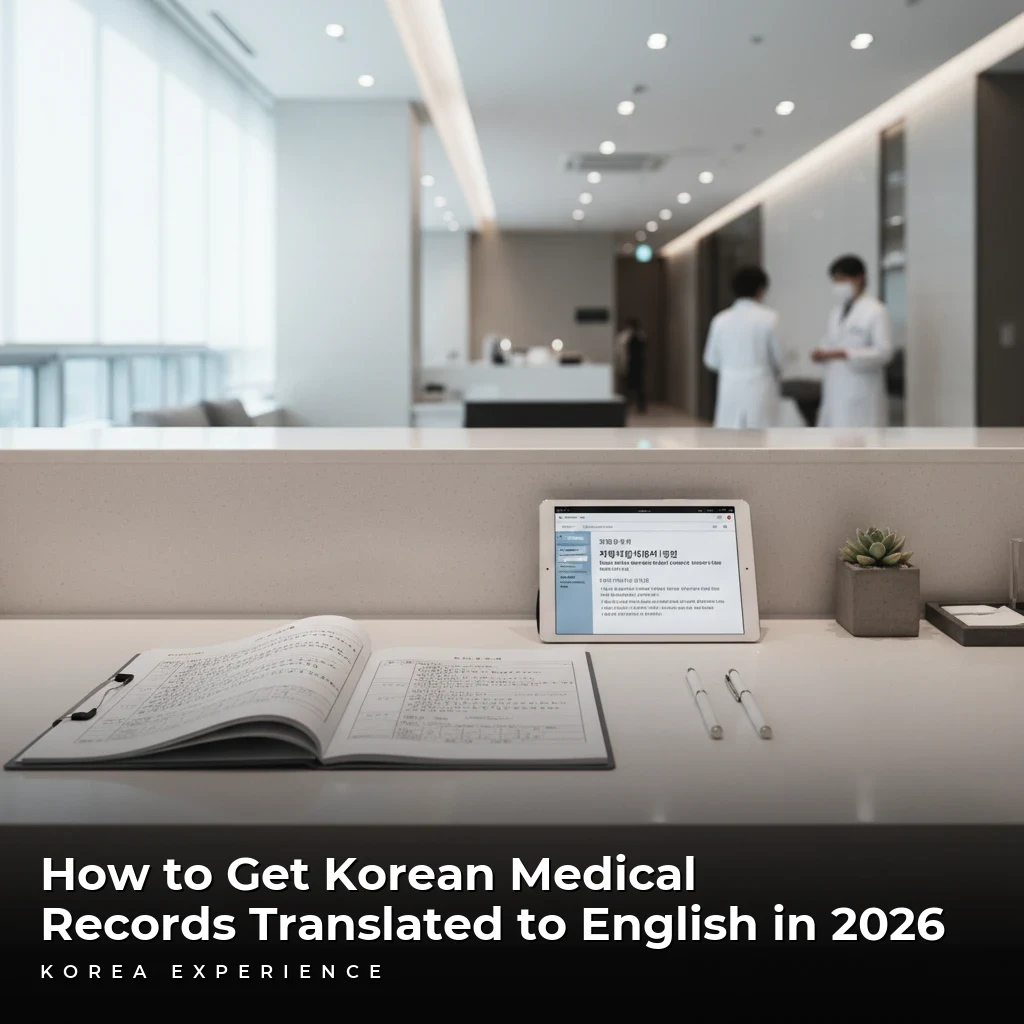
Navigating the healthcare system in a foreign country can be daunting, but retrieving your medical history in a language you understand is often the most critical step for continuity of care. Whether you have undergone a complex surgery in Gangnam or visited a local clinic for a sudden illness, obtaining Korean medical records with English translations is a specific administrative process that differs significantly from Western systems.
The short answer: Major university hospitals in Korea (Tier 3) can issue an "English Medical Certificate" (diagnosis summary) immediately upon request for 15,000-₩20,000. However, detailed operative notes and daily charts are usually in Korean and require third-party translation for official use abroad.
Key Takeaways
- 1English Medical Certificates (diagnosis/treatment summary) are widely available at major hospitals.
- 2Detailed daily charts and nursing notes are legal documents kept in Korean and require certified translation.
- 3You must present a valid passport or ARC to request records due to strict privacy laws.
- 4Fees range from ₩1,000 per page for copies to ₩20,000 for English certificates.
- 5Copies of MRI/CT scans are provided on CD/DVD (10,000-₩20,000) and usually follow DICOM standards.
Understanding the Korean Medical Record System
Before you approach the hospital administration desk, it is vital to understand what "medical records" actually mean in the Korean healthcare context. In many Western countries, a medical record is a singular file. In Korea, the documentation is fragmented into specific categories, and the language used within them varies.
The Two Types of Documents
When international patients ask for "medical records," there is often a miscommunication. You are likely looking for one of two things:
-
Medical Certificate (Jinhdan-seo / Soyeon-seo): This is a formal summary written by the doctor. It includes the final diagnosis code (ICD-10), the treatment period, and a brief summary of the procedure or medication.
- Availability in English: High. Most "General Hospitals" (2nd Tier) and "Tertiary Hospitals" (3rd Tier) have a system to generate this in English.
- Cost: Approximately ₩15,000 to ₩20,000 ($11-$15 USD).
-
Medical Charts/Copy of Records (Uiryo-girok-sa-bon): These are the raw daily logs, nursing notes, operative reports, and anesthesia records.
- Availability in English: Low. While medical terms (like "Appendicitis" or "Propofol") might be in English or Latin, the surrounding grammar and nursing observations are in Korean.
- Cost: Usually ₩1,000 to ₩3,000 for the first few pages, and ₩100 per page thereafter.
📊 Medical Language Stats
If you are planning a surgery and need to understand the consultation process before worrying about records, read our guide on booking medical consultations in Korea.
Step-by-Step Guide to Requesting Records
The process of obtaining these documents is highly bureaucratic due to Korea's strict Personal Information Protection Act. You cannot simply email a doctor and ask for a PDF attachment. You must visit in person or follow strict proxy protocols.
📖 How to Request English Medical Records
Step 1: Request During Consultation
The best time to ask is while you are with the doctor. Tell them: 'I need an English Medical Certificate.' The doctor must input this order into the computer system.
Step 2: Visit the Issuance Desk
After your appointment, do not go to the payment counter yet. Look for the 'Certificate Issuance' (Je-jung-myeong / 제증명) window. Take a number ticket.
Step 3: Verify Identity
Present your Passport or Alien Registration Card (ARC). Digital IDs on phones are often rejected; bring the physical card.
Step 4: Select Documents
Specify if you need 'English Certificate' (diagnosis) or 'Full Chart Copy'. For charts, you must specify the dates (e.g., 'records from Jan 1, 2026 to Jan 5, 2026').
Step 5: Payment and Receipt
Pay the fee (Credit cards accepted). You will receive physical paper copies stamped with the hospital's official seal. Digital PDFs are rarely provided to patients directly.
Average Wait Times
At a major university hospital in Seoul (like Seoul National University Hospital or Severance), the wait time at the Certificate Issuance desk averages 20 to 40 minutes on weekdays. On Saturday mornings, wait times can exceed 60 minutes. It is highly recommended to visit between 9:30 AM and 11:00 AM on a Tuesday or Wednesday for the shortest queues.
Cost Breakdown: Planning Your Budget
Medical record fees in Korea are regulated by the Ministry of Health and Welfare to prevent price gouging, but there is still a variance between clinic types.
💵 Document Issuance Costs (2026)
Required for international insurance or travel proof
Standard diagnosis proof for Korean workplaces/schools
Per page fee. First 5 pages are expensive, subsequent are cheap.
If you are undergoing cosmetic procedures, the documentation costs are often separate from the surgery package. For more on what to expect financially with aesthetic treatments, check our article on anti-aging treatments in Korea.
The Language Barrier: Translation Services
This is the most critical section for international patients. If you receive a "Medical Certificate" in English, you are generally set for insurance claims. However, if your doctor back home needs to see the operative report (how the surgery was performed) or nursing notes (how you recovered day-by-day), the hospital will likely give you a stack of papers in Korean.
Hospital Interpretation vs. Document Translation
Hospitals often provide interpreters (people who speak to you) for free or a small fee. They generally do not provide written translation of past records.
- Scenario: You have a 50-page chart in Korean.
- The Problem: The hospital staff will not translate this for you. They will print it "as is."
- The Solution: You must hire a certified medical translator.
Translation Validity
For legal purposes or international insurance disputes, a self-translated document is invalid. You must use a "Certified Administrative Translator" (Haeng-jeong-sa) authorized by the Korean government. The cost averages ₩30,000 to ₩50,000 per page (roughly $25-$40 USD).
Where to Find Translators
- Embassy Lists: Most embassies (US, UK, Canada) maintain a list of certified translators in Seoul.
- Medical Tourism Facilitators: If you booked through an agency, they often include translation of records as part of their concierge service.
- Online Services: specialized agencies like "Textiferous" or local notary offices near the Seoul Southern District Court specialize in legal and medical translation.
Medical Imaging (X-Ray, MRI, CT)
Unlike paper records, medical imaging is universal. Korea uses the DICOM (Digital Imaging and Communications in Medicine) standard, which is the global norm.
When you request your images:
- You will pay between ₩10,000 and ₩20,000.
- You will receive a CD, DVD, or sometimes a USB drive.
- The disc usually contains a built-in "Viewer" program (like a light version of PACS software).
- Important: Do not try to open these files on your phone. You need a Windows PC to execute the viewer software properly.
📋 Imaging Data Facts
Legal Requirements and Proxy Pick-up
Korea has one of the strictest privacy laws in Asia. This protects you, but it also makes it difficult if you have already left the country and forgot to get your records.
Can a friend pick up my records? Yes, but the paperwork is extensive. If you have already departed Korea, you must send the following to your friend (proxy):
- Application Form: Signed by you (the patient).
- Consent Form: Signed by you, explicitly naming the proxy.
- ID Copy (Patient): A copy of your passport or ARC.
- ID (Proxy): The friend must bring their physical ID.
Signature Match
Hospitals are extremely strict about signatures. The signature on your Consent Form must match the signature on your Passport exactly. If your passport is signed with a full name and the form is initialed, the request will be denied.
Because of these hurdles, it is strongly advised to get all records before you head to Incheon Airport. For those looking into recovery options before flying out, consider reading about best Korean healing foods for surgery recovery.
Terminology Guide for the Hospital
Even at an International Healthcare Center, knowing the specific Korean terms can speed up the process. Show these terms to the desk staff if communication fails.
Don't just ask for "records." Be specific. If you need it for insurance, ask for "Young-mun Jin-dan-seo" (English Diagnosis Certificate). If you need the full history for a new doctor, ask for "Jin-ryo Gi-rok Sa-bon" (Copy of Medical Records). The clerks treat these as completely different administrative tasks.
| English Term | Korean Pronunciation | Korean Hangul | Context |
|---|---|---|---|
| English Diagnosis Certificate | Young-mun Jin-dan-seo | 영문 진단서 | For Insurance/Travel |
| Copy of Medical Records | Jin-ryo Gi-rok Sa-bon | 진료기록사본 | For Doctor Reference |
| Receipt (for tax/insurance) | Young-su-jeung | 영수증 | Proof of Payment |
| Certificate of Admission | Ip-won Hwak-in-seo | 입퇴원 확인서 | Proof of Hospital Stay |
| Detailed Statement | Se-bu Nae-yeok-seo | 진료비 세부내역서 | Itemized Bill |
The Role of International Healthcare Centers (IHC)
Most "Big 5" hospitals in Seoul (Asan, Samsung, Seoul National, Severance, St. Mary's) operate dedicated International Healthcare Centers.
Using the International Healthcare Center (IHC)
- ✓Staff fluent in English, Russian, Arabic, and Chinese
- ✓Dedicated issuance desks with shorter lines
- ✓Automatic English translation of basic certificates
- ✗consultation fees are 20-30% higher than standard clinics
- ✗May require appointment weeks in advance
- ✗Located only in major tertiary hospitals
If you visit a smaller clinic—for example, a dermatology clinic in Gangnam—they may not have a dedicated international desk. In these cases, the "English translation" might be done informally by the doctor. For plastic surgery specifically, ensure you verify what documentation is included in your surgery price. Our guide on best plastic surgery clinics for foreigners in Seoul covers which clinics are known for better administrative support.
Timeline for Record Retention
Legally, Korean hospitals must keep your records for a specific period. If you visited Korea 5 years ago and want records now, are they still there?
- Medical Records: Preserved for 10 years.
- Surgery Records: Preserved for 10 years.
- Prescriptions: Preserved for 2 years.
- Diagnostic Images (X-Ray/MRI): Preserved for 5 years.
If you request records older than these limits, the hospital is under no obligation to provide them, and in many cases, they are securely destroyed to protect privacy.
Insurance Claims and the "Itemized Receipt"
A common point of friction for medical tourists is the insurance claim. Western insurance companies often require a "Detailed Itemized Bill" that breaks down every syringe, bandage, and pill.
- The Korean Standard: The standard Korean receipt is a summary (Consultation, Surgery, Medicine, Room Charge).
- The Solution: You must specifically ask for the "Jin-ryo-bi Se-bu Nae-yeok-seo" (Detailed Statement of Medical Expenses).
- Language: This detailed list is almost always in Korean, even at big hospitals. The drug names will be in English/Chemical names (e.g., "Acetaminophen"), but the categories will be Korean. You may need to annotate this yourself or hire a translator if your insurance company is strict.
Geographic Differences: Seoul vs. Busan vs. Jeju
While the laws are national, the ease of service varies by region.
- Seoul: Gangnam and Jongno districts handle thousands of foreigners daily. English forms are standard.
- Busan: The medical tourism hub in Seomyeon is rapidly improving, but smaller clinics may struggle with English documentation.
- Jeju: Due to visa-free entry, major hospitals are well-equipped for Chinese and English documentation.
- Rural Areas: If you are treated in a rural clinic, expect zero English support. You will receive handwritten or Korean-typed records. You will almost certainly need to bring a translator to the clinic to facilitate the request.
Severance Hospital (Yonsei University)(세브란스병원)
Common Pitfalls and How to Avoid Them
1. The "Name Order" Issue
Korean databases often list names as LAST NAME + FIRST NAME (e.g., SMITH JOHN). If your passport says John Smith, verify that the hospital documents match your passport order, or at least the spelling. Discrepancies can cause insurance rejections.
2. The Digital Signature Issue
Some foreign insurance companies require a "wet ink" signature. Korean hospitals moved to digital signatures (EMR) years ago. The printed certificate will have a printed stamp. If your insurer insists on a wet signature, you must beg the administration staff to manually stamp it. They are often reluctant but will do it if you explain the necessity.
3. The "CD Won't Open" Panic
You get home, pop the CD in, and nothing happens. This is common because the software on the disc (usually a lite version of GE Centricity or similar) is an .exe file designed for Windows.
- Mac Users: You will likely need a third-party DICOM viewer (like OsiriX Lite) to view the images, as the included software rarely works on macOS.
Specialized Records: Dental and Oriental Medicine
Dental Records: Dental charts often use a numbering system (FDI World Dental Federation notation) which is internationally standard. However, the treatment notes will be in Korean. Panoramic X-rays are easily obtained on CD/USB.
Traditional Korean Medicine (Hanbang): If you visit a Traditional Korean Medicine clinic for acupuncture or herbal treatments, translating records is notoriously difficult. The terminology (Qi, meridians, constitution types) does not have direct Western medical equivalents. A standardized English diagnosis is rare in this field.
Record Accessibility by Facility Type
| Facility Type | English Cert | English Charts | Imaging (CD) |
|---|---|---|---|
| University Hospital (Big 5) | ✅ | Partial | ✅ |
| Plastic Surgery Clinic | ✅ | ❌ | ✅ |
| Local Neighborhood Clinic | Rare | ❌ | Sometimes |
| Pharmacy | ❌ | ❌ | ❌ |
Frequently Asked Questions
❓ Frequently Asked Questions
Have more questions?Contact us →
Final Thoughts
Obtaining English medical records in Korea is a streamlined process at the "Certificate" level but becomes complex if you need detailed "Charts." The key is to ask early, check your documents before leaving the counter, and budget for extra time at the hospital.
Korea's medical system is efficient and high-tech, but the administrative side remains heavily paper-based and security-focused. By preparing your passport, understanding the difference between a "Diagnosis Certificate" and "Chart Copies," and utilizing the International Healthcare Centers, you can ensure you leave the country with the documentation you need for your health and peace of mind.
If you are looking to balance your medical trip with some leisure, check out our recommendations for best day trips from seoul 2026 to relax after your treatment.
About the Author
Korea Experience Team
Written by the Korea Experience editorial team - experts in Korean medical tourism, travel, and culture with years of research and firsthand experience.
⚠️ Medical Disclaimer
The information provided on this website is for general informational purposes only and does not constitute medical advice. Always consult with qualified healthcare professionals before making any medical decisions.
Explore more in Medical Tourism
World-class medical procedures at competitive prices. From plastic surgery and dermatology to dental care and health checkups — your complete guide to medical tourism in Korea.
Browse All Medical Tourism ArticlesContinue Reading
Explore more articles you might find interesting
Complete 2026 guide to recovery hotels in Seoul. Compare prices (₩100k-500k/night), find nursing services, and book the perfect aftercare stay.
A comprehensive guide to body contouring in Korea. Compare LAMS vs. traditional liposuction, analyze 2026 pricing, and find top-rated Gangnam clinics.
Compare 2026 prices for clear aligners in Seoul. Save up to 50% with local brands (₩1.5M+) vs Invisalign (₩3.5M+) while enjoying world-class dental care.
A complete guide to hair transplant costs in Korea for 2026, featuring price comparisons, top methods like FUE and DHI, and realistic recovery timelines.
A complete guide to navigating Korean orthopedics, physical therapy, and sports medicine for travelers in 2026. Costs, clinics, and recovery tips included.

Everything you need to know about getting glass skin in Korea, from Rejuran Healer costs to the best clinics in Gangnam for 2026.