Camping in Korea: Glamping vs traditional sites for travelers 2026
Compare Korean glamping ($150+) vs traditional camping ($30) in 2026. Discover booking tips, best seasons, and amenities for the perfect outdoor stay.
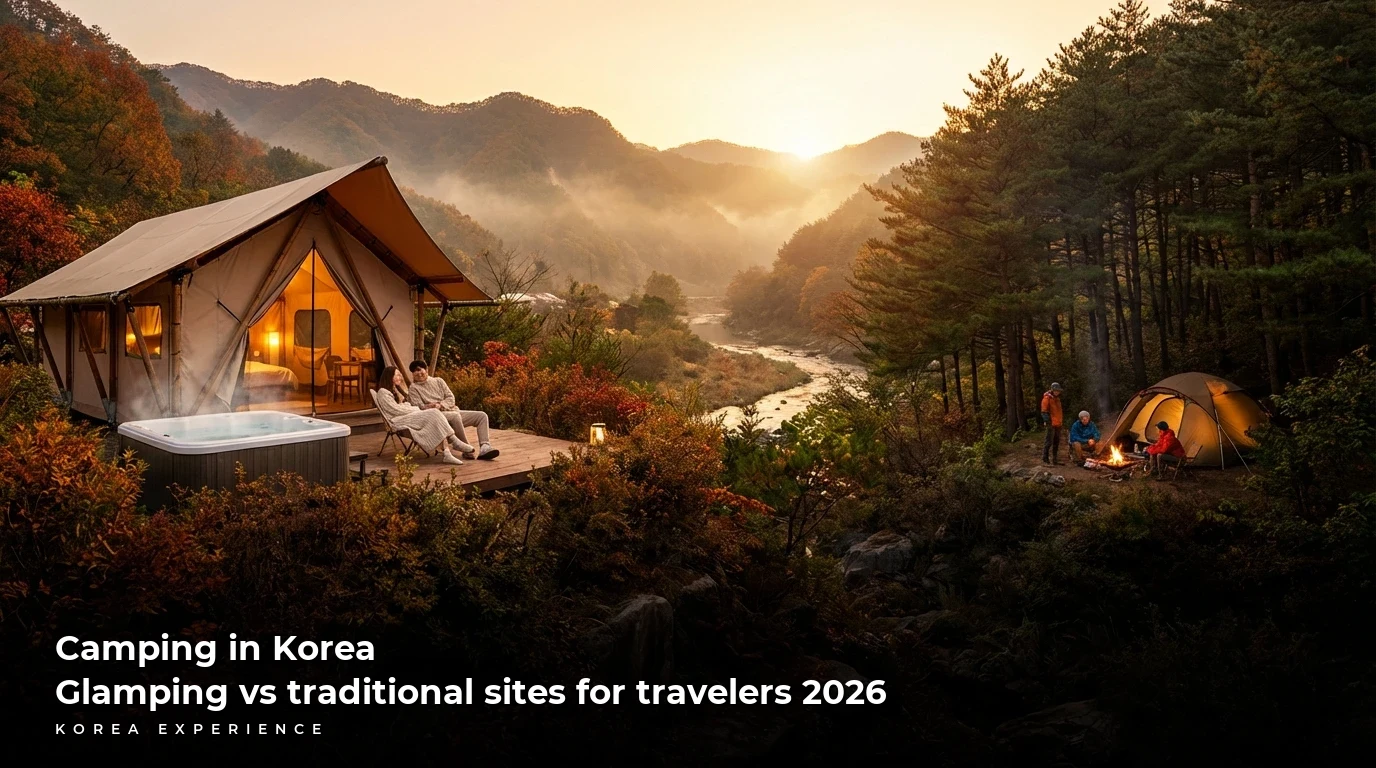
For international travelers deciding between glamping and traditional camping in Korea, the choice ultimately depends on your access to equipment and your desire for convenience versus authenticity. Glamping (Glamorous Camping) in Korea offers a hotel-like experience with pre-set tents, beds, air conditioning, and en-suite bathrooms, making it ideal for short-term visitors without gear. Traditional Camping (Auto-Camping) provides a designated plot of land (deck or gravel) with electricity hookups but requires you to bring 100% of your own equipment, offering a significantly cheaper and more communal experience.
The short answer: Glamping is the best choice for travelers without cars or gear, costing between ₩150,000 and ₩350,000 per night, while traditional camping offers a deeper cultural immersion for residents or long-term travelers at a budget-friendly ₩30,000 to ₩60,000 per night.
Key Takeaways
- 1Glamping sites provide full amenities including AC and private bathrooms
- 2Traditional sites require full gear but cost 80% less on average
- 3Quiet hours (Manner Time) are strictly enforced starting at 10 PM
The Korean Camping Boom: 2026 Context
Camping in Korea has evolved from a niche hobby into a massive lifestyle trend, often referred to as "Cam-ping" (캠핑). As of 2026, the industry has matured significantly following the surge in outdoor activities over the last five years. It is no longer just about sleeping outside; it is about "Sensibility Camping" (Gamseong Camping), where the aesthetic appeal of your setup is just as important as the function.
The market has bifurcated into two distinct streams. On one side, you have high-end glamping resorts near Seoul—specifically in Gapyeong and Pocheon—that rival 5-star hotels. On the other, you have the "Chabak" (car camping) and Auto-Camping enthusiasts who invest heavily in brands like Snow Peak and Helinox to create elaborate outdoor living rooms.
📊 Korea Camping Market 2026
If you are visiting Korea for a short time, understanding these distinct cultures is vital to avoiding disappointment. A "campsite" in Korea is rarely a secluded spot in the wilderness; it is a highly organized, socially regulated community space.
Glamping in Korea: The Luxury Option
For 90% of international visitors, glamping is the logical choice. It bypasses the logistical nightmare of renting gear and transporting it via public transit. Korean glamping sites are exceptionally well-equipped. Unlike the rustic canvas tents found in some Western countries, Korean glamping units often function as "soft-walled cabins."
What to Expect
In 2026, a standard glamping unit in a popular area like Gapyeong (approx. 60km east of Seoul) includes:
- Climate Control: Ondol (floor heating) for winter and powerful air conditioning for summer.
- Private Sanitation: A private toilet and shower inside the tent (in about 70% of luxury sites).
- Cooking: A dedicated BBQ deck with a charcoal grill (usually an extra ₩20,000-₩30,000 fee).
- Tech: High-speed Wi-Fi and often a projector for watching movies.
Gapyeong Star Forest Glamping(가평 별숲 글램핑)
The "Body-Only" Concept
Koreans often use the phrase "Mom-man gamyeon dwae" (You only need to bring your body). This is the essence of glamping here. Many high-end sites even offer "BBQ Sets" where, for an additional ₩50,000 to ₩80,000 for two people, they provide the pork belly (Samgyeopsal), vegetables, kimchi, rice, and dipping sauces.
💵 Glamping Tier Comparison (Per Night)
En-suite bath, AC, Han River view
Shared bathroom, basic fan/heater
Traditional Sites: Auto-Camping Culture
"Auto-Camping" in Korea refers to driving your car right up to your designated campsite (or very close to it) and setting up a tent. This is distinct from "wild camping," which is heavily restricted in Korea.
The Infrastructure
Korean Auto-Camping sites are incredibly convenient compared to many Western counterparts.
- Electricity: almost every site offers electric hookups (usually 600W limit per site).
- Flooring: Sites are usually divided into "Deck" (wooden platform) or "Paseok" (crushed gravel). Decks are preferred for cleanliness but may require special anchor pegs.
- Facilities: Communal kitchens with sinks, microwaves, and hot water are standard.
The Challenge for Travelers
The barrier to entry for Auto-Camping is equipment. You cannot easily rent a full camping set (tent, sleeping bag, mat, chairs, table, stove, lantern) at the campsite itself. While some rental shops exist in Seoul, hauling 20kg of gear on the subway is physically demanding.
If you are an expat living in Korea, however, this is the way to go. You can find excellent gear at entry-level prices at Daiso (for accessories) or Decathlon, before upgrading to premium brands.
Strict Wild Camping Rules
Pitching a tent in non-designated areas, especially National Parks (like Bukhansan or Seoraksan), is illegal and carries fines up to ₩500,000. Always use designated campgrounds or permitted "Noji" (off-grid) locations.
Cost Comparison: The Financial Breakdown
Let's look at the hard numbers for a 1-night trip for two people in 2026. This assumes you are traveling from Seoul to a site within Gyeonggi-do province (approx. 1-2 hours away).
Cost Analysis: 1 Night for 2 People
| Item | Luxury Glamping | Auto-Camping (Rental Gear) |
|---|---|---|
| Accommodation | ₩200,000 | ₩50,000 (Site Fee) |
| Gear Rental | ₩0 | ₩100,000 (Full Set) |
| Food/BBQ | ₩80,000 (Ordered) | ₩40,000 (Grocery) |
| Firewood | ₩20,000 | ₩15,000 |
| TOTAL | ₩300,000 | ₩205,000 |
As you can see, if you have to rent gear, the price gap narrows significantly. Auto-camping only becomes financially superior if you own your gear or plan to camp multiple times during your stay.
Booking and "Picketting"
Booking a popular campsite in Korea is competitive. The phenomenon is called "Picketting" (Piano + Ticketing), referring to the speed required to secure a spot.
📖 How to Book a Campsite
Step 1: Choose Your Platform
Use 'Naver Maps' (search 캠핑장) or the 'Camfit' app. Naver Booking is most accessible for foreigners with a browser translator.
Step 2: Check the Date
Bookings usually open on the 1st or 15th of the month at 10:00 AM or 2:00 PM.
Step 3: Payment
Most sites require bank transfer within 1-3 hours of booking. Foreign cards often fail on small platforms.
For those struggling with the language barrier, we recommend checking our guide on best apps for English speakers to understand the UI logic of Korean booking systems.
The Culture of "Manner Time"
This is perhaps the most critical cultural aspect to understand. Manner Time (매너타임) is the designated quiet time, usually starting at 10:00 PM or 11:00 PM.
In many Western countries, camping implies drinking around a fire until 2:00 AM. In Korea, campsites are often family-oriented. Once Manner Time hits, campsite hosts (Camjigi) will patrol. Lights must be dimmed, and voices reduced to a whisper. If you are loud, you will be evicted.
"Many foreigners are surprised when I ask them to be quiet at 10:30 PM. But Korean campers value privacy and sleep. If you want to party late, look for 'Solo Camping' zones or rent a private pension house, not a glamping tent."
Best Seasons and Weather Considerations
Korea has four distinct seasons, and your camping experience will vary wildly depending on when you visit.
📋 Camping Season Guide
- Spring (April - May): The most popular season. You can camp under cherry blossoms. Temperatures range from 10°C to 20°C.
- Summer (June - August): Hot, humid, and monsoon rains (Jangma). Glamping with AC is essential. Traditional camping can be miserable due to high humidity and mosquitoes.
- Autumn (September - November): The "Golden Season." Crisp air, red autumn foliage, and no bugs. This is the peak time for "Bulmeong" (Fire Gazing). Check our guide to autumn colors for the best scenic spots.
- Winter (December - March): Only for hardcore campers ("Dong-gye Camping"). Temperatures drop to -15°C. Glamping is still viable if the heating is good.
Food: The Heart of Korean Camping
Camping in Korea is 70% about eating. The standard itinerary involves arriving, setting up, eating lunch, resting, and then starting the BBQ for dinner.
Must-Try Camping Foods:
- Samgyeopsal (Pork Belly): The gold standard.
- Ramyeon: Eaten usually the next morning for breakfast.
- Marshmallows: A Western import that has become trendy for roasting.
- Sweet Potatoes: Wrapped in foil and thrown into the embers of your fire pit.
Delivery to Your Tent
Uniquely, many campsites in Korea (even semi-remote ones) have delivery zones. You can order fried chicken or pizza via Baedal Minjok to the campsite entrance! This is a great backup if your cooking fails.
For a deeper dive into Korean BBQ culture, read our article on best Korean BBQ restaurants, as the grilling techniques used there apply perfectly to camping.
Getting There: Transportation Options
Most campsites are in Gyeonggi-do (Gapyeong, Pocheon, Yangpyeong) or Gangwon-do (Chuncheon, Hongcheon).
- Rental Car: The best option. Use Lotte Rent-a-Car or Socar (if you have a resident ID).
- Taxi: You can take the ITX train to Gapyeong Station and then a taxi (approx. 15-20 mins) to most glamping sites.
- Public Bus: Intercity buses run to terminals, but you will likely need a taxi for the "last mile."
If you are considering driving, ensure you are familiar with local rules. Our guide on buying a used car offers insights into vehicle types suitable for rugged terrain if you plan to stay long-term.
Recommended Routes: A Dual Experience
If you have 24 hours to spare, here is how you can structure a trip to Gapyeong, the camping capital of Korea.
24 Hours in Gapyeong: Glamping vs Nature
The Dualism Concept: Experience the best of both worlds — premium luxury moments paired with authentic budget-friendly experiences in one route.
Luxury Glamping
Check into a premium tent with river view.
Nami Island Tour
Take the ferry to the famous winter sonata filming location.
Combine a luxury stay with budget-friendly nature walks for the best balance.
Pros and Cons Summary
To help you make your final decision, here is a balanced look at both options.
Glamping vs Traditional Camping
- ✓Glamping: Zero setup time, arrive and relax
- ✓Glamping: Full climate control (crucial in summer/winter)
- ✓Traditional: Significantly cheaper per night
- ✓Traditional: Authentic connection with Korean outdoor culture
- ✗Glamping: Can be as expensive as a 5-star hotel
- ✗Glamping: Walls are thin; noise travels easily
- ✗Traditional: Requires owning or renting heavy gear
- ✗Traditional: Shared bathrooms can be crowded
Conclusion
In 2026, the choice between glamping and traditional camping in Korea is largely defined by your budget and your desire for comfort. For most short-term travelers, Glamping offers a unique, stress-free way to experience the Korean countryside without the burden of logistics. It captures the "aesthetic" of camping that is so popular on Korean social media, while ensuring you get a good night's sleep.
However, if you are an expat or a long-term traveler looking to make local friends and save money, investing in a basic camping setup and hitting the Auto-Camping sites is a rewarding adventure. Just remember to respect the "Manner Time"—it is the golden rule that keeps the Korean camping community harmonious.
For more ideas on escaping the city, check out our guide to best weekend getaways for expats.
❓ Frequently Asked Questions
Have more questions?Contact us →
About the Author
Korea Experience Team
Written by the Korea Experience editorial team - experts in Korean medical tourism, travel, and culture with years of research and firsthand experience.
Explore more in Travel & Tourism
From Seoul's neon-lit streets to Jeju's volcanic landscapes — discover the best of Korea with insider travel tips, itineraries, and seasonal guides.
Browse All Travel & Tourism ArticlesContinue Reading
Explore more articles you might find interesting
Discover the top 15+ English-friendly temple stays in Korea. From Seoul to mountains, learn booking tips, costs (₩50k-80k), and schedules for 2026.
Discover the best Korea SIM cards for long-term stays. Compare MVNOs, postpaid plans, and verification steps to save money and stay connected.
Discover the soul of Korea through sound. A complete guide to booking and experiencing traditional Gayageum and Janggu classes in Seoul.
Discover the best traditional Korean hanbok experience in Seoul with rental tips, pricing guides, and hidden photo spots for 2026 travelers.

Discover how AI-powered skin analysis in Seoul creates your perfect routine. We review top clinics, costs (₩50,000+), and booking tips for 2026.
Compare Airbnb and recovery hotels for medical tourism in Korea. Discover costs, safety features, and amenities for your post-surgery stay.