Korean Clinic Payment Guide: Insurance, Cards, and Refunds 2026
Comprehensive guide to paying for medical procedures in Korea.
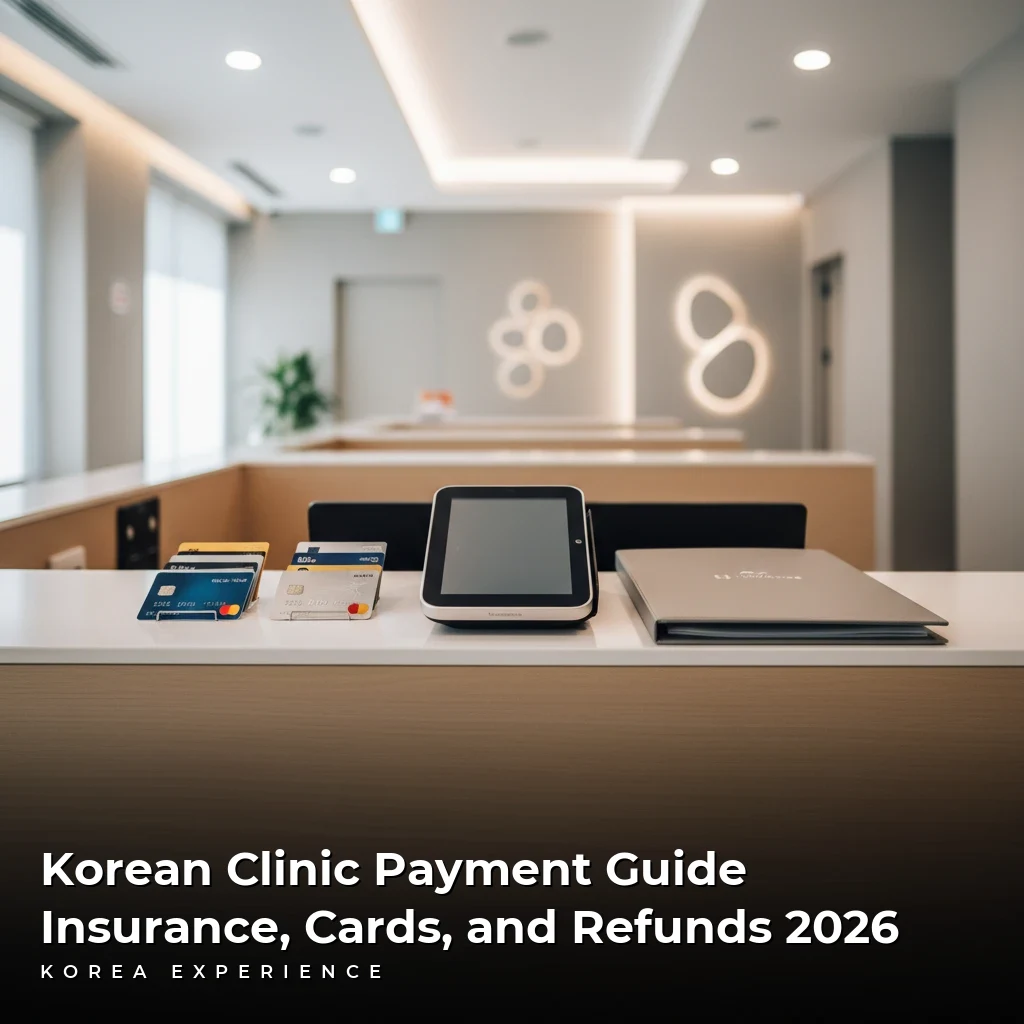
Most international travelers visiting Korean clinics can pay using major international credit cards (Visa, Mastercard), cash (Korean Won or USD), or wire transfers. However, coverage by international insurance is rare for outpatient cosmetic procedures, meaning you will likely pay upfront and claim reimbursement later. Importantly, tourists are eligible for a 10% VAT tax refund on cosmetic surgeries if the clinic is a registered medical tourism provider.
The short answer: You should bring a Visa or Mastercard with no foreign transaction fees, but carrying cash (USD or ₩) can often secure a 5-10% discount on non-insured procedures. Always ask for a tax refund slip for cosmetic treatments.
Key Takeaways
- 1International cards are widely accepted, but Amex coverage is spotty outside major hospitals.
- 2Tourists can claim a 7-8% net tax refund on cosmetic procedures at the airport.
- 3National Health Insurance (NHIS) is mandatory for residents residing over 6 months.
- 4Cancellation fees are regulated: 90% refund of deposit if cancelled 3 days prior.
Understanding the Korean Medical Payment Ecosystem
South Korea boasts one of the most sophisticated healthcare systems in the world, ranking consistently in the top 5 globally for efficiency. However, the financial logistics for a foreigner—whether a short-term medical tourist or a long-term resident—can be a labyrinth of regulations, exchange rates, and insurance tiers.
In 2026, the medical tourism sector in Korea has fully rebounded, expecting over 500,000 international patients annually. With this influx comes a strict set of payment protocols. Unlike some countries where you might negotiate payment plans after the fact, Korean clinics operate on a strict pay-before-treatment or pay-immediately-after model.
This guide covers everything from the "cash discount" culture in Gangnam plastic surgery clinics to the specific banking codes required for wire transfers, ensuring you don't get stuck with a declined card 5,000 miles from home.
Medical Disclaimer
We are travel and lifestyle experts, not financial or medical advisors. While we strive to keep this data accurate for 2026, banking regulations and clinic policies can change. Always confirm payment methods in writing before your appointment. Emergency Medical Information Center: 1339.
Payment Methods: What is Accepted?
When you walk into a clinic in Apgujeong or a general hospital in Jongno, you need to know exactly how to settle your bill. The infrastructure is highly digital, but gaps exist for foreign instruments.
1. International Credit and Debit Cards
South Korea is nearly a cashless society for locals, with credit card penetration exceeding 90%.
- Accepted Networks: Visa and Mastercard are accepted at 99% of clinics. JCB is widely accepted due to the high volume of Japanese tourists.
- American Express/Discover: Acceptance is hit-or-miss. Major university hospitals (Samsung Medical Center, Severance) accept Amex, but smaller dermatology or dental clinics often do not due to higher merchant fees (around 2.5-3%).
- DCC (Dynamic Currency Conversion): When you hand over your foreign card, the terminal may ask if you want to pay in won (₩) or your home currency (e.g., USD, EUR). Always choose won (₩). Paying in your home currency triggers DCC, which allows the merchant's bank to set a terrible exchange rate, often costing you an extra 3-5% on top of your bank's fees.
Before traveling, call your bank to authorize large transactions in South Korea. I've seen patients unable to pay for their $5,000 surgery because their bank flagged the transaction as fraud. Also, check your daily spending limit—many cards cap at $2,000 or $3,000 per day.
2. Cash Payments (₩ vs. USD)
Cash remains king in the medical tourism districts.
- Korean Won (₩): This is the safest and most standard method.
- US Dollars/Euros/Yen: Many plastic surgery and dermatology clinics in tourist zones (Gangnam, Myeongdong) accept foreign currency directly. They will apply the day's exchange rate, which is usually fair but verify it against a live source like XE.com.
- The "Cash Discount": It is an open secret that paying in cash can sometimes yield a discount. Clinics save on credit card processing fees (2-3%) and may pass that savings to you. However, ensure you still receive a receipt.
3. Wire Transfers
For major surgeries (orthopedic, comprehensive plastic surgery) costing over ₩5,000,000 ($3,800 USD), clinics often prefer wire transfers beforehand to secure the booking.
- Swift Transfers: Traditional bank transfers take 3-5 business days. You must cover the "intermediary bank fees" so the clinic receives the full amount.
- Fintech Apps (Wise/Remitly): These are increasingly accepted and offer much better exchange rates than traditional banks. However, you need the clinic's specific business registration number to process these transfers in Korea.
📋 Payment Data 2026
The Tax Refund System for Medical Tourists
One of the biggest financial incentives for getting procedures done in Korea is the VAT Refund system. Since 2016, the Korean government has allowed foreign tourists to claim back the 10% Value Added Tax (VAT) on eligible medical services.
Eligibility Requirements
To qualify, you must meet all the following criteria:
- You are a foreigner (non-resident) staying in Korea for less than 6 months.
- The clinic is registered with the Ministry of Health and Welfare as a "Medical Tourism Institution."
- The medical expense exceeds ₩30,000 (approx. $23 USD).
- You depart Korea within 3 months of the procedure.
Covered Procedures
Not all medicine is tax-free. The refund specifically targets cosmetic and aesthetic procedures, which are usually not covered by insurance.
- Eligible: Double eyelid surgery, rhinoplasty, breast augmentation, liposuction, facelifts, dermatology (laser, botox, fillers), dental scaling/whitening/laminates.
- Not Eligible: Essential medical treatments (cancer treatment, appendicitis surgery), postpartum care, internal medicine.
📖 How to Claim Your Medical Tax Refund
Step 1: Pay & Request Slip
After paying the full amount (including VAT) at the clinic, present your passport and request the 'Certificate of Selling Medical Service for Overseas Patient' (Tax Refund Slip).
Step 2: Airport Kiosk
At Incheon or Gimpo Airport, go to the Tax Refund Kiosks (usually near Customs or Gate 27/28). Scan your passport and the refund slip.
Step 3: Customs Inspection
For refunds under ₩75,000, the kiosk processes it automatically. For larger amounts, you may need a customs officer to stamp your receipt.
Step 4: Receive Cash
Go to the refund counter to receive your cash in won (₩), USD, or have it refunded to your credit card.
For those looking to explore more about cosmetic procedures, check our guide on Best Plastic Surgery Clinics for Foreigners in Seoul to find registered institutions.
Insurance: Travel vs. NHIS vs. Private
The insurance landscape in Korea is strictly divided between residents and visitors. Understanding which category you fall into is critical for managing costs.
1. International Travel Insurance (For Tourists)
Most Korean clinics do not do direct billing with international insurance companies (e.g., Cigna Global, Aetna International), with the exception of the International Healthcare Centers at "Big 5" hospitals (Asan, Samsung, Seoul National, Severance, St. Mary's).
- Process: You must pay the full bill upfront out-of-pocket.
- Documentation: The clinic will provide an English invoice and a detailed medical report (sometimes for a fee of 10,000 - ₩20,000).
- Claim: You submit these documents to your insurer back home for reimbursement.
- Exclusions: Travel insurance almost never covers elective cosmetic procedures (Botox, Lasik, Plastic Surgery). It covers accidents and acute illnesses.
2. National Health Insurance Service (NHIS) (For Residents)
If you are living in Korea on a visa (E-2, F-4, F-6, etc.) for more than 6 months, enrollment in the NHIS is mandatory.
- Cost: The average monthly premium for foreigners is roughly ₩150,000 ($115 USD) as of 2026, though this varies by income and visa type.
- Coverage: NHIS covers roughly 50-80% of medical costs. A doctor's visit might cost you only ₩5,000 ($4 USD) out of pocket.
- Dental: Basic dental (scaling once a year, extractions) is covered. Implants are generally not covered for those under 65.
Insurance Coverage Comparison
| Feature | Travel Insurance | NHIS (Residents) |
|---|---|---|
| Payment Mode | Pay First, Claim Later | Direct Co-pay |
| Eligibility | Tourists | Residents (>6 mo) |
| Cosmetic Surgery | No | No |
| Dental Basic | Emergency Only | Yes |
| Monthly Cost | $50-100 (varies) | ~₩150,000 |
For expats settling in, our article on Credit Cards in Korea: Which Banks Accept Foreigners is essential reading for setting up your financial life to pay these premiums.
Deposits and Cancellation Refunds
When booking surgery, clinics will require a deposit (Ye-yak-geum), typically 10% of the total surgery cost. This locks in your surgery date and the doctor's time.
Disputes over deposit refunds are the #1 complaint among medical tourists. However, the Korea Fair Trade Commission (KFTC) has standard terms for resolving consumer disputes.
Standard Refund Policy (KFTC Guidelines)
While clinics may try to have their own policies, the KFTC guidelines act as the legal baseline. If a clinic refuses a refund that aligns with these rules, you can report them to the Korea Consumer Agency or the Medical Mediation & Arbitration Board.
Cancellation Refund Timeline
90% Refund
If you cancel 3+ days before surgery date, you get 90% of the deposit back.
50% Refund
Cancellation 2 days prior yields a 50% refund of the deposit.
20% Refund
Cancellation 1 day prior yields a 20% refund of the deposit.
No Refund
Cancellation on the day of surgery or no-show results in 0% refund.
Important Note: This applies to the deposit (contract fee), not the full surgery amount. If you paid the full amount in advance, the refund calculations apply to the total, but clinics will fight harder on this. Never pay the full surgery amount until you are physically at the clinic on the day of the procedure, except for the deposit.
"Foreigner Pricing" vs. Local Pricing
Is it true that foreigners pay more? Yes, usually. Before you get angry, understand the "Dualism" of the market. This isn't necessarily a scam; it's a difference in service tiers.
💵 Price Structure Comparison
English translator, concierge service, airport pick-up, tax refund eligible.
The extra 20-30% often covers:
- Interpretation: Professional medical translators cost money.
- Agency Fees: If you booked through a medical tourism agency, they take a 15-20% commission (legal and standard).
- Marketing: The cost of acquiring an international patient is higher.
- Tax Refund: The clinic has to handle the VAT refund administration.
If you speak fluent Korean and hold an Alien Registration Card (ARC), you can often access the local price, but you forfeit the VAT refund.
Dealing with Agencies and Brokers
Many tourists use agencies (like Docfinderkorea, Eunogo, etc.) to book appointments.
- Pros: They handle all payments, translations, and disputes. You usually pay the agency, and they pay the clinic.
- Cons: You might not see the itemized bill from the clinic.
- Illegal Brokers: Unregistered brokers (often met on WeChat or KakaoTalk) may inflate prices by 50-100%. Always check if the agency is registered with the Korea Health Industry Development Institute (KHIDI).
📊 Market Transparency
Practical Tips for Your Visit
1. Currency Exchange Strategy
Do not exchange all your money at your home airport; the rates are terrible.
- Best Rate: Exchange a small amount ($100) at Incheon Airport for transport, then exchange the rest at money changers in Myeongdong or Insadong. The spread there is often less than 1%.
- ATMs: Global ATMs are everywhere (look for the "Global" sign). The withdrawal limit is usually ₩1,000,000 ($760) per transaction and ₩6,000,000 ($4,600) per day.
2. Using Pre-paid Cards
Services like NAMANE or WOWPASS are incredibly popular in 2026. You can load these cards with foreign currency cash, and they act like a local Korean debit card. This is excellent for paying for smaller treatments (facials, skincare) without incurring multiple foreign transaction fees on your home credit card.
Money Box Myeongdong(머니박스 명동점)
3. Splitting Payments
It is very common to split payments. You can pay the deposit by wire transfer, 50% of the balance on Credit Card A, and the remaining on Credit Card B or in cash. Just inform the reception desk before they run the card.
If you are recovering from a procedure, you might want to look into comfortable accommodations. Read our guide on Airbnb vs Recovery Hotels for Medical Tourists to decide where to rest.
Potential Scams and Pitfalls to Avoid
While Korea is safe, financial misunderstandings occur.
- The "Additional Treatment" upsell: You go in for a $100 laser, and they pressure you into a $500 package. Payment is demanded immediately. Solution: Be firm. Say "I only have budget for what I booked."
- Shadow Doctors: In surgery, a different doctor performs the operation than the one you consulted. This is illegal. Solution: Ask for CCTV footage guarantees (many clinics now offer this).
- Receipt Refusal: If a clinic refuses to give a receipt for a cash payment, they are likely dodging taxes. Do not proceed. You have no recourse if something goes wrong.
How to Handle a Dispute
If you feel you were overcharged or the result was malpractice:
- Keep all receipts: Credit card slips, tax refund slips, and consultation agreements.
- Contact the Medical Mediation & Arbitration Board: +82-2-6210-0114. They offer services in English.
- Emergency Police: 112 (for fraud/theft).
For those interested in specific treatments, our deep dive into Anti-Aging Treatments in Korea: Botox, Fillers, and More 2026 offers price benchmarks so you know if you are being overcharged.
FAQ: Common Payment Questions
❓ Frequently Asked Questions
Have more questions?Contact us →
Conclusion
Navigating the financial side of Korean medical tourism is all about preparation. By ensuring you have a high-limit credit card, understanding the tax refund process, and knowing your rights regarding cancellations, you can focus on your recovery and results rather than stressing over the bill.
Remember, the Korean medical system is fast-paced. Decisions are made quickly in the consultation room, and payment is expected immediately after. Being financially prepped allows you to make calm, rational decisions about your health and beauty.
If you are planning a trip soon, don't forget to check the Best Time to Visit Korea to align your recovery with pleasant weather.
Payment Methods Summary
- ✓Credit cards accepted almost everywhere
- ✓Tax refunds available for tourists (7-8% net)
- ✓Cash can provide negotiation leverage
- ✓Transparent pricing laws in place
- ✗Foreign transaction fees can add up
- ✗International insurance rarely billed directly
- ✗Strict deposit cancellation policies
- ✗Amex acceptance is limited
About the Author
Korea Experience Team
Written by the Korea Experience editorial team - experts in Korean medical tourism, travel, and culture with years of research and firsthand experience.
⚠️ Medical Disclaimer
The information provided on this website is for general informational purposes only and does not constitute medical advice. Always consult with qualified healthcare professionals before making any medical decisions.
Explore more in Medical Tourism
World-class medical procedures at competitive prices. From plastic surgery and dermatology to dental care and health checkups — your complete guide to medical tourism in Korea.
Browse All Medical Tourism ArticlesContinue Reading
Explore more articles you might find interesting
A comprehensive guide to FFS, VFS, and top surgery in Seoul for 2026. Includes costs, recovery times, and clinic recommendations for international patients.
A comprehensive guide to anesthesia types in Korean medical tourism, costs, safety protocols, and what to expect during surgery. Average read time 15 mins.
Everything you need to know about medical tourism insurance for Korea in 2026, covering complications, costs, provider comparisons, and claim procedures.
A complete guide to insurance reimbursement for medical tourism in Korea. Learn about coverage limits, VAT refunds, and claim success rates in 2026.
A comprehensive guide to English-speaking medical facilities in Seoul. Includes wait times, 2026 pricing, insurance details, and the top 15 clinics for expats.
A comprehensive guide to mastering the NHIS website and app in 2026. Learn login hacks, payment methods, and coverage checks to avoid penalties.