Motorcycle Rental in Korea: Guide for Experienced Riders 2026
Can foreigners rent big bikes in Korea? A complete guide to licenses, the highway ban, costs (starting ₩50,000/day), and top routes for 2026.
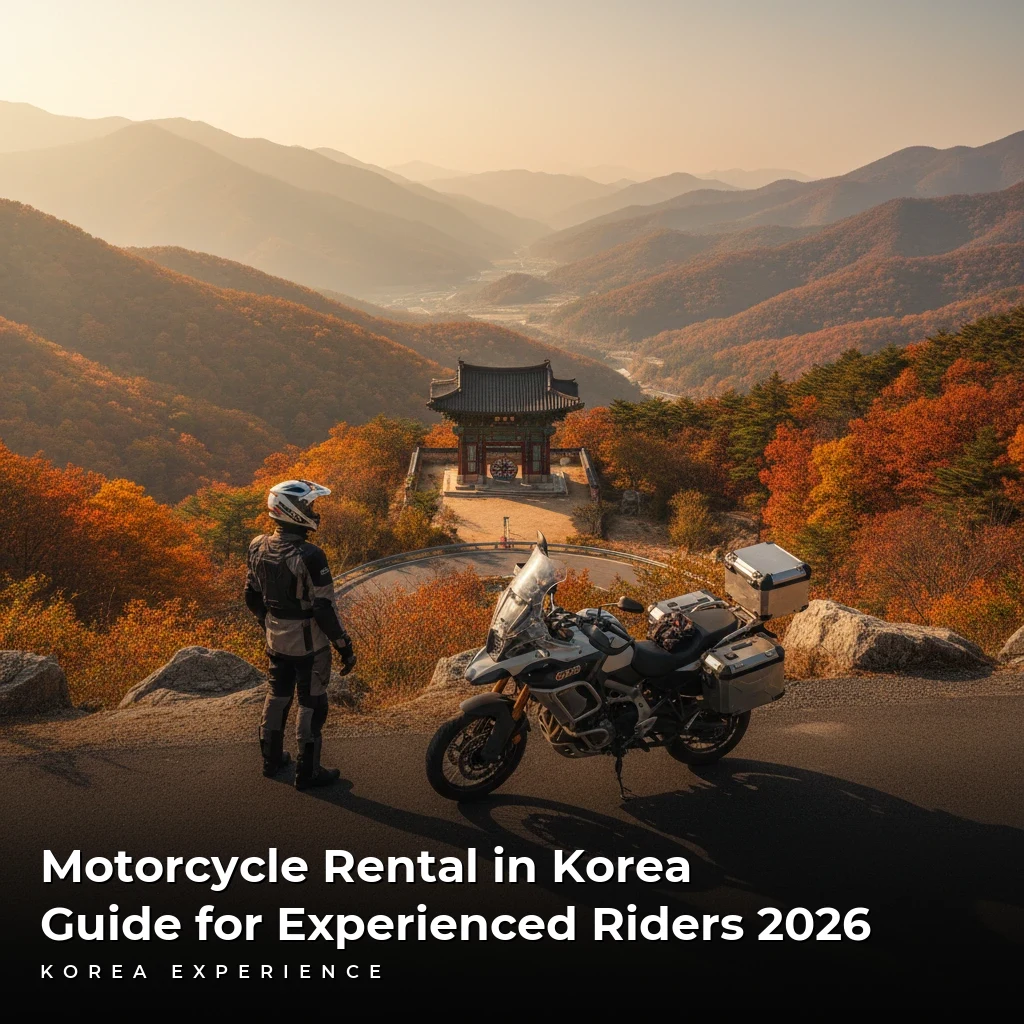
Renting a motorcycle in South Korea as a foreigner is entirely possible, but the experience differs significantly from riding in Europe, North America, or Southeast Asia due to unique legal restrictions and road hierarchies. For experienced riders looking to tour the peninsula on two wheels, the most critical factor is possessing a valid International Driving Permit (IDP) with a specific motorcycle stamp (Type A), as a standard car license (Type B) is legally insufficient for any machine over 125cc.
The short answer: Yes, experienced riders can rent high-displacement motorcycles (600cc+) in Korea if they hold a full motorcycle license from home and a Type A-stamped IDP, though you are strictly banned from riding on expressways regardless of bike size.
Key Takeaways
- 1Strict Highway Ban: Motorcycles are legally prohibited from all expressways (toll roads), regardless of engine size.
- 2License Rule: You must have an International Driving Permit (IDP) stamped specifically for motorcycles to rent anything over 125cc.
- 3Rental Costs: Expect to pay ₩100,000–₩180,000 per day for 600cc+ bikes, with deposits ranging from ₩500,000 to ₩1,000,000.
- 4Navigation: Google Maps does not offer turn-by-turn navigation; you must use Naver Map or KakaoMap set to 'Two-Wheeled Vehicle' mode.
The Legal Landscape: Licenses and the Highway Ban
Before you plan a cross-country tour from Seoul to Busan, you must understand the regulatory environment. Korea is unique among OECD nations in its treatment of motorcycles on high-speed infrastructure.
The International Driving Permit (IDP)
To legally rent a motorcycle in Korea, you must present a passport and a valid International Driving Permit issued under the 1949 Geneva Convention.
Crucially, if you intend to rent a "big bike" (anything over 125cc), your IDP must have the motorcycle stamp (Category A). Many rental agencies are extremely strict about this. If you only have a Category B (passenger car) stamp, you will be limited to 125cc scooters or bikes, or denied rental entirely at premium shops.
The 125cc License Trap
Do not assume your car license covers small bikes. While Korean law allows car license holders to ride bikes under 125cc, many rental insurance policies require a specific motorbike license for any two-wheeled rental to ensure coverage. Always check with the shop beforehand.
The "Highway Ban" (Goseok-doro)
The most shocking realization for riders coming from Western countries is the prohibition of motorcycles on expressways.
In South Korea, motorcycles are banned from:
- Expressways (Goseok-doro): These are the high-speed toll roads connecting major cities.
- Automobile-Only Roads (Jeonyong-doro): These are highways and bridges (often within cities like Seoul) designated solely for cars.
This law applies to all motorcycles, whether you are riding a 125cc scooter or a 1200cc BMW R1250GS. There are no exceptions for engine displacement. If you are caught riding on these roads, the police will escort you off, and you face fines.
📊 Highway Violation Penalties
This ban significantly impacts travel times. A trip that takes 4 hours by car on the expressway might take 6 to 7 hours by motorcycle because you are forced to use secondary national roads (Gukdo). However, for adventure riders, this is often a blessing in disguise, as the national roads offer superior scenery, winding mountain passes, and a closer look at rural Korea.
Where to Rent: Seoul vs. Jeju Island
The motorcycle rental market in Korea is bifurcated into two main categories: utility scooters for delivery/commuting and premium leisure bikes for touring.
Renting in Seoul (The Mainland)
Seoul is the hub for big bike rentals. The primary district for anything motorcycle-related is Toegyero (near Chungmuro Station). This street is lined with dozens of dealerships and repair shops.
For experienced riders looking for BMWs, Ducatis, or Harleys, specialized rental shops have emerged. These shops cater to enthusiasts and often organize tours. Unlike the utilitarian scooter shops, these agencies require significant deposits but offer well-maintained fleets.
Toegyero Motorcycle Street(퇴계로 오토바이 거리)
When renting in Seoul, you are positioned perfectly to explore the mountainous Gangwon province to the east. However, escaping the city limits can be stressful due to heavy traffic and the complex web of "Automobile-Only Roads" that you must navigate around.
For those interested in exploring shorter distances or city riding, you might consider alternative transport methods. For instance, the public transport system is excellent, or you could look into bicycle rental systems in Seoul if you decide a motorbike is too much hassle for the city center.
Renting in Jeju Island
Jeju Island is the undisputed paradise for motorcycle touring in Korea. Traffic is lighter, the pace is slower, and the coastal roads are spectacular.
Jeju has a robust rental infrastructure catering to tourists. You can easily find everything from a Honda Super Cub to a Harley Davidson. The Jeju Coastal Road (Route 1132) is a roughly 200km loop that encircles the entire island, making it a perfect 1-2 day journey.
Rental Experience: Seoul vs. Jeju
| Feature | Seoul (Mainland) | Jeju Island |
|---|---|---|
| Traffic Density | Very High | Low to Moderate |
| Route Complexity | High (Must avoid highways) | Low (Easy coastal loops) |
| Bike Availability | High (All models) | Moderate (Seasonal) |
| Scenery | Urban/Mountain | Coastal/Volcanic |
Cost Analysis: Budgeting for Your Ride
Motorcycle rental in Korea is generally more expensive than in Southeast Asia but comparable to Europe. Prices fluctuate based on the season (spring and autumn being peak) and the bike's displacement.
Daily Rates
- 125cc Scooters (PCX, NMAX): ₩40,000 – ₩60,000 per day.
- 300cc - 500cc (MT-03, Rebel 500): ₩80,000 – ₩120,000 per day.
- Liter Class / Premium (BMW GS, Harley, Goldwing): ₩150,000 – ₩250,000 per day.
Most shops offer discounts for multi-day rentals (usually 10-15% off for 3+ days).
💵 24-Hour Rental Cost Comparison
Includes panniers & insurance
Helmet included, limited range
Insurance and Deposits
This is a critical area. Unlike car rentals where comprehensive insurance is standard, motorcycle rental insurance in Korea often has high deductibles.
- Basic Insurance: Usually included, covers third-party liability.
- Collision Damage Waiver (CDW): Often not available or very expensive.
- Deposit: Expect to place a credit card hold or cash deposit ranging from ₩300,000 for a scooter to over ₩1,000,000 for a premium bike.
Document Everything
Before riding off, take a 4K video of the entire bike with your phone, zooming in on existing scratches. Korean shop owners are generally honest, but having proof protects you from disputes over pre-existing damage.
If you are planning a long-term stay, you might consider buying a cheap used vehicle instead of renting, although the registration process for foreigners can be complex. For a comparison of vehicle acquisition methods, see our guide on buying a used car in Korea.
Riding Culture and Navigation
The "Delivery" Factor
You will notice thousands of delivery riders (Baedal) on scooters weaving aggressively through traffic, running red lights, and riding on sidewalks. As a foreigner on a rental, do not imitate them. Police are cracking down on two-wheeled violations. Ride defensively and assume cars do not see you.
Navigation Apps are Critical
Google Maps is essentially useless for navigation in Korea due to government data restrictions. It will not provide turn-by-turn directions.
You must download Naver Map or KakaoMap. Both have English interfaces. Most importantly, you must go into the settings and select "Two-Wheeled Vehicle" or "Motorcycle" as your transport mode.
- Why? This setting automatically routes you away from the illegal expressways (Goseok-doro) and automobile-only roads. If you use "Car" mode, you will end up on a prohibited highway, facing a potential ₩300,000 fine and police intervention.
📖 Setting Up Naver Map for Riding
Step 1: Download App
Install Naver Map from App Store/Play Store.
Step 2: Set Language
Menu > Settings > Language > English.
Step 3: Choose Route
Enter destination. Click the 'Car' icon, then look for the 'Two-wheeler' icon (usually looks like a scooter).
Step 4: Verify Route
Ensure the route avoids toll gates (red/blue ying-yang symbol icons usually indicate toll roads).
Best Routes for Enthusiasts (2026 Edition)
Once you have your bike, where should you go? Korea is 70% mountainous, meaning the roads are twisty, technical, and incredibly fun.
1. The Route 6 Corridor (Seoul to Yangpyeong)
This is the classic "Sunday Morning Ride" for Seoul bikers.
- Distance: Approx. 60km one way.
- Highlights: The road follows the Han River, passing through tunnels and winding valleys.
- Pit Stop: Yangmanjang (Yangpyeong Meeting Plaza). This is a legendary rest stop where hundreds of bikers gather every weekend. It's a car show on two wheels.
- Extension: Continue to Sockho on the East Coast for a 200km cross-country run crossing the Taebaek mountain range.
2. The East Coast Run (Route 7)
Riding along the East Coast from Gangneung down to Pohang is breathtaking. You have the ocean on your left and mountains on your right.
- Atmosphere: Relaxed, scenic, fewer traffic lights.
- Best Season: October (Autumn foliage). For more on seasonal beauty, check our guide to autumn colors and hiking spots.
3. Jeju Island Route 1100
While the coastal road is famous, the 1100 Road cuts through the center of Hallasan Mountain.
- Elevation: Climbs to 1,100 meters above sea level.
- Experience: Technical switchbacks, dense forest, and cooler temperatures. It is one of the highest roads in Korea.
Day Trip: Seoul to Gapyeong
The Dualism Concept: Experience the best of both worlds — premium luxury moments paired with authentic budget-friendly experiences in one route.
Premium Rental (BMW)
Rental fee + premium fuel
Scooter Rental (PCX)
Rental fee + regular fuel
Ride Route 46 towards Chuncheon for the best river views and stop for Dakgalbi (spicy chicken).
Practical Tips for the Road
Fueling Up
Gas stations are abundant.
- Red Nozzle: Gasoline (Hwibalyu). Almost all bikes take this.
- Green/Blue Nozzle: Diesel (Gyeongyu). Never put this in a bike.
- Payment: Most pumps are self-service. You need a credit card. Insert card -> Select Amount (or 'Full') -> Pump -> Remove Card.
Parking
Technically, motorcycles should park in parking spaces. In reality, in Seoul, motorcycles park on sidewalks, tucked away near buildings so as not to block pedestrian flow.
- Strict Zones: Do not park on crosswalks, bus stops, or yellow jagged lines.
- CCTVs: Korea is covered in cameras. Illegal parking fines (₩40,000) are mailed to the rental shop, which will charge your credit card later.
"In rural areas, gas stations close early, often by 8 PM. If you are riding in the mountains of Gangwon-do, never let your tank drop below 30%. Also, beware of 'Black Ice' in tunnel exits during early spring (March) and late autumn (November)."
Seasonal Gear
Korea has four distinct seasons, and they dictate your riding gear.
- Winter (Dec-Feb): Riding is virtually impossible due to ice and sub-zero temps (-10°C is common).
- Summer (July-Aug): Extremely hot (35°C+) and humid, plus the Monsoon season (Jangma). Heavy rains make riding dangerous.
- Spring (Apr-Jun) & Autumn (Sept-Nov): The "Golden Season." Perfect temperatures (15°C - 25°C).
If you are visiting during the hotter months and want to save money, check our guide on budget travel in Korea, which includes tips on affordable accommodation that often has parking.
Recommended Rental Shops (2026 Update)
While shops open and close, these established names have a track record of serving foreigners. Always contact them via WhatsApp or KakaoTalk before visiting.
- Rainers (Seoul): Known for specialized rentals and English-friendly service.
- Star Motorcycle (Seoul - Toegyero): Large fleet of scooters and manual bikes.
- Jeju Scooter Tour (Jeju): Specialists in island rentals with good insurance packages.
- Big Bike (Seoul): Focuses on high-displacement machines for enthusiasts.
Motorcycle Travel in Korea
- ✓Incredible mountain roads (70% of terrain)
- ✓High-quality road surfaces
- ✓Extremely safe from theft
- ✓Rider Cafe culture is booming
- ✗Highway ban increases travel time
- ✗Aggressive driving style of taxis/buses
- ✗Google Maps limitations
- ✗Harsh winter stops riding for 3 months
Conclusion
Renting a motorcycle in Korea offers a visceral way to connect with the landscape that a train or bus simply cannot match. The prohibition on expressways, while initially frustrating, forces you onto the old national roads that snake through rice paddies, hanok villages, and misty mountain passes—the parts of Korea that actually matter.
For the experienced rider, the combination of technical mountain roads, high-tech infrastructure, and the booming "Rider Cafe" culture makes Korea an underrated gem for moto-tourism. Just remember: bring your IDP (Type A), download Naver Map, and watch out for the delivery scooters.
❓ Frequently Asked Questions
Have more questions?Contact us →
Explore More
If you're planning a trip to Korea, don't miss our other essential guides:
- Best Day Trips from Seoul - Perfect destinations for your ride.
- Buying a Used Car in Korea - If you decide four wheels are safer.
- Bicycle Rental Systems - For lighter two-wheeled adventures.
About the Author
Korea Experience Team
Written by the Korea Experience editorial team - experts in Korean medical tourism, travel, and culture with years of research and firsthand experience.
Explore more in Travel & Tourism
From Seoul's neon-lit streets to Jeju's volcanic landscapes — discover the best of Korea with insider travel tips, itineraries, and seasonal guides.
Browse All Travel & Tourism ArticlesContinue Reading
Explore more articles you might find interesting
Complete 2026 guide to renting a car in Korea. Learn IDP rules, Naver Map navigation, costs starting at ₩60,000/day, and specific driving laws.
Master the unique Korean housing market. A complete guide to Jeonse lump-sum deposits vs Wolse monthly rent, costs, and safety tips for 2026.
Master Seoul transit in 2026. Learn why T-money costs 4,000 KRW, how to rent 1,000 KRW bikes without an ARC, and the truth about the Climate Card for tourists.
Complete 2026 guide to Korean intercity buses. Compare Express vs. Intercity, master T-Money GO & Kobus apps, and find routes starting from ₩15,000.
Discover Korea's top coastal cycling routes. From the 234km Jeju Fantasy Path to the East Coast trail, get maps, rental costs, and itinerary tips.
A complete guide to revision nose surgery in Seoul including 2026 costs, recovery timelines, rib cartilage techniques.