Traditional martial arts trying taekwondo vs taekkyeon 2026
Compare Taekwondo vs Taekkyeon in Korea for 2026. Discover costs, cultural differences, and where to train for an authentic martial arts experience.
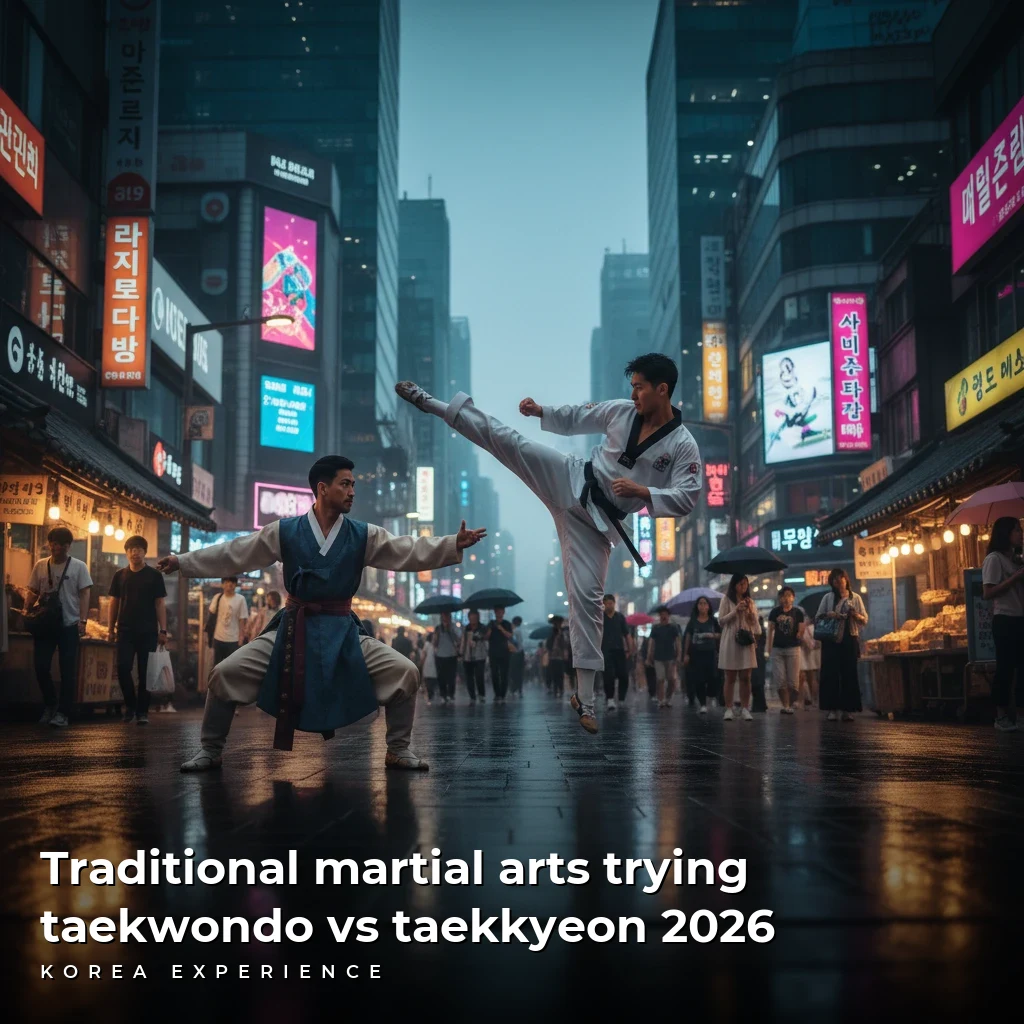
When travelers land at Incheon International Airport, they are entering a nation where martial arts are not just sports but intrinsic parts of the national identity. In 2026, the interest in immersive cultural tourism has surged by over 35% compared to previous years, with visitors seeking more than just sightseeing—they want to sweat, learn, and embody the Korean spirit. The debate often lands on two distinct disciplines: the world-famous, Olympic-standard Taekwondo, and its ancient, rhythmic ancestor, Taekkyeon.
For more details, check out our guide on Bonsai and Zen gardens finding peace in Korea traditional....
Related reading: Rainy Seoul Evenings.
Related reading: Korean Traditional Architecture Palace Tour Guide and Tips.
Learn more in our comprehensive guide to Korean traditional music and performance guide.
Choosing between trying Taekwondo vs Taekkyeon depends entirely on what kind of "Korea experience" you crave. Do you want the crisp, high-impact kicks that defined modern Korean soft power? Or are you looking for the fluid, dance-like movements of a UNESCO Intangible Cultural Heritage that dates back to the Joseon Dynasty? This guide breaks down the costs, locations, and physical demands of both to help you decide.
Key Takeaways
- 1Taekwondo focuses on linear power and high kicks; Taekkyeon emphasizes fluid rhythm and tripping techniques.
- 2A one-day Taekwondo experience costs roughly ₩40,000 ($30), while Taekkyeon introductory classes are often cheaper or free at cultural centers.
- 3The best Taekwondo is at Kukkiwon in Gangnam, while the authentic home of Taekkyeon is Chungju, 1.5 hours south of Seoul.
Understanding the Core Differences: Hard vs. Soft
To the untrained eye, both involve kicking. However, the philosophy and execution are diametrically opposed. Taekwondo, formalized in the 1950s, is a "hard" style. It relies on speed, linear force, and percussive impact. It is the most practiced martial art in the world, with over 80 million practitioners globally. In contrast, Taekkyeon is a "soft" style, characterized by a unique rhythmic stepping motion called Gumsil.
While Taekwondo matches are won by points scored through impact, Taekkyeon matches are won by throwing the opponent or kicking them in the head—but gently. The goal is dominance without severe injury.
Discipline Comparison: Taekwondo vs Taekkyeon
| Feature | Taekwondo | Taekkyeon |
|---|---|---|
| Primary Focus | Striking & High Kicks | Trips, Throws & Low Kicks |
| Movement Style | Linear, rigid, explosive | Curvilinear, rhythmic, dance-like |
| UNESCO Status | Pending/Cultural Heritage | First Martial Art Listed (2011) |
| Global Status | Olympic Sport since 2000 | Cultural Folk Art |
| Est. Calorie Burn/Hr | 600-800 kcal | 450-600 kcal |
Many foreigners find Taekkyeon surprising because of the 'Ik-ek' sound we make. Unlike the sharp 'Kihap' shout in Taekwondo used to tense the core, 'Ik-ek' helps release tension and maintain rhythm. Don't be shy to make the sound; it's essential to the breathing technique!
The Taekwondo Experience: The Way of the Foot and Fist
In 2026, Taekwondo remains the crown jewel of Korean athletic exports. If you choose this path, you are choosing a structured, rigorous workout. A typical session for tourists involves learning the basic stance (Juchum Seogi), basic punches, and the front kick (Ap Chagi).
Where to Experience Taekwondo in Seoul
The epicenter of World Taekwondo is the Kukkiwon in Gangnam. Located just 600 meters uphill from Gangnam Station (Exit 12), it is the spiritual headquarters where dan (black belt) certifications are issued. In 2026, they have expanded their "International Visitor Experience" program.
Another prime location is the National Taekwondowon, though this requires travel. Located in Muju, roughly 240 kilometers south of Seoul, it is a massive complex dedicated entirely to the sport. The travel time is approximately 2.5 hours by bus from Seoul Nambu Terminal, costing around ₩28,000 for a one-way ticket.
Kukkiwon (World Taekwondo Headquarters)(국기원)
The Training Environment
Taekwondo dojangs (gyms) are ubiquitous. In Seoul alone, there is roughly one dojang every 500 meters in residential areas. The floor is padded with puzzle mats. The atmosphere is disciplined. You will be expected to bow to the flag and the master. The commands are given in Korean, but purely physical instruction makes it easy to follow.
📊 Taekwondo in Korea 2026
The Taekkyeon Experience: The Ancient Dance
Taekkyeon offers a completely different vibe. It feels less like a military drill and more like a folk game. The movements are soft, circular, and deceivingly powerful. The fundamental step, Pumbalbgi, creates a triangle on the ground, shifting weight constantly. This makes it an excellent workout for core stability and joint health, particularly for travelers over 40 who might be wary of the high-impact jumps in Taekwondo.
Where to Find Taekkyeon
Taekkyeon is rarer. While you won't find it on every street corner, the experience is often more intimate. The Kyulyun Taekkyeon Association in Seoul (near Insadong) offers classes for foreigners.
However, for the ultimate experience, you should visit Chungju, the home of the World Martial Arts Park. Chungju is located about 110 kilometers southeast of Seoul. Thanks to the KTX-Eum (high-speed train) introduced earlier in the decade, you can now reach Chungju Station from Pangyo in just 65 minutes for approximately ₩12,000.
Cultural Context
Taekkyeon was nearly wiped out during the Japanese occupation (1910-1945) but was secretly preserved by Master Song Duk-ki. Today, it is recognized by UNESCO, making a class feel like a living history lesson rather than just a workout.
What a Class Feels Like
You wear a white simplified Hanbok (traditional clothing) rather than the V-neck heavy cotton uniform of Taekwondo. The class begins with rhythmic stepping. There is lots of laughter; Taekkyeon culture encourages enjoyment (Heung). You will learn to kick from obscure angles, hooking your foot behind an opponent's leg to off-balance them.
Cost Breakdown: 2026 Prices
Budgeting for your martial arts experience is straightforward, but prices have adjusted for inflation. In 2026, the average cost of leisure activities in Seoul has risen by roughly 8% compared to 2024.
Short-Term Experience Costs
If you are looking for a one-time "cultural experience" aimed at tourists (which includes uniform rental and a certificate):
- Taekwondo: ₩40,000 – ₩60,000 ($30 - $45 USD)
- Taekkyeon: ₩25,000 – ₩40,000 ($19 - $30 USD)
Long-Term Training Costs (Per Month)
If you are staying in Korea for a month or more (e.g., as a digital nomad or student), joining a local gym is more economical per session but requires an upfront fee.
💵 Monthly Training Costs (Seoul 2026)
3 classes/week, Uniform extra (₩50,000)
📋 Gear & Extras Costs
Step-by-Step: How to Book Your Class
Booking systems in Korea have become highly digitized by 2026. While you can still walk in, apps are the preferred method.
📖 How to Book a Martial Arts Class
Step 1: Choose Your Platform
For English service, use Klook, Trazy, or TripAdvisor. For local gyms, use Naver Map.
Step 2: Search Terms
Type 'Taekwondo Experience' or 'Taekkyeon Center'.
Step 3: Message the Master
If using Naver, click 'Talk'. Send a simple message: 'Do you accept foreigners for 1-day training?'
Step 4: Prepare Cash/Card
Most gyms accept cards, but some smaller traditional centers prefer bank transfer or cash. Prepare roughly ₩50,000.
Which One Should You Choose?
This decision often paralyzes travelers. To help you decide, here is a balanced look at the pros and cons of trying Taekwondo vs Taekkyeon in 2026.
For the Fitness Enthusiast (Taekwondo)
If you want to burn 700+ calories, sweat profusely, and feel powerful, Taekwondo is the answer. It is aerobic and anaerobic. The shouting helps release stress.
For the Cultural Explorer (Taekkyeon)
If you are interested in history, dance, and body mechanics, Taekkyeon is superior. It connects you to the peasant culture of old Korea. It is less about fighting and more about harmony.
Experience Analysis
- ✓Taekwondo: High energy, great stress relief, recognized globally.
- ✓Taekwondo: Easy to find, English instruction common.
- ✓Taekkyeon: Gentle on joints, unique cultural insight.
- ✓Taekkyeon: Friendly, non-competitive atmosphere.
- ✗Taekwondo: Can be repetitive (drills).
- ✗Taekwondo: Risk of minor injury (hamstrings).
- ✗Taekkyeon: Harder to find locations.
- ✗Taekkyeon: Movements may feel awkward at first.
Suggested Itineraries
To maximize your time, combine your martial arts training with nearby attractions. Here are two curated timelines for a perfect day in Seoul.
The Gangnam Warrior (Taekwondo Day)
Breakfast
Light porridge (Juk) near Gangnam Station (₩10,000).
Kukkiwon
Watch the demo team and visit the museum.
Lunch
Bibimbap for energy.
Training
90-minute specialized foreigner class.
Recovery
Visit a jjimjilbang (sauna) to soak tired muscles.
The Cultural Flow (Taekkyeon Day)
Insadong
Explore traditional crafts and tea houses.
Intro Class
Taekkyeon session at Kyulyun HQ (near Anguk).
Gyeongbokgung
Visit the palace (15 min walk) to see where royal guards trained.
Makgeolli
Dinner with Makgeolli, traditionally enjoyed after Taekkyeon matches.
Practical Tips for Your Visit
Etiquette inside the Dojang
- Bowing: Always bow when entering and leaving the floor.
- Shoes: strictly off. Socks are usually off for Taekwondo, but sometimes worn in Taekkyeon (special padded socks exist).
- Terminology: Learning "Gamsahamnida" (Thank you) and "Sabumnim" (Master) goes a long way.
Health Warning
Both arts require hip flexibility. If you have existing hip or knee issues, arrive 15 minutes early to stretch and inform the instructor. Taekkyeon is generally safer for bad knees due to its soft movements.
2026 Specific Updates
The "K-Culture Pass" introduced by the Korea Tourism Organization now often includes discounts for martial arts experiences. Check the VisitKorea app before booking; you might save up to 20% on entrance fees or class costs.
Furthermore, many gyms now offer AI-assisted posture analysis. At high-end Taekwondo centers in Gangnam, cameras may record your kick and overlay it with a "perfect" form to show you exactly where your angle is off.
Final Verdict
The battle of Taekwondo vs Taekkyeon isn't about which is "better" for fighting. It is about which aspect of the Korean soul you wish to touch. Taekwondo represents the modern, dynamic, "Bali-Bali" (hurry hurry) culture of Korea—efficient, powerful, and successful. Taekkyeon represents the Han and Heung—the deep sorrow and joyous rhythm of the past.
For a first-time visitor in 2026, we recommend a one-day Taekwondo experience for the sheer spectacle and bucket-list value. However, if you are returning to Korea or staying for more than two weeks, seek out a Taekkyeon center. The community you will find there is warmer, the movements more forgiving, and the connection to history deeper.
❓ Frequently Asked Questions
Have more questions?Contact us →
About the Author
Korea Experience Team
Written by the Korea Experience editorial team - experts in Korean medical tourism, travel, and culture with years of research and firsthand experience.
Explore more in K-Culture
K-Pop, K-Drama, traditional arts, and modern culture — dive deep into the cultural phenomena that have captivated the world.
Browse All K-Culture ArticlesContinue Reading
Explore more articles you might find interesting
Compare KTX and SRT high-speed trains in Korea. Discover price differences (10% cheaper), station locations, and how to book tickets for your 2026 trip.
Discover why market vendors give free food. Learn how to navigate 24000 stalls in 2026 using WOWPASS and experience the 16 percent sales boom firsthand.
Train like an idol in Seoul for just 30,000 KRW. Discover top studios like 1Million and MuDoctor, visa rules, and the 2026 trainee reality.
Master the rules of Yutnori and Jegichagi. Discover the history, gameplay strategies, and best places to experience traditional Korean culture.
Discover the best traditional Korean hanbok experience in Seoul with rental tips, pricing guides, and hidden photo spots for 2026 travelers.
Discover the best venues for Gugak performances in Seoul. From royal palaces to modern theaters, find ticket info, etiquette, and top cultural experiences.