Traveling Korea with Kids: Stroller Access and Theme Parks 2026
Complete 2026 guide to stroller access in Seoul, Lotte World tips, and Everland hacks. Learn why 95% of subway stations are accessible but buses are not.
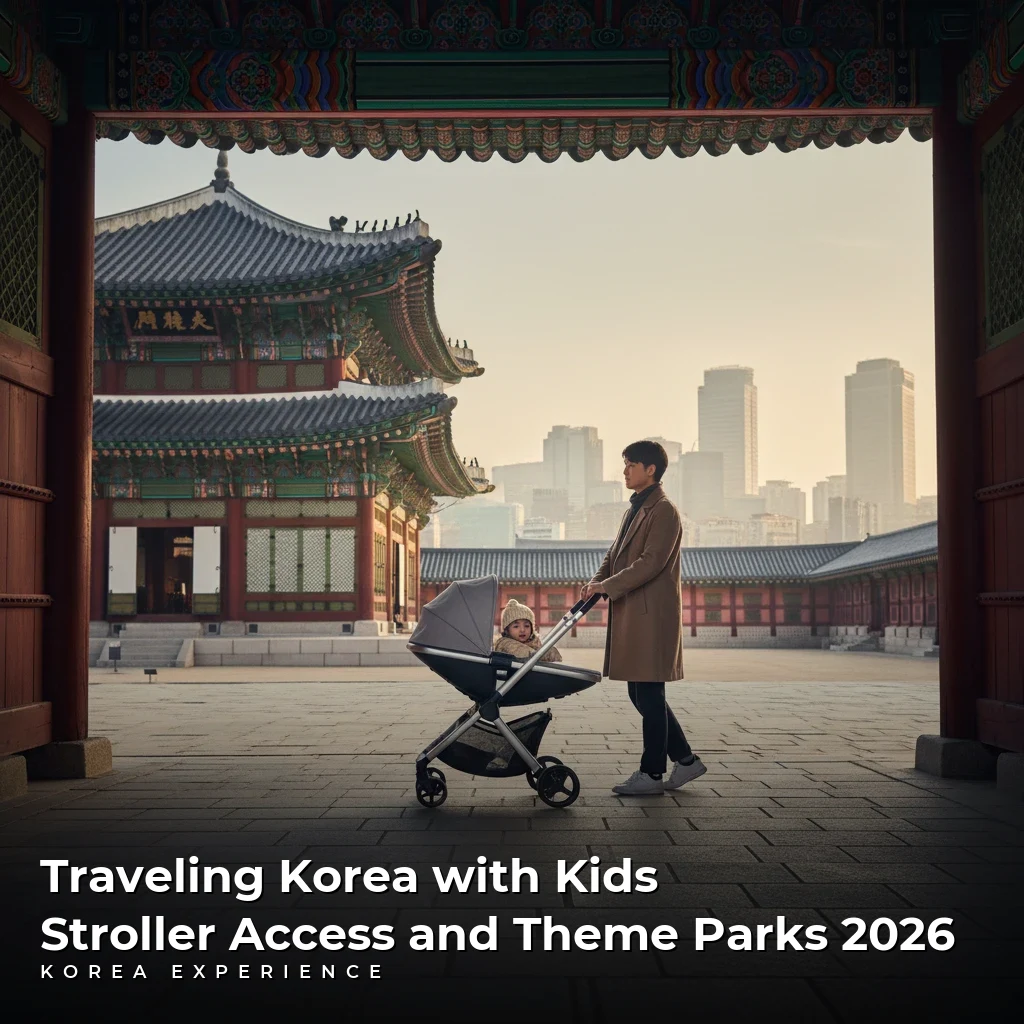
Is traveling to Korea with young children and a stroller a nightmare or a breeze in 2026? The answer depends entirely on your preparation and understanding of the local infrastructure. While Seoul is a modern metropolis with world-class amenities, the juxtaposition of ultra-modern facilities with hilly terrain and crowded public transport can catch parents off guard.
The short answer: Korea is very family-friendly, but you must avoid city buses with strollers. The subway system is 95% accessible via elevators, though transfers can add 15-20 minutes to your journey. For theme parks like Everland, a durable stroller is mandatory due to steep hills.
Key Takeaways
- 1City buses are dangerous for open strollers; stick to subways or Kakao T Venti vans.
- 2Lotte World is mostly indoor and flat; Everland is extremely hilly and requires sturdy wheels.
- 3Nursing rooms (Su-yu-sil) are ubiquitous, clean, and often equipped with microwaves and purifiers.
- 4KakaoMetro app is essential for finding the 'elevator' route in subway stations.
Stroller Logistics: Navigating Korean Public Transport
Transport is the single biggest hurdle for parents visiting Korea. In 2026, the gap between "accessible" and "convenient" is still significant. Here is the breakdown of how to move around Seoul and Busan with a stroller.
The Subway System: Accessible but Time-Consuming
Seoul's subway system is massive, with over 300 stations. As of 2026, approximately 95% of stations have elevator access from the street to the platform. However, "accessible" does not mean "fast."
If you are traveling solo with a stroller, finding the specific exit with an elevator often means walking an extra 200 to 400 meters compared to using stairs or escalators. Transfers at major hubs like Dongdaemun History & Culture Park or Express Bus Terminal can take up to 25 minutes just to navigate between lines via elevators.
📊 Seoul Subway Accessibility 2026
Pro Tip: Use the KakaoMetro App
Download KakaoMetro. When planning a route, check the "Fast Transfer" car number. More importantly, look for the wheelchair icon on exits to identify elevator locations before you arrive. This saves an average of 10 minutes of aimless walking per trip.
City Buses: A Hard "No"
Unlike some European or North American cities where buses kneel and have dedicated stroller bays, standard Korean city buses are generally not stroller-friendly. Drivers are often in a rush, braking is abrupt, and the buses are crowded. You would need to fold your stroller and carry the child before boarding, which is stressful during rush hour (8:00–9:30 AM and 6:00–7:30 PM).
Low-floor buses are becoming more common (about 60% of the fleet in Seoul), but they are usually packed. Unless it is an emergency, avoid the blue and green buses with an open stroller.
Taxis and Ride-Hailing
This is your best friend. Standard taxis (silver or orange) have trunk space that fits a standard collapsible stroller (like a Yoyo or Bugaboo Butterfly). However, the tanks for LPG fuel (which most taxis run on) take up half the trunk space. If you have a large jogging stroller (e.g., UPPAbaby Vista), it likely won't fit in a standard sedan taxi.
For larger families or big strollers, use the Kakao T app to book a "Venti" or "Large" taxi. These are Kia Carnivals (minivans) that can take a fully assembled stroller or hold a folded large stroller plus 4-5 passengers easily.
💵 Taxi Cost Comparison (5km Trip)
Minivan. Fits non-folded strollers.
Silver/Orange Sedan. Limited trunk space.
Pavements and Streets
Seoul is a city of hills. Gangnam is relatively flat and wide, but older areas like Bukchon Hanok Village, Itaewon, and parts of Hongdae have uneven pavement, steep inclines, and cobblestones. A stroller with small plastic wheels will struggle in these historic districts.
For those planning routes, check out our guide on accessible routes in Seoul, which shares significant overlap with stroller-friendly paths.
Theme Park Guide: Lotte World vs. Everland
The two giants of Korean entertainment offer vastly different experiences for parents. Your choice should depend on the weather, your child's age, and your stroller type.
Lotte World: The Indoor Safe Bet
Located in Jamsil (Southeast Seoul), Lotte World is distinct because its main "Adventure" section is indoors. This makes it perfect for the extreme temperatures of Korean summer (August: 30°C+) or winter (January: -10°C).
Stroller Access: Lotte World is very stroller-friendly. The indoor floors are smooth tile. Elevators connect the four floors, though they are small and often crowded. You can rent strollers at the entrance for approximately ₩4,000 per day (requires ID deposit).
Ride Tips for Toddlers: The "Kidstoria" zone is a soft play area safe for walkers. The monorail and balloon ride offer great views without height restrictions (infants must be held).
Lotte World Adventure(롯데월드)
Everland: The Hilly Outdoor Adventure
Everland is located in Yongin, about 60-90 minutes from Seoul. It is massive and built on the side of a mountain.
The "Killer" Hills: Warning: Everland is incredibly steep. Pushing a stroller back up from the "European Adventure" zone (bottom) to the entrance (top) is a strenuous workout equivalent to 20 minutes of heavy cardio.
Stroller Strategy: There is a "Sky Cruise" (gondola) that allows strollers. Use this. Do not try to walk up the hill. Take the gondola down to the safari area and back up. If you rent a stroller here (₩5,000 for a single, ₩15,000 for a double), be aware they are basic models. Bringing your own robust stroller with good brakes is highly recommended.
Safari World & Lost Valley: These are the highlights for kids. You can see tigers, bears, and giraffes up close. However, you must park your stroller outside the ride queues.
Lotte World vs. Everland for Strollers
- ✓Lotte World: Indoor climate control (rain/snow proof)
- ✓Lotte World: Flat terrain, easy pushing
- ✓Everland: Wider paths, less claustrophobic
- ✓Everland: Better animal encounters (Safari)
- ✗Lotte World: Crowded corridors, small elevators
- ✗Lotte World: Fewer thrill rides for older siblings
- ✗Everland: Extreme hills (exhausting to push)
- ✗Everland: Weather dependent
Legoland Korea Resort: The Toddler Paradise
Opened in Chuncheon in 2022, Legoland Korea has matured into a prime destination for families with kids aged 2-10. Unlike Everland, Legoland is entirely flat (built on an island).
Getting There: Take the ITX-Cheongchun train from Yongsan Station to Chuncheon Station (approx. 70 mins). From Chuncheon Station, there is a shuttle bus. Note: The shuttle bus can accommodate strollers in the luggage hold.
Why it wins for strollers: Wide paths, zero hills, and every ride has designated stroller parking. The park is designed specifically for young children, meaning bathrooms with changing tables are everywhere, and ride height restrictions are much lower (many accessible at 90cm).
Beyond Theme Parks: Stroller-Friendly Itineraries
If you aren't doing theme parks, where can you go?
1. Shopping Malls (The Sanctuary)
Korean malls are built for families. Starfield COEX (Gangnam) and The Hyundai Seoul (Yeouido) offer free high-end stroller rentals (often Stokke or Egg brands) if you are a member, though sometimes they accept passports for foreigners. They have pristine nursing rooms with bottle warmers, air purifiers, and comfortable nursing chairs.
Check out our guide to best areas to stay near shopping districts to position yourself near these hubs.
2. The Han River Parks
Yeouido Hangang Park and Banpo Hangang Park consist of miles of flat, paved bicycle and walking paths. It is the perfect place to let a toddler run free while you push the stroller. You can rent picnic mats and order fried chicken delivery right to the park.
3. The Royal Palaces
Gyeongbokgung and Changdeokgung are accessible, but with a caveat. The grounds are expansive and mostly dirt/sand. While hard-packed enough for strollers, it can get dusty. Many of the internal gates have raised wooden thresholds (about 10-15cm high) that you will need to tilt the stroller over.
Day Out in Gangnam: Kids & Culture
The Dualism Concept: Experience the best of both worlds — premium luxury moments paired with authentic budget-friendly experiences in one route.
Coex Aquarium
Stroller friendly underwater tunnels
Bongeunsa Temple
Peaceful walking paths (some stairs)
Start at the Aquarium in the mall, then walk across the street to the temple for a quiet nap time.
Essential Survival Tips for Parents
Nursing Rooms (Su-yu-sil)
Korea excels here. Almost every subway station, department store, and museum has a "Su-yu-sil." In department stores (Shinsegae, Lotte, Hyundai), these are luxurious suites with separate sleeping rooms, changing stations with sinks, and kitchenettes with purified hot water (set to 40°C or 70°C for formula) and microwaves.
Diapers and Formula
You can find diapers (Gijwigui) at convenience stores like CU or GS25, but they usually only stock small emergency packs (3-5 count) of limited sizes. For full packs, go to Lotte Mart, Emart, or Homeplus.
- Common Brands: Huggies and Bosomi are dominant. Pampers are available but imported and pricier.
- Formula: Aptamil and Hipp are popular imports available in large marts, but Korean brands like Absolute (Maeil) are high quality.
No-Kids Zones
Be aware that some trendy cafes, especially in areas like Seongsu-dong or Hannam-dong, operate as "No-Kids Zones" (usually banning children under 12). Look for signs at the door. If you are unsure, just peek in—if the vibe is whisper-quiet and full of breakable ceramics, it's best to skip it.
Dining with a Stroller
Korean restaurants are often tight on space.
- BBQ Restaurants: Hazardous with hot coals and crowded aisles. Look for larger, chain BBQ places or ask for a corner table.
- Traditional Markets: Gwangjang Market is extremely crowded. Navigating a stroller through the food alley is nearly impossible during lunch hours. Go early (10:00 AM) or fold the stroller.
- High Chairs: Most casual restaurants have IKEA high chairs, but traditional floor-seating restaurants are disappearing.
For food recommendations that the whole family can enjoy, see our list of 50 must-try Korean foods. Non-spicy options like Seolleongtang (ox bone soup) and Bulgogi are kid-favorites.
📖 How to Order a Taxi with a Car Seat (Limited)
Step 1: Download Kakao T
Ensure you have the app set up with a foreign credit card.
Step 2: Select Venti
Choose the Venti option. Car seats are NOT guaranteed in standard taxis.
Step 3: Message Driver
If you have a lot of luggage + stroller, use the message function: 'Baby stroller and luggage' (translate to Korean).
Best Time to Visit with Kids
Weather dictates stroller comfort.
- Spring (April-May): Perfect. Cherry blossoms, mild temps (15-20°C). High pollution (Yellow Dust) days can occur—buy child-sized KF94 masks.
- Summer (July-August): Brutal. High humidity and monsoon rains make stroller rain covers a sauna. Stick to malls.
- Autumn (September-November): Best season. Clear skies, crisp air, beautiful foliage.
- Winter (December-February): Very cold. You need a heavy footmuff for the stroller.
Check our detailed breakdown on the best time to visit Korea for specific monthly clothing advice.
Expert Tips for 2026
"In 2026, many department stores have started offering stroller sterilization services next to the rental counters. Also, if you visit Lotte World Mall, the 4th floor has a dedicated 'Family Lounge' that is better than most hotel lobbies. For dining, look for 'Han-jeong-sik' (table d'hote) restaurants; they usually offer private rooms which are perfect for containing toddlers while you eat."
Itinerary Ideas: 3 Days with a Stroller
-
Day 1: The Modern & Flat.
- Morning: COEX Aquarium (Stroller friendly).
- Lunch: Starfield Library area (plenty of food courts).
- Afternoon: Bongeunsa Temple (across the street).
- Evening: Lotte World Tower (Seoul Sky elevator is stroller accessible).
-
Day 2: The Park Day.
- Morning: Seoul Forest (Deer enclosure, flat paths).
- Lunch: Pizza nearby in Seongsu-dong (check for No-Kids zones).
- Afternoon: Kid's cafe. Korea has the best kid's cafes in the world like Lilliput or Champion.
-
Day 3: The Adventure.
- Option A (Weather bad): Lotte World Adventure.
- Option B (Weather good): Everland (Bring the hiking shoes).
For a more comprehensive plan that you can adapt for kids, look at our 24-hour Seoul itinerary.
Stroller Rental Options 2026
| Service | Location | Price/Day | Quality |
|---|---|---|---|
| Lotte World | Main Gate | ₩4,000 | Basic (Umbrella style) |
| Everland | Main Gate | ₩5,000 | Standard (Sturdy) |
| Starfield Mall | Info Desk | Free | Premium (Egg/Stokke) |
| Private Rental | Online/Hotel Delivery | ₩15,000+ | High-End (Yoyo/Bugaboo) |
Conclusion
Traveling Korea with kids in 2026 is an adventure of convenience mixed with physical challenges. The infrastructure inside buildings (malls, stations, airports) is world-class. The infrastructure outside (hills, bus transitions, old pavements) requires a sense of humor and a bit of muscle.
If you plan your routes using the "elevator first" mentality on the subway, utilize the inexpensive and spacious Venti taxis, and mix intense days (Everland) with easy days (Kids Cafes and Malls), you will find Korea to be an incredibly welcoming place for families. The locals love children, and you will likely find grandmothers stopping to wave at your baby or offer them a treat.
Pack a lightweight but durable stroller, download KakaoMap, and get ready for a memorable family trip.
❓ Frequently Asked Questions
Have more questions?Contact us →
About the Author
Korea Experience Team
Written by the Korea Experience editorial team - experts in Korean medical tourism, travel, and culture with years of research and firsthand experience.
Explore more in Travel & Tourism
From Seoul's neon-lit streets to Jeju's volcanic landscapes — discover the best of Korea with insider travel tips, itineraries, and seasonal guides.
Browse All Travel & Tourism ArticlesContinue Reading
Explore more articles you might find interesting
Discover Korea's best underground shopping streets. Save up to 70% on fashion in Goto Mall, Gangnam, and Busan with our 2026 guide to prices and locations.
Experience authentic Hanji making in Jeonju 2026. Workshops range from ₩5,000 to ₩30,000 with hands-on drying and crafting sessions for travelers.

Explore Seoul's largest vintage market with our 2026 guide. Find luxury brands for ₩5,000, navigate 600+ stalls, and discover hidden boutiques.
Discover Korea's best markets beyond Seoul. Explore Busan, Jeju, and Daegu with specific food prices, transport tips, and 2026 travel data.
Discover top Korean ski resorts and ice festivals for 2026. From High1 to Hwacheon, find prices, transport tips, and gear rentals in our complete guide.
Discover Seoul's top 8 traditional markets. From Gwangjang's ₩5,000 noodles to Namdaemun's 10,000+ shops, get the ultimate 2026 shopping guide.