Korean funeral traditions understanding death and remembrance 2026
A comprehensive guide to Korean funeral etiquette, the three-day vigil, and condolence money customs for international travelers and expats in 2026.
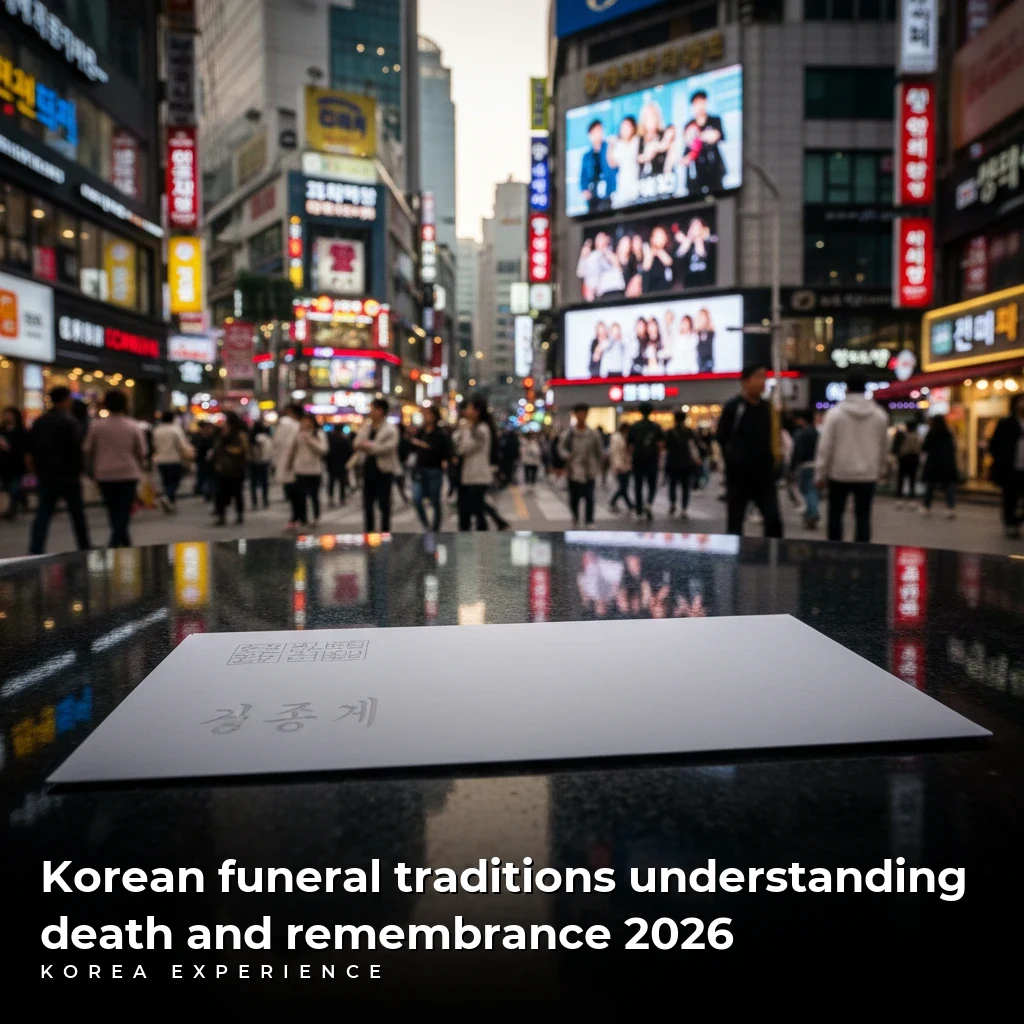
Navigating the cultural landscape of death and remembrance in a foreign country can be one of the most daunting experiences for an expat or traveler. In South Korea, funeral traditions—known as Jangrye—are a profound blend of deep-rooted Confucian values and hyper-modern efficiency. Unlike Western services that often last a few hours, a Korean funeral is an immersive three-day event that emphasizes communal mourning, filial piety, and the collective sharing of grief.
As we move through 2026, these traditions are evolving. While the core rituals remain, the logistics have modernized, with over 90% of services now held in specialized hospital funeral centers rather than private homes. Understanding these nuances is crucial, not just to avoid social faux pas, but to genuinely connect with Korean friends or colleagues during their most vulnerable moments.
You might also enjoy our article about Korean parenting styles understanding the tiger mom vs ne....
This guide provides an exhaustive look at what to expect, how to behave, and the deeper meanings behind the rituals you will witness.
Learn more in our comprehensive guide to Korean wedding traditions what to expect at a local wedding.
Key Takeaways
- 1Korean funerals typically last three days with visitors attending on days 1 and 2
- 2Condolence money (Bu-ui-geum) must be given in odd-numbered amounts, starting at ₩50,000
- 3The standard bowing ritual involves two full bows to the deceased and one half-bow to the family
The Three-Day Vigil (Sam-il-jang)
The most distinct feature of a Korean funeral is its duration. It is almost universally a three-day process (Sam-il-jang), operating 24 hours a day. This ensures that distant relatives and busy colleagues have ample time to pay their respects.
Learn more in our comprehensive guide to Understanding Uri We in Korean Culture 2026 Guide.
The Three-Day Funeral Timeline
Imjong and Preparation
The body is moved to the funeral hall. The family puts on mourning clothes (Sangbok). Food is prepared for guests.
Munsang (Visitation)
The busiest day. Friends, colleagues, and extended family visit to bow, eat, and drink. The body is cleansed (Yeomseup) and placed in the coffin (Ip-gwan).
Balin (Departure)
The funeral cortege leaves the hall early in the morning for the cremation center or burial site.
Day 1: Immediate Action
Upon death, the body is immediately transferred to a funeral hall, typically located in the basement or annex of a major hospital. By 2026, the average cost for a standard room rental for three days in Seoul has reached approximately ₩2.5 million ($1,850 USD), excluding food and services. The chief mourner (Sangju), usually the eldest son, begins contacting relatives.
Related reading: The philosophy of nunchi understanding Korea social super....
Day 2: The Main Event
This is when you, as a friend or colleague, are expected to visit. Unlike Western funerals with a set service time, you can arrive anytime, though staying between 10:00 AM and 10:00 PM is standard for non-close friends. The atmosphere can be surprisingly lively; the noise is believed to comfort the spirit of the deceased, ensuring they do not feel lonely.
Day 3: The Farewell
The final day involves the procession to the hearse. This takes place early, often between 5:00 AM and 8:00 AM. Unless you are a close family member or a best friend, you generally do not attend Day 3.
Pro Tip: Best Time to Visit
If you are a colleague or casual acquaintance, the best time to visit is after work hours (around 6:00 PM to 8:00 PM) on Day 2. This allows you to join the communal dinner without interrupting the immediate family's morning rituals.
Dress Code: The Uniform of Grief
In 2026, the aesthetic of a Korean funeral remains strictly conservative. The visual uniformity creates a sense of equality and shared sorrow among mourners.
For Men
The standard is a black suit, white shirt, and a black tie. Socks must be black. If you do not own a black suit, a dark navy or dark charcoal suit is acceptable.
- Critical Detail: Do not wear flashy watches or jewelry.
- Socks: You will be taking your shoes off immediately upon entering. Ensure your socks are hole-free and black.
For Women
A black dress, skirt suit, or pant suit is appropriate. Hemlines should be below the knee. Makeup should be minimal.
- Evolution: In the past, traditional white Hanbok was common for female family members, but in 2026, modernized black Hanbok or simple black formal wear is the norm for 95% of attendees.
"Many foreigners panic because they didn't pack a black suit. If you are a tourist and must attend a funeral unexpectedly, dark grey or navy clothing is forgiven. However, never wear shorts, sandals, or bright colors like red, which is associated with festivity and is considered highly offensive."
The Ritual of Condolence Money (Bu-ui-geum)
Perhaps the most anxiety-inducing aspect for foreigners is the "envelope culture." Giving money is mandatory; it helps the family cover the high costs of the funeral, which average ₩15 million ($11,200 USD) in metropolitan areas like Seoul and Busan.
The Rules of Numbers
The amount you give is dictated by your relationship to the deceased and, crucially, must involve odd numbers (3, 5, 7, 10). In Korean culture, odd numbers represent yang (positivity) and becoming, while even numbers are associated with yin. Note that 10 is considered a lucky number comprising two 5s, so it is an exception.
💵 Condolence Money Standards (2026)
The absolute minimum for colleagues or distant friends.
Standard for friends you see regularly or direct supervisors.
How to Prepare the Envelope
- Most funeral halls have a kiosk or desk at the entrance with envelopes.
- Write your name vertically on the back of the envelope on the left side.
- Write your affiliation (company name) next to your name so the family knows exactly who sent it.
- Do not seal the envelope; the family needs to count it immediately to record it in their ledger.
📋 Money Etiquette Facts
Entrance and Bowing Etiquette
Once you arrive at the specific room (memorial hall) assigned to the deceased, there is a strict choreography to follow. It takes approximately 5 to 10 minutes.
📖 How to Perform the Funeral Bow (Jeol)
Step 1: Sign the Guestbook
Enter the foyer, sign your name in the guestbook, and place your envelope in the box (or hand it to the person at the desk).
Step 2: Approach the Altar
Walk to the altar. You may burn incense (one stick) or place a white chrysanthemum on the altar. If using incense, light it, shake it to extinguish the flame (NEVER blow it out), and place it in the holder.
Step 3: Bow to the Deceased
Perform two full bows (kneeling to the floor) followed by one light half-bow (standing, head down 45 degrees) toward the photo of the deceased.
Step 4: Bow to the Family
Turn to the side where the Chief Mourner and family are standing. Perform one full bow (or a deep standing bow) to them. Exchange brief words of consolation.
Religious Exemptions
If you are Christian or your religion forbids bowing to ancestors, you may stand in silent prayer for one minute at the altar instead of performing the full floor bows. This is widely understood and respected in modern Korea.
The Meal: More Than Just Food
After the bowing ritual, you will be ushered into an adjacent dining room. This is not optional; refusing the meal is considered rude as sharing food symbolizes the communal carrying of grief.
The menu is remarkably consistent across the country. You will almost certainly be served:
- Yukgaejang: Spicy beef and scallion soup. The red color is traditionally believed to ward off bad spirits.
- Pyeonyuk: Boiled pork slices.
- Jeon: Korean savory pancakes.
- Soju and Beer: Alcohol is free-flowing.
Dining Etiquette
- Pouring: Pour drinks for others, never for yourself.
- Toasting: NEVER clink glasses. Toasting is for celebrations. At a funeral, you drink quietly.
- Atmosphere: While somber, laughter is permitted. The goal is to distract the family from their sorrow. You may see people playing Go-Stop (a Korean card game) in the corner; this is traditional to keep the mourners awake during the 24-hour vigil.
Yonsei Severance Funeral Hall(연세세브란스 장례식장)
Modern Trends: Cremation and Digital Legacies
By 2026, the landscape of Korean burials has shifted dramatically due to land shortages. The government actively promotes cremation, and the statistics reflect this change.
📊 2026 Burial Statistics
The Rise of Columbariums
Instead of grassy mounds (San-so), most Koreans now rest in "Charnel Houses" or Columbariums (Napgol-dang). These are glass-fronted lockers housing the urn, photos, and small mementos.
Tree Burials (Sumokjang)
A rapidly growing trend in 2026 is "natural burials," where cremated ashes are buried around the roots of a designated tree. This eco-friendly option now accounts for nearly 25% of new interments, appealing to the younger generation's environmental consciousness.
Cremation vs. Traditional Burial
- ✓Significantly lower cost (approx. 1/5th of burial)
- ✓Easier maintenance for descendants
- ✓Environmentally sustainable
- ✗Less traditional 'Feng Shui' alignment
- ✗Visit time limits at popular columbariums
- ✗Requires booking months in advance for premium spots
Understanding the "Sangju" (Chief Mourner)
The Chief Mourner, distinct by his armband (usually striped), carries a heavy burden. Traditionally the eldest son, he must stay at the funeral hall for the entire three days, greeting every guest and often sleeping less than 4 hours a night on the floor of the visitation room.
In 2026, gender roles are slightly shifting. While the eldest son is still the primary Sangju, it is becoming more common to see daughters taking active leadership roles, especially in single-child families.
Armband Significance
You will see armbands on the male family members' left arms.
- Two Stripes: Chief Mourner (Eldest Son).
- One Stripe: Other sons or sons-in-law.
- No Stripe: Grandchildren or distant relatives. Women generally wear a small white ribbon hairpin.
Practical Logistics for Travelers
If you are an expat living in Korea, or a traveler attending a funeral, here are the logistical details you need to know.
Transportation
Funeral halls at major hospitals (Asan Medical Center, Samsung Medical Center, Seoul National University Hospital) are enormous complexes.
- Parking: Usually free for 1-2 hours for guests, but costly for longer stays.
- Shuttles: Most operate free shuttles from the nearest subway station every 15 minutes.
What to Say
If you don't speak Korean, a simple nod and a firm handshake (using two hands) is sufficient. If you want to speak:
- "Sam-ga go-in-ui myeong-bok-eul bim-ni-da" (I pray for the repose of the deceased).
- This is a mouthful. A simple, sorrowful "An-ta-kkap-seum-ni-da" (It is regrettable/unfortunate) is also acceptable and easier to pronounce.
Gift vs. Money Comparison
| Feature | Condolence Money | Wreath (Hwahwan) | Fruit Basket |
|---|---|---|---|
| Acceptability | Mandatory | Business Only | Rare |
| Convenience | High | Low (Logistics) | Medium |
| Cost Impact | Helps Family | Showcase Only | Neutral |
Conclusion: A Culture of "Jeong"
Attending a Korean funeral is a lesson in Jeong (deep emotional connection/attachment). It is not a sterile, private goodbye, but a noisy, crowded, communal effort to shoulder the weight of sadness. By showing up, eating the soup, and bowing, you are not just an observer; you are participating in the social fabric of Korea.
In 2026, even as AI manages the guestbook and digital screens display the deceased's life story, the core of the ceremony remains human connection. Whether you are there for 30 minutes or 3 hours, your presence is the most valuable gift you can offer.
❓ Frequently Asked Questions
Have more questions?Contact us →
About the Author
Korea Experience Team
Written by the Korea Experience editorial team - experts in Korean medical tourism, travel, and culture with years of research and firsthand experience.
Explore more in K-Culture
K-Pop, K-Drama, traditional arts, and modern culture — dive deep into the cultural phenomena that have captivated the world.
Browse All K-Culture ArticlesContinue Reading
Explore more articles you might find interesting
Master the nuances of Korean work culture with our comprehensive guide on office etiquette, hierarchy, and business customs for international professionals.

Master the art of sending packages from Korea. A complete guide to EMS, box sizes, customs apps, and shipping costs for expats and travelers.
Master the intricate world of Korean side dishes with our comprehensive guide to banchan varieties, dining etiquette, and the best places to buy them in Seoul.
Master Korean business culture in 2026. A comprehensive guide to bowing, business cards, and meeting protocols for international professionals.
Master the art of Korean tea etiquette with our 2026 guide to Darye including best teahouses brewing steps and cultural insights for travelers
Discover the soul of Korean music. A complete 2026 guide to Pansori and Samulnori performances, venues, tickets, and etiquette for travelers.