Korean Festivals 2026: Fireflies, Mud & Beyond Cherry Blossoms
Discover Korea's best 2026 festivals beyond spring flowers. From Boryeong Mud Festival tickets (₩14,000) to Muju Fireflies, here is your complete guide.
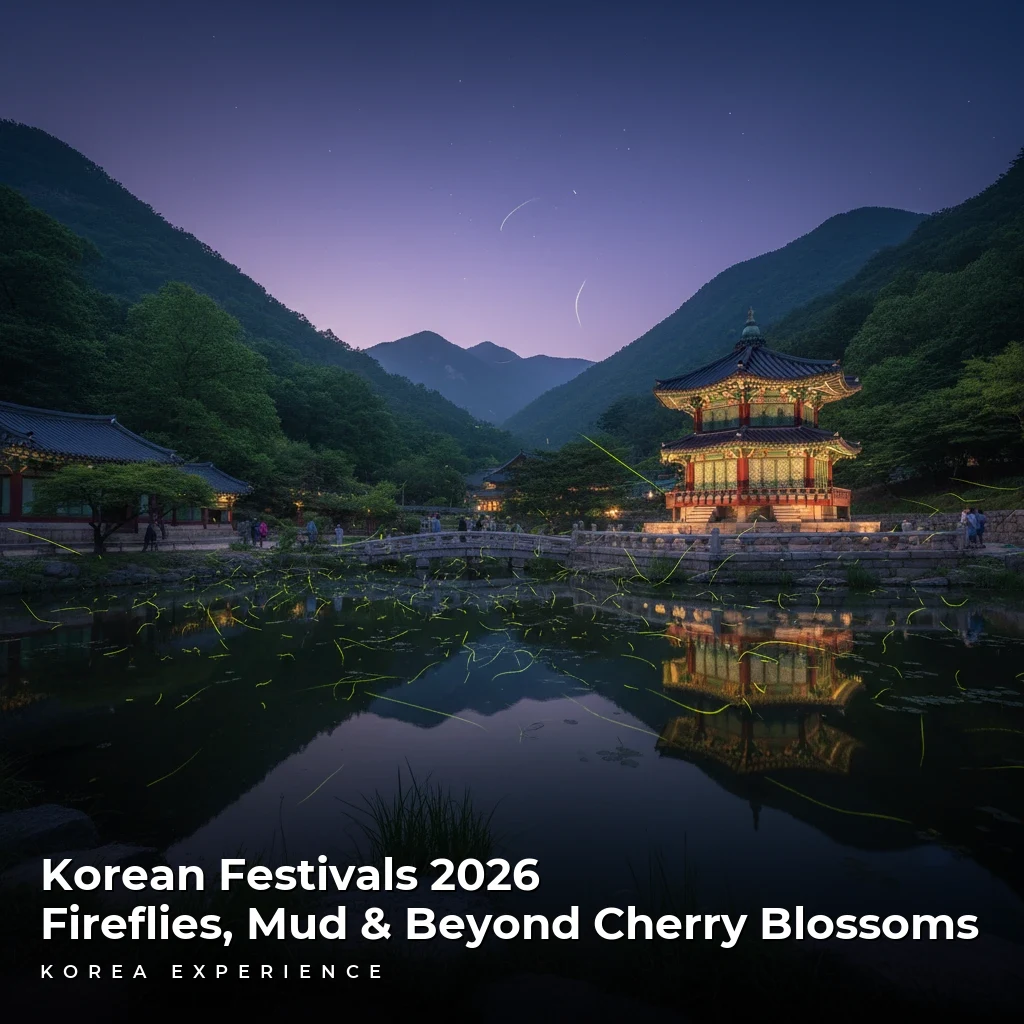
While the fleeting pink petals of April garner the most Instagram likes, seasoned travelers know that South Korea’s festival calendar is a year-round powerhouse of culture, adrenaline, and natural wonder. If you are planning a trip for 2026 and want to experience the peninsula like a local, you need to look beyond the cherry blossoms.
Most international visitors cluster their trips around the first two weeks of April. However, this often leads to inflated flight prices (upwards of 30-40% higher) and overcrowded landmarks. The real magic of Korea often happens in the humid heat of July, the crisp air of October, and the freezing clarity of January. Whether it is rolling in mineral-rich mud, watching thousands of fireflies illuminate a protected ecological zone, or walking across a parted sea, Korea offers experiences that are far more interactive than flower viewing.
The short answer: For 2026, the must-visit non-spring festivals are the Boryeong Mud Festival (July 17-26 estimate) for high-energy fun and the Muju Firefly Festival (late August/early September) for eco-tourism. Expect entry fees ranging from ₩5,000 to ₩15,000 depending on the event.
Key Takeaways
- 1Boryeong Mud Festival (July) requires booking accommodation 3 months in advance due to 2M+ visitors.
- 2Muju Firefly Festival tickets (₩8,000-15,000) are limited per night to protect the insects.
- 3Winter festivals like Hwacheon Sancheoneo occur on 20cm+ thick ice and offer sashimi on-site.
Summer: The Energy of Earth and Water (July - August)
Summer in Korea is hot and humid, with temperatures averaging 30°C (86°F) and humidity often hitting 80-90%. While many travelers hide in air-conditioned cafes, the locals head to the coast or the mountains for some of the country's most energetic festivals.
The Boryeong Mud Festival: The Global Party
Expected Dates: Mid-July 2026
Located approximately 200 kilometers south of Seoul, Daecheon Beach in Boryeong transforms into a massive gray playground every July. Originally conceived in 1998 to promote the therapeutic benefits of the region's mineral-rich mud, it has evolved into Korea's most international festival.
For 2026, the festival is scaling up its "Global Zone." You aren't just standing in mud; you are sliding down giant inflatables, wrestling in mud pits, and dancing to EDM concerts while being sprayed with mud cannons.
📋 Boryeong Mud Festival Facts
The Experience: The mud here is rich in germanium and bentonite, emitting high amounts of far-infrared rays. However, the science is secondary to the fun. The festival is divided into a Family Zone and a General Zone (Adults). The General Zone is where the chaos happens. You will be covered in mud within 5 minutes of entering.
Cost Breakdown:
- Entrance Fee: ₩14,000 for adults (Mon-Thu), ₩16,000 (Fri-Sun).
- Locker Rental: ₩2,000 - ₩3,000 (Coins only, bring cash).
- Showers: ₩3,000 at public facilities.
Accommodation Warning
Hotels near Daecheon Beach skyrocket in price during the festival week. A standard motel room can jump from ₩60,000 to ₩250,000 per night. Book at least 3 months in advance or plan to stay in nearby Boryeong City and take a 20-minute bus/taxi (approx. ₩15,000 taxi fare) to the beach.
How to get there: Take the train from Yongsan Station (Seoul) to Daecheon Station. The Mugunghwa train takes about 2.5 hours and costs roughly ₩11,000. The KTX does not run directly to Daecheon, but the Saemaeul train is a slightly faster option (2 hours 15 mins) for around ₩16,000.
The Buyeo Seodong Lotus Festival: A Gentle Contrast
Expected Dates: Mid-July 2026
If the chaos of Boryeong sounds exhausting, head inland to Buyeo, the ancient capital of the Baekje Kingdom. This festival coincides with the blooming of thousands of lotus flowers at Gungnamji Pond, Korea’s first artificial pond.
This is a photographer's paradise. The pond spans 380,000 square meters, filled with 50 different varieties of lotuses. The highlight is the night canoe ride, where you can paddle through the illuminated flowers.
- Distance from Seoul: 2 hours by bus.
- Entrance: Free (some experiences like canoe riding cost ₩5,000).
- Vibe: Romantic, historical, quiet.
Late Summer: The Magic of Nature (late August - Early September)
As the intense heat breaks, Korea’s ecology takes center stage. This period hosts one of the most strictly regulated and beautiful festivals in the country.
Muju Firefly Festival: Eco-Tourism at its Peak
Expected Dates: Late August to Early September 2026
Muju, located in North Jeolla Province (Jeollabuk-do), is famous for its pristine environment. It is the only place in Korea where fireflies (Natural Monument No. 322) live in such abundance. Unlike other festivals focused on consumption, this one focuses on conservation.
The Main Event: Firefly Exploration This is the core reason to visit. Visitors are taken by bus to a pitch-black ecological conservation area.
- Process: You walk silently along a designated path for about 1-1.5 kilometers.
- Sight: Thousands of fireflies blinking in the forest. It is strictly prohibited to use flash photography, cell phones, or flashlights.
- Tickets: ₩15,000 per person. These tickets sell out online instantly. For 2026, foreign visitors are advised to check the "Global Ticket" allocation on the official website or book through a designated tour agency.
📖 How to Secure Muju Firefly Tickets
Step 1: Check the Schedule
Visit the official Muju Firefly Festival website in mid-July. Dates change based on the lunar calendar and insect hatching predictions.
Step 2: Booking Opening
Ticket reservations usually open at 10:00 AM KST exactly one month before the festival.
Step 3: The Backup Plan
If you miss the 'Exploration' tickets, you can still visit the 'Firefly Dome' at the main festival ground (Bandiland), though it is an indoor experience.
Why it matters: Muju represents the "Green Korea" movement. The air here is noticeably cleaner. While in the area, you can also explore the Taekwondowon, the world's largest Taekwondo training center.
Dining Tip: Muju is famous for eojuk (spicy fish porridge), made from freshwater fish caught in the clean Geumgang River. A bowl costs approximately ₩10,000-12,000. For more on regional flavors in this province, check out our guide to regional flavors in Jeolla-do.
Autumn: Heritage, Light, and Harvest (September - October)
Autumn is arguably the best time to visit Korea. The humidity drops to comfortable levels (15-20°C), and the skies turn a deep, clear blue.
Jinju Namgang Yudeung (Lantern) Festival
Expected Dates: October 1-15, 2026
This is widely considered Korea's most aesthetically pleasing festival. Located in Jinju, Gyeongsangnam-do, the festival commemorates the 1592 Jinjuseong Fortress Battle, where lanterns were used as military signals and to communicate with family members outside the fortress.
Today, the Namgang River is covered with over 70,000 lanterns of various shapes and sizes—from traditional dragons to modern cartoon characters.
Jinju Namgang Yudeung Festival(진주 남강 유등 축제)
Cost:
- General Admission: Usually free to enter the grounds, but crossing the pontoon bridges costs ₩2,000 - ₩5,000 (one-day pass).
- Make a Wish Lantern: You can buy a lantern kit for ₩10,000-15,000, write your wish, and hang it in the tunnel of wishes.
- River Cruise: ₩20,000 for a boat ride through the lanterns.
If you enjoy historical settings, this festival pairs perfectly with a visit to traditional sites. You can read more about historic K-drama sets and palaces to understand the architectural context of Jinju Fortress.
Andong Mask Dance Festival
Expected Dates: Late September - Early October 2026
Andong is the spiritual capital of Korea. The Mask Dance Festival celebrates the Talchum (mask dance drama), which was historically used by commoners to satirize the ruling class and monks.
The festival takes place near the UNESCO-listed Hahoe Folk Village. The performances are energetic, interactive, and often hilarious, even if you don't speak Korean (the physical comedy translates well).
- Travel Time: The new KTX-Eum train has reduced travel time from Seoul (Cheongnyangni Station) to Andong to just 2 hours.
- Ticket Price: Entrance to the festival grounds is free; performance tickets range from ₩7,000 to ₩10,000.
- Must-Eat: Andong Jjimdak (soy-braised chicken). A large platter for 3-4 people costs about ₩35,000.
- Read More: For a full guide on visiting this area, see our article on Andong Hahoe Village.
Winter: Ice, Snow, and Survival (January)
Winter in Korea is harsh, with temps dropping to -15°C (5°F) in the northern provinces. Yet, this is when the most unique festivals occur.
Hwacheon Sancheoneo Ice Festival
Expected Dates: January 4-26, 2026
Listed by CNN as one of the "7 Winter Wonders of the World," this festival takes place on a frozen stream in Hwacheon, Gangwon-do, just south of the DMZ. The ice here is strictly monitored and must be at least 20-30cm thick to support the weight of thousands of visitors.
The Activity: Ice Fishing. You are given a small plastic rod and a hole in the ice. The goal is to catch Sancheoneo (mountain trout).
Ice Fishing Festival: Is it for you?
- ✓Unique cultural experience
- ✓Fresh sashimi from your catch
- ✓Ice sledding and sculptures
- ✗Extremely cold (-10°C average)
- ✗Very crowded on weekends
- ✗Standing still on ice freezes toes
Bare-Hand Fishing: For the brave, there is a pool of freezing water where you jump in wearing shorts and try to catch fish with your bare hands. Participants are given a warm foot bath and hot tea immediately after.
Eating Your Catch: Once you catch your limit (usually 3 fish per person), you take them to the grilling center. For a small fee (₩3,000 per fish), the staff will clean and grill them in massive foil ovens, or slice them into sashimi.
Costs:
- Entry/Fishing Ticket: ₩15,000.
- Voucher Rebate: Usually, they give you a ₩5,000 voucher back to spend on local agricultural products or food at the festival. Effectively, the ticket costs ₩10,000.
Taebaeksan Mountain Snow Festival
Expected Dates: Late January 2026
If you prefer looking at snow rather than fishing in it, Taebaek is the place. At 800 meters above sea level, Taebaek City is the highest city in South Korea. The festival features massive snow sculptures—think 10-meter high dragons and palaces—at Taebaeksan National Park.
- Hiking: Many combine the festival with a hike up Taebaeksan. It’s relatively easy (2 hours to the peak) and offers stunning "snow flower" (hoarfrost) views on the branches.
- Gear: Crampons (spikes for shoes) are mandatory for hiking. You can buy them at the entrance for ₩10,000-15,000, but quality varies.
For more winter activity ideas, check our guide on adventure travel in Korea.
Spring: The Alternative to Cherry Blossoms (March - April)
If you are visiting in spring but want to avoid the cherry blossom crowds in Yeouido, head south.
Jindo Miracle Sea Road Festival
Expected Dates: March or April 2026 (Depends on Tidal Charts)
This is a natural phenomenon often compared to the biblical Parting of the Red Sea. Once a year, extremely low tides reveal a 2.8-kilometer-long, 40-meter-wide path connecting Jindo Island and Modo Island.
The Window: The path is only fully visible for about 1 hour per day during the festival. Hundreds of thousands of people walk the path simultaneously, collecting clams and seaweed along the way.
Data Points:
- Location: Jindo, Jeollanam-do (approx. 5 hours from Seoul by bus).
- Ticket: ₩5,000 (often returned as a local currency voucher).
- Boots: Essential. You can rent rubber boots at the entrance for ₩5,000-8,000.
Budgeting for a Festival Trip
Festivals in Korea are generally affordable compared to Western standards, but transportation and accommodation add up. Here is a comparison for a 2-day festival trip for two people (e.g., to Boryeong or Andong).
💵 2-Day Festival Trip Budget (Per Person)
Bus travel, Motel/Jimjilbang stay, street food
Practical Tips for Festival Goers
1. Transportation Strategy
Korea's public transport is excellent, but festivals strain the system.
- KTX: Tickets open 1 month in advance. For popular routes (Seoul to Busan/Jinju/Gangneung), they can sell out in 20 minutes on Friday evenings.
- Festival Shuttle Buses: Many festivals operate direct shuttles from Seoul (Gwanghwamun or Sadang Station) specifically for foreigners. Companies like Trazy or Klook often sell these packages including entry tickets. This is often cheaper and easier than navigating public buses.
- Car Rental: Generally not recommended for festivals due to parking shortages. If you must drive, use an app like KakaoNavi. For details on driving, read buying a used car/driving in Korea for regulatory context, though for short trips, rental is the way to go.
2. Accommodation
Accommodation in rural areas (Gun or Eup level) is different from Seoul.
- Yeogwan/Motels: These are ubiquitous. Don't be put off by the exterior. A renovated motel (often labeled "Hotel" or "Drive-in") usually costs ₩50,000-80,000 and is clean, with huge TVs and bathtubs.
- Pensions: Holiday homes common near beaches and mountains. Great for groups. Expect to pay ₩150,000+ per night.
- Glamping: Becoming huge in Korea. Muju and Gapyeong have excellent luxury camping spots (₩200,000+).
"If you can't find a hotel online for a rural festival like Hwacheon or Muju, don't panic. Many local 'Minbak' (homestays) and older motels are not on Agoda or Booking.com. If you speak a little Korean or use a translation app, calling the local 'Tourist Information Center' (dial 1330) can help you find offline rooms."
3. Food and Dining
Festival food is its own genre. Expect to pay a premium (about 20-30% higher than normal street prices).
- Cash is King: While credit cards are accepted almost everywhere in Korea, temporary food stalls at rural festivals sometimes prefer cash or bank transfers.
- Hygiene: Look for stalls with the "Safe Food" certification sticker from the local municipality.
- Local Specialties: Always eat the region's specialty. Icefish in Hwacheon, Bibimbap in Jeonju (nearby Muju), and Eel in Boryeong.
For help navigating food options, our guide to best food apps for English speakers is essential for booking restaurants near major festival cities.
Statistics: The Rise of Regional Tourism
The Korean government has been pushing "Local Tourism 100" to disperse tourists away from Seoul.
📊 Regional Festival Growth 2026
Conclusion
Visiting Korea solely for cherry blossoms is like visiting a 5-course dinner only for the appetizer. The real flavor of the country lies in the communal energy of splashing mud in Boryeong, the silent awe of Muju's fireflies, and the biting cold joy of catching a trout on a frozen river.
By planning your 2026 trip around these seasonal pillars, you gain access to a side of Korea that is louder, brighter, and significantly more memorable.
Frequently Asked Questions
❓ Festival FAQ
Have more questions?Contact us →
About the Author
Korea Experience Team
Written by the Korea Experience editorial team - experts in Korean medical tourism, travel, and culture with years of research and firsthand experience.
Explore more in Travel & Tourism
From Seoul's neon-lit streets to Jeju's volcanic landscapes — discover the best of Korea with insider travel tips, itineraries, and seasonal guides.
Browse All Travel & Tourism ArticlesContinue Reading
Explore more articles you might find interesting
The ultimate 2026 guide to spring in Korea. Discover bloom dates, Jinhae and Seoul festivals, budget tips, and photo spots. Expect to spend ₩50,000 daily.
Discover the best spots for tulips, roses, and cosmos in Korea. Complete 2026 guide with dates, entry fees, and transport tips for spring and autumn blooms.
Discover top Korean ski resorts and ice festivals for 2026. From High1 to Hwacheon, find prices, transport tips, and gear rentals in our complete guide.
Discover Korea's best underground shopping streets. Save up to 70% on fashion in Goto Mall, Gangnam, and Busan with our 2026 guide to prices and locations.
Discover Seoul's best winter spots for 2026. From ₩1,000 skating at City Hall to luxury spas, find temperatures, costs, and festivals in this complete guide.
Discover the best mountain temple stays in Korea for 2026. From ₩50,000 retreats to martial arts training, here is your complete guide to finding inner peace.