Korea Pharmacy Essentials: Pain Relief & Wound Care for Tourists
The complete guide to buying pain relief and wound care in Korea. Prices, brands, and how to find 'Yakguk' pharmacies for travelers in 2026.
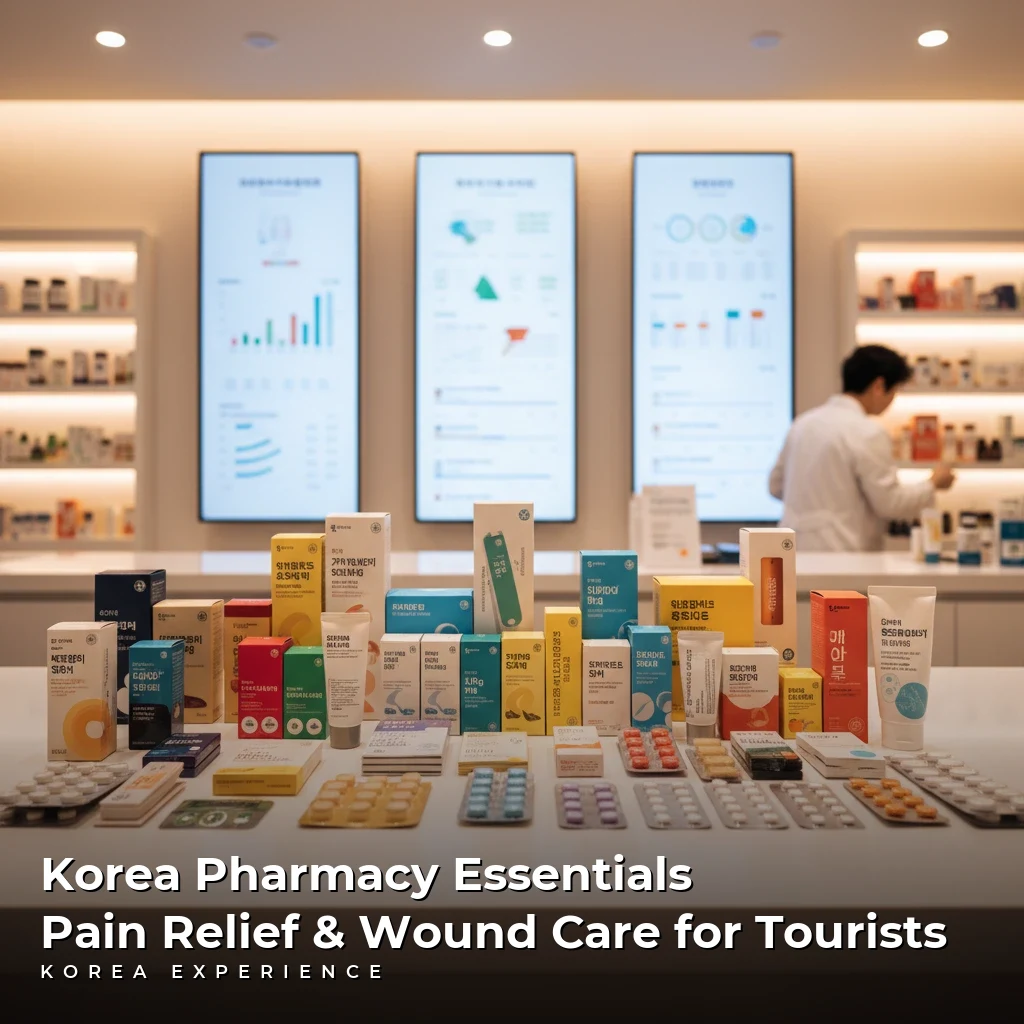
If you are currently experiencing pain or have a minor injury in Korea, you do not need a prescription for most standard painkillers, muscle patches, or wound care ointments. Go to any store with a "Yak" (약) sign; pharmacists are generally helpful and many speak basic English.
The short answer: For headache and body pain, ask for 'Tylenol' (Acetaminophen) or 'Ez-n6' (Ibuprofen). For muscle pain, buy 'Ketotop' patches. For cuts, buy 'Madecassol' ointment and 'Medifoam' hydrocolloid bandages.
Key Takeaways
- 1Standard painkillers (NSAIDs/Tylenol) cost ₩3,000-5,000 per box.
- 2Convenience stores sell basic Tylenol, but pharmacies have stronger options.
- 3Korean 'Pasu' (muscle patches) are a cultural staple and highly effective.
- 4Medifoam is the gold standard for wound healing in Korea—buy it immediately for scrapes.
- 5Emergency medical consultation is available by dialing 1339.
Navigating the Korean Pharmacy (Yakguk) System
Navigating the healthcare landscape in a foreign country can be daunting, especially when you are in pain. Fortunately, South Korea has one of the most accessible and efficient pharmacy systems in the world. Pharmacies, known as Yakguk (약국), are ubiquitous in cities like Seoul and Busan, often located within 100 meters of each other near subway stations and hospitals.
In 2026, the distinction between what you can buy over-the-counter (OTC) and what requires a prescription is clear, but slightly different from Western countries. While antibiotics always require a doctor's visit, high-quality anti-inflammatories, stomach medicine, and advanced wound care products are readily available for purchase.
📊 Pharmacy Access in Seoul
Most pharmacies operate from 9:00 AM to 6:00 PM on weekdays, and 9:00 AM to 1:00 PM on Saturdays. Most are closed on Sundays, though "Public Night Pharmacies" operate in designated areas. If you need basic painkillers late at night, convenience stores like CU, GS25, and 7-Eleven carry a limited selection of "safe household medicines" 24/7.
Pro Tip: Finding a Sunday Pharmacy
If you need a pharmacy on a Sunday or holiday, look for the sign "Humanyakguk" (Human Pharmacy) or use the Naver Map app and search for "약국" (Yakguk), filtering by "Open" to find currently operating locations.
Essential Pain Relief: Headache and Fever
When a headache strikes after a long flight or a fever spikes, knowing exactly what to ask for saves time and discomfort. Korean painkillers are effective, affordable, and often come in liquid soft-gel capsules for faster absorption.
Acetaminophen (Tylenol)
Tylenol is a household name in Korea just as it is in the West. It is the go-to medication for simple headaches, fevers, and minor aches.
- Brand Name: Tylenol (타이레놀)
- Dosage: usually 500mg tablets.
- Price: Approximately ₩3,000 ($2.20 USD) for a box of 10.
- Where to buy: Pharmacies and 24-hour convenience stores.
If you are sensitive to caffeine or need a specifically "nighttime" version, check the packaging carefully or ask the pharmacist, as some generic versions might include caffeine buffers.
Ibuprofen (The "Advil" Equivalent)
If you are looking for Advil, you might not find the brand name "Advil" as easily as local brands, but the ingredient Ibuprofen is widely available. The most popular and highly recommended brand by locals is Ez-n6 (이지엔6).
💵 Korean Painkiller Price Comparison
Includes diuretic for bloating
Long-lasting for joint pain
Ez-n6 Variants:
- Ez-n6 Any: The standard liquid soft gel Ibuprofen. Excellent for general headaches.
- Ez-n6 Eve: Specifically formulated for menstrual cramps; contains a diuretic (Pamabrom) to help with bloating.
- Ez-n6 Strong: Contains a higher dosage for severe pain.
Naproxen (For Muscle & Joint Pain)
For stronger, longer-lasting relief, especially for back pain from walking around palaces all day or hiking Bukhansan, Naproxen is the active ingredient you want.
- Brand Name: Takusen (탁센)
- Description: Green soft capsules. Very popular among office workers and athletes.
- Price: ₩4,000 ($3.00 USD) per box.
Medical Disclaimer
Always consult a pharmacist before mixing medications. Korean pharmacists are highly trained professionals. Even if there is a language barrier, you can show them a translation of your symptoms or the chemical name of the drug you need.
The Culture of "Pasu" (Muscle Relief Patches)
You cannot talk about Korean pharmacy essentials without discussing "Pasu" (파스). These are transdermal analgesic patches that Koreans use for everything from stiff necks to strained ankles. If you have spent a day hiking or exploring, this is your best friend.
Unlike the subtle heat patches found in some Western countries, Korean Pasu are medicated with Ketoprofen, Flurbiprofen, or Felbinac, providing potent anti-inflammatory relief directly to the muscle.
Cool vs. Hot Patches
- Cool Pasu (Cool-pas): Use this for acute injuries, sprains, or sudden swelling. It provides a freezing sensation to reduce inflammation.
- Hot Pasu (Hot-pas): Use this for chronic pain or stiff shoulders. The heat increases blood flow to relax tight muscles.
Top Brands to Buy
- Ketotop (케토톱): The market leader. It uses Ketoprofen and is beige-colored to blend with skin. It’s excellent for arthritis and deep muscle aches.
- Price: ₩10,000-12,000 for a large pack (34 sheets).
- Sinsin Pas (신신파스): A classic brand often cheaper than Ketotop.
- Price: ₩3,000-5,000 for smaller packs.
📋 Pasu (Patch) Facts
Coin Patches
If you find the large rectangular patches uncomfortable or they peel off at the joints, try "Coin Patches." These are small, round stickers (about the size of a large coin) that you place on specific pressure points.
- Brand: Roihi-Tsuboko (Japanese brand, widely sold in Korea) or Korean equivalents.
- Usage: Stick 2-4 dots around the painful area. They generate significant heat.
If you are planning a heavy trekking itinerary, perhaps exploring the best day trips from Seoul, packing a few sheets of Pasu is non-negotiable.
Wound Care: The Korean Approach to Healing
Korean wound care is arguably superior to what is commonly found in standard Western drugstores, focusing heavily on minimizing scarring and maintaining moisture. If you get a blister from walking or a scrape, do not just let it scab over.
Step 1: Disinfection (Posol)
Korean disinfectants often don't sting. Look for "Posol" or simple hydrogen peroxide, but modern sprays containing chlorhexidine are preferred.
- Price: ₩1,000-2,000.
Step 2: The Ointment (Madecassol vs. Fucidin)
This is a classic "dualism" debate in Korean households. Every home has one or both.
Ointment Showdown: Fucidin vs. Madecassol
| Feature | Fucidin (후시딘) | Madecassol (마데카솔) |
|---|---|---|
| Primary Use | Infection Prevention | Skin Regeneration |
| Antibiotic | Strong (Fusidic Acid) | Mild (Neomycin + Centella) |
| Best For | Deep, dirty wounds | Clean scrapes, reducing scars |
| Texture | Thick, orange gel | White cream or powder |
Expert Recommendation: If the wound is potentially dirty (e.g., a fall on the street), use Fucidin first to kill bacteria. Once the wound begins to close, switch to Madecassol (containing Centella Asiatica) to prevent scarring and speed up skin regeneration. Centella is a key ingredient in many K-Beauty products; learn more about skincare ingredients in our complete guide to Korean skincare routines.
Step 3: The Cover (Medifoam)
Forget flimsy plastic strips. Korea runs on Hydrocolloid Bandages, generically referred to as "Medifoam." These are thick, squishy pads that absorb exudate (wound fluid) and turn white as they heal the wound. They create a moist environment that speeds healing by up to 50% and prevents scabs (which cause scars).
📖 How to Use Medifoam Correctly
Step 1: Clean and Dry
Disinfect the wound and ensure the surrounding skin is completely dry. The bandage won't stick to wet skin.
Step 2: Cut to Size
Buy the large sheet version and cut it to be slightly larger than your wound.
Step 3: Apply and Hold
Press the patch onto the wound and hold with your palm for 30 seconds. Body heat helps the adhesive set.
Step 4: Leave It On
Do not change it daily. Leave it until it swells white and starts to peel off naturally (usually 2-3 days).
Price: Medifoam is more expensive than standard bandaids, ranging from ₩7,000 to ₩10,000 ($5-8 USD) per pack, but the results are worth every won.
Digestive Aids and Hangovers
Korean food is delicious, but the spice levels or bacteria in raw seafood might upset a sensitive traveler's stomach. Furthermore, Korea's drinking culture is legendary, and so are their hangover cures.
Digestion (Sohwa-je)
If you feel bloated or have indigestion after a heavy Korean BBQ meal:
- Festal (훼스탈): The standard digestive enzyme tablet.
- Price: ₩2,500 for a strip of 6-10.
- Bearse (베아제): A stronger alternative, often green pills.
- Gas Hwalmyeongsu (까스활명수): This is a carbonated herbal drink sold in small bottles. It tastes like medicinal root beer and works wonders for immediate relief.
- Price: ₩1,000-1,200 per bottle.
- Location: Convenience stores and pharmacies.
For recommendations on where to eat (so you can need these digestives later!), check our guide to best Korean BBQ restaurants in Seoul.
Hangover Cures (Sukchwi-haeso-je)
Korea has a dedicated market for hangover cures worth over $200 million USD annually. These are typically taken before drinking, but work after too.
- Condition (컨디션): The green bottle.
- Dawn 808 (여명 808): The can with the inventor's face on it. It tastes terrible but works effectively.
- RU21: Vitamin pills popular with younger crowds.
Seasonal Issues: Allergies, Colds, and Dust
Korea has four distinct seasons, and with them come specific health challenges. Spring brings "Yellow Dust" from the Gobi Desert, which can irritate throats and eyes.
Allergy Medicine
For hay fever or dust allergies, ask for:
- Zyrtec (지르텍): Available OTC.
- Floradix: Or generic cetirizine.
- Price: ₩4,000-5,000.
Cold and Flu
If you catch a cold:
- Panpyrin (판피린): A small glass bottle liquid medicine for early cold symptoms. Be careful, the bottle cap is sharp when opening.
- Theraflu: Available in powder form for hot tea.
- Modcold (모드콜): A comprehensive cold syrup capsule (Yellow for day, Blue for night).
If you are visiting during winter, perhaps to see the winter illuminations, keep Panpyrin handy as the dry air is harsh.
Purchasing Guide: Vocabulary and Tips
To ensure you get exactly what you need, here is a breakdown of essential vocabulary. While Papago (Naver's translation app) is excellent, having these words ready shows effort and precision.
Buying Meds: Pharmacy vs. Convenience Store
- ✓Pharmacy: Access to stronger dosages (e.g., higher dose Ibuprofen)
- ✓Pharmacy: Expert advice from licensed pharmacists
- ✓Store: Open 24/7/365
- ✓Store: No conversation required, just grab and pay
- ✗Pharmacy: Often closed on Sundays and holidays
- ✗Pharmacy: Some older pharmacists may not speak English
- ✗Store: Very limited selection (only about 13 safe items allowed)
- ✗Store: Often slightly more expensive per pill
Essential Vocabulary
- Painkiller: Jintong-je (진통제)
- Headache: Dutong (두통)
- Menstrual Cramps: Saengli-tong (생리통)
- Muscle Pain: Geunyuk-tong (근육통)
- Digestion Medicine: Sohwa-je (소화제)
- Bandage: Daebandu (대반창고)
- Ointment: Yeong-go (연고)
- I have a fever: Yeol-i-nayo (열이 나요)
- Please give me this: Igeo juseyo (이거 주세요)
Many foreigners buy pills and take them without water because they saw it in a drama! Please don't do this. Also, be aware that many Korean cold medicines contain a small amount of caffeine to counteract drowsiness. If you want to sleep, ask specifically for 'Jol-lim' (sleepy) or 'Night-time' medicine.
Prices and Budgeting for Medical Needs
Medical supplies in Korea are generally very affordable compared to the US or Europe. You rarely need insurance for OTC drugs.
- Consultation: Free at the pharmacy counter.
- Pills: ₩3,000 - ₩5,000 ($2.25 - $3.75 USD) per box.
- Patches: ₩3,000 - ₩12,000 depending on quantity.
- Advanced Wound Care: ₩8,000+ (Medifoam is premium).
If you are on a tight budget, check out our guide on how to see Seoul for $50 a day; saving on food might let you splurge on premium muscle patches!
Bringing Your Own vs. Buying Locally
Should you pack your entire medicine cabinet?
- Prescription Meds: YES. Bring them with a doctor's note.
- Basic Painkillers: NO. Buy them here; they are cheap and effective.
- Strong Decongestants: MAYBE. Pseudoephedrine is regulated. If you need Sudafed, you will have to sign a logbook at the pharmacy, showing your passport.
Emergency Situations
If your pain is beyond the scope of OTC medication, do not hesitate to seek help. Korea's medical system is fast and high-quality.
- Call 119: For Ambulance and Fire (Free).
- Call 1339: Korea Disease Control and Prevention Agency (KCDC). They offer medical consultation in English and can tell you which hospital to go to.
- International Clinics: Major hospitals like Severance (Sinchon) and Asan Medical Center (Songpa) have dedicated International Healthcare Centers.
If you are staying in a major tourist hub, you are likely near help. Check our guide on the best neighborhoods for expats in Seoul to see where the major hospitals are located relative to popular accommodation areas.
Special Considerations for Specific Travelers
Hikers and Active Travelers
Korea is 70% mountainous. If you are here for the peaks, your pharmacy kit should include:
- Compression Bandage: "Ap-bak Bung-dae" (압박 붕대).
- Air Salonpas: A spray version of the muscle patch for instant cooling relief on the trail.
- Mosquito Repellent: Essential in summer. Look for "Mogi-yak" (Mosquito medicine).
Families with Children
Korean pharmacies carry excellent pediatric syrups.
- Champ Syrup (챔프): These are individual stick-packs of acetaminophen or ibuprofen syrup for kids. They are hygienic and easy to pack.
- Red Pack: Acetaminophen.
- Blue Pack: Ibuprofen.
- Pororo Bandages: Because a cute character bandage heals faster, according to every child.
Treating a Sudden Injury in Korea
Assess
If bleeding is heavy, call 119. If minor, find nearest convenience store for water/cleaning.
Locate Yakguk
Look for the 'Yak' (약) sign. Use Papago to translate symptoms.
Get Supplies
Buy Saline (Sik-yeom-su), Madecassol, and Medifoam.
Rest & Food
Eat Samgyetang (chicken soup) for strength.
Conclusion
Getting sick or injured while traveling is never part of the plan, but in Korea, it doesn't have to ruin your trip. The "Pharmacy Essentials Pain Relief And Wound Care Products" available in Korea are high-quality, affordable, and easily accessible.
From the miraculous healing powers of Medifoam to the muscle-relaxing heat of a Pasu patch, you might even find yourself stocking up on these items to take back home. Remember, the pharmacists are there to help, and with a little translation assistance, you can access world-class minor medical care on almost every street corner.
❓ Frequently Asked Questions
Have more questions?Contact us →
About the Author
Korea Experience Team
Written by the Korea Experience editorial team - experts in Korean medical tourism, travel, and culture with years of research and firsthand experience.
⚠️ Medical Disclaimer
The information provided on this website is for general informational purposes only and does not constitute medical advice. Always consult with qualified healthcare professionals before making any medical decisions.
Explore more in Medical Tourism
World-class medical procedures at competitive prices. From plastic surgery and dermatology to dental care and health checkups — your complete guide to medical tourism in Korea.
Browse All Medical Tourism ArticlesContinue Reading
Explore more articles you might find interesting
Find the best medical compression garments in Seoul for post-surgery recovery. Detailed guide on locations, prices, and sizing in Gangnam and beyond.
The complete 2026 guide to emergency medical care in Seoul. Find the best international hospitals, ER costs, and English-speaking services for travelers.
Discover the best Lotte Department Store flagship locations. Compare Myeongdong vs Jamsil, find 2026 luxury brands, food courts, and duty-free prices.
A complete guide to buying eyewear in Korea. Discover prices, 20-minute prescription glasses, trending brands like Gentle Monster, and contact lens tips.
A complete guide to Korean post-procedure care, featuring top pharmacy creams, deswelling treatments, and recovery protocols with 2026 pricing data.
Compare 2026 prices for clear aligners in Seoul. Save up to 50% with local brands (₩1.5M+) vs Invisalign (₩3.5M+) while enjoying world-class dental care.